
Reviewed · WORKSHOPS
Silver Ring Workshop in Kent, England
Turning a plain strip of silver into a ring you can wear home is the heart of this private Canterbury workshop. With silversmith Annie guiding you step by step, you’ll saw, texture, forge, solder, file, and polish your own piece. It is hands-on, not a demonstration where you simply watch from a chair.
I especially like the small-group format and the fact that Annie makes the process feel manageable for beginners. I also like the personal result: your ring can carry a texture, stamp, or finish chosen by you, and the finished piece gives you a better sense of the work behind handmade jewellery. The main point to watch is the extra materials charge, which is not included in the booking price.
Key points to know before booking
- You make the ring yourself: Annie demonstrates each stage, then you repeat it at your own workbench.
- The workshop is private: Only your group takes part, with sessions for one or two people.
- Expect simple designs: This is a beginner class, so signet rings and complex settings are not part of the session.
- Budget for silver: Materials cost an additional £10 to £30 per ring, depending on the finished weight.
- The work is practical: You use a saw, torch, files, forging tools, and polishing equipment.
- It is well suited to a special occasion: Couples have made wedding or anniversary rings, while others book it as a creative gift or personal treat.
A handmade souvenir in the heart of Canterbury
Many Canterbury activities ask you to look, listen, and move on. This one asks you to make something. That simple difference gives the morning a clear purpose, and you leave with more than a photograph or a fact sheet.
The workshop takes place at 76 Castle Street, in a gallery and studio set in an old Canterbury building. The setting adds character without taking over the experience. You are there to work at a bench, but the surrounding gallery gives the session a pleasant artistic feel.
The price is $131.95 per person, with the silver charged separately. That makes the final cost higher than the advertised rate, so you should allow for the extra £10 to £30 per ring. Still, the value is not just in the metal. You receive private tuition, use specialist tools, learn several jewellery-making techniques, and take home a ring made largely by your own hands.
If you are comparing this with a standard craft class, the private instruction is the important difference. Annie can watch your technique, correct a small mistake before it grows, and adjust the pace to suit you. If you are comparing it with buying a silver ring, the value is more personal than financial. You are paying for the making as well as the object.
More workshops in Canterbury:
- Fully Guided Tour of Warner Bros Studio Tour London – The Making of Harry Potter
★ 4.5 · 722 reviews - Warner Bros. Studio Tour London – The Making of Harry Potter and Oxford Day Trip
★ 4.5 · 592 reviews - Surf Lesson
★ 5.0 · 349 reviews
Starting at 10am with a design and finger measurement
Your session begins at 10am. Annie discusses basic designs with you and measures your finger before you start cutting metal. This early conversation matters because the class is intended for beginners, and the design needs to suit the tools, time, and skills available.
You can add personality through pattern, texture, or stamped marks. That gives you room to make a ring that feels individual without asking you to master advanced jewellery work in one morning. Keep your plans sensible. The workshop does not cover signet rings, and the designs remain fairly simple.
Annie provides an apron and makes coffee or tea before you settle at the workbench. That small welcome helps the session feel relaxed rather than like a formal technical lesson. You can ask questions as you go, and the teaching style is based on demonstration followed by practice.
Left-handed visitors should not worry. One left-handed participant needed to move to Annie’s bench for part of the process, but the arrangement was handled without fuss. That is useful to know because jewellery tools can feel awkward when you are learning, and a flexible teacher makes a real difference.
Sawing the silver to length
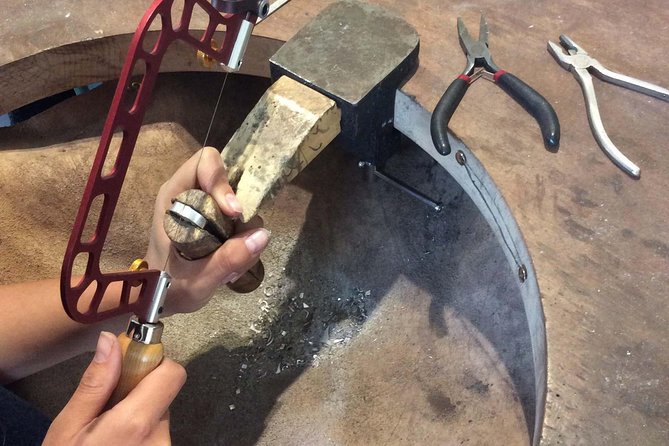
The first practical job is to saw the silver to the right length. It sounds basic, but this is where you begin to understand the care needed in jewellery making. A cut that is too short affects the fit, while a rough cut creates more work later.
Annie shows you how to handle the saw and how to work with control. You are not expected to arrive with metalworking skills. The class is designed to take you from a raw strip of silver to a finished ring in a clear sequence.
At this stage, your piece may not look promising. That is part of the appeal. The material starts as a plain, dull band, and the changes happen through a series of small jobs rather than one dramatic trick.
Adding texture, pattern, and stamped marks
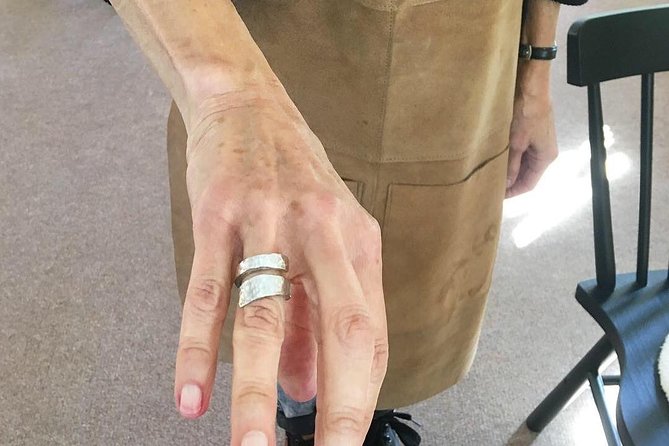
Once the silver is cut, you can personalise it. Annie teaches you how to pattern, texture, and stamp the surface. This is one of the best points in the workshop for making a design choice that is truly your own.
A textured band can look more informal than a smooth ring. Stamped marks can give it a handmade character. The available result depends on the simple beginner designs used in the class, but you still have meaningful decisions to make about the surface and appearance.
This stage also explains why handmade jewellery is rarely as quick to produce as it first appears. A ring may look plain, yet its finish depends on careful preparation and repeated handling. You begin to see how small marks can become part of the final character rather than flaws to hide.
A few more Canterbury days out to weigh up
- Leeds Castle, Cliffs of Dover and Canterbury Day Trip from London with Guided Cathedral Tour
★ 4.5 · 2,820 reviews - Canterbury Cathedral, Dover Castle & White Cliffs Guided Day Tour from London
★ 4.5 · 837 reviews - Leeds Castle, Canterbury, Dover & Greenwich Boat ride
★ 4.5 · 604 reviews - Leeds Castle, Canterbury Cathedral and Cliffs of Dover Day Trip
★ 4.5 · 487 reviews
Using the torch and annealing the metal
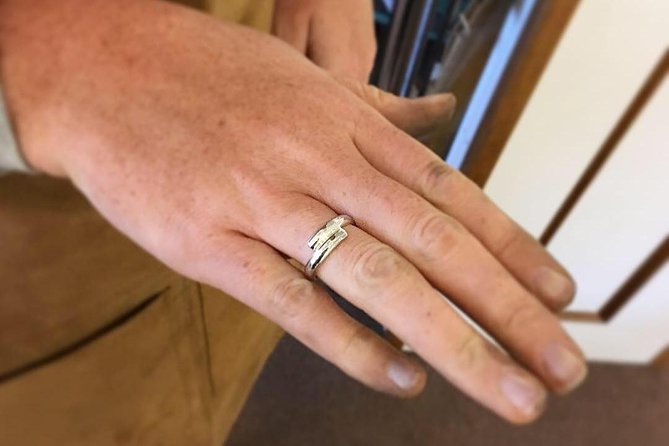
The silver then needs to be annealed. Annie explains why this is necessary and teaches you to use the torch. In straightforward terms, heating makes the metal easier to shape after it has been worked and stressed.
For a first-time maker, using a torch may be the most memorable part of the session. Annie demonstrates the process before you try it, so you understand what the tool does and how it fits into the wider sequence.
This is also where good instruction matters most. The process involves heat and precision, but you are not left to guess. Annie’s teaching style is patient and encouraging, with the emphasis on showing you the reason for each stage rather than handing you a tool without explanation.
Forging the band into a ring
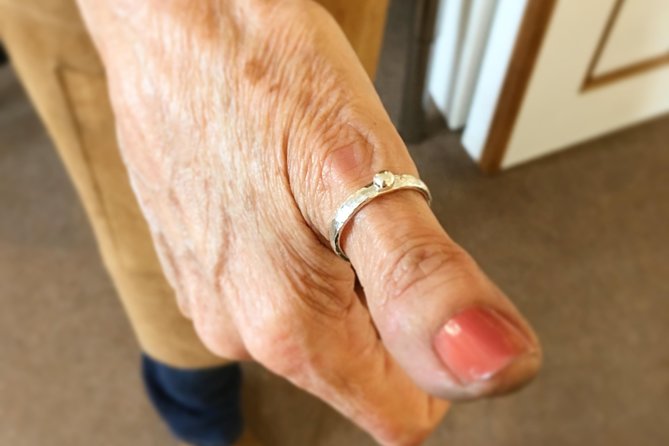
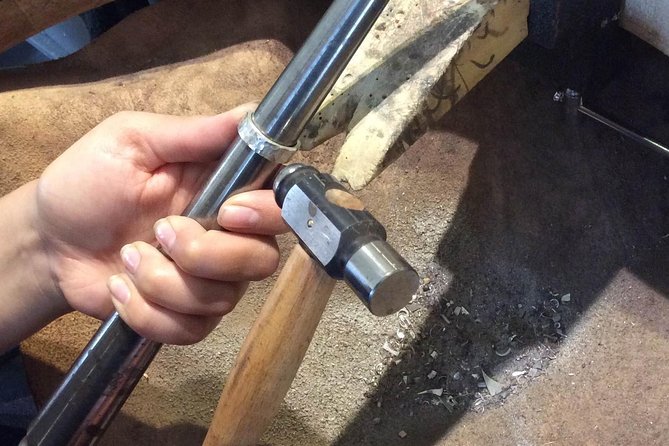
After annealing, you forge the silver into a ring shape. You then saw it to size so the ends meet correctly. At this point, your flat strip finally begins to look like jewellery.
Forging gives the ring its basic form, but it is not the final finish. The band still needs to be joined, cleaned, and polished. That gradual change is satisfying because you can see exactly how each task affects the result.
The session lasts about two to three hours for one or two people, although the advertised duration is approximately three hours. You should keep the morning free rather than scheduling a tight appointment immediately afterward. A little patience is useful, especially if you are learning at a careful pace or making two rings.
Soldering the join
Once the ring is shaped and sized, you solder the join. Annie explains how the process works, then you use the torch to connect the two ends of the band.
Soldering is a key step because it turns a shaped strip into a continuous ring. It is also a stage where rushing can spoil the appearance, so listen closely to the instructions and let Annie guide you through the timing.
The experience is hands-on, but it is not unsupervised. Annie demonstrates the technique and remains available as you work. That balance is important. You get the satisfaction of doing the task yourself, while a skilled silversmith is there to help you avoid an avoidable error.
Couples have used this workshop to make wedding and anniversary rings together. The simple design limit may not suit someone seeking a heavily ornamented wedding band, but it can suit a pair who value the act of making something side by side.
Filing, buffing, and polishing the final ring
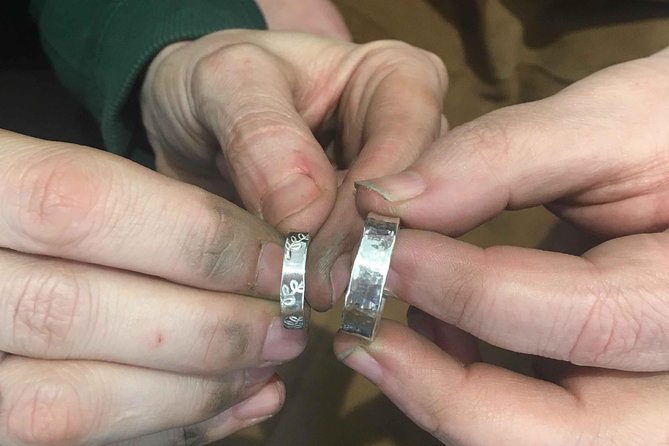
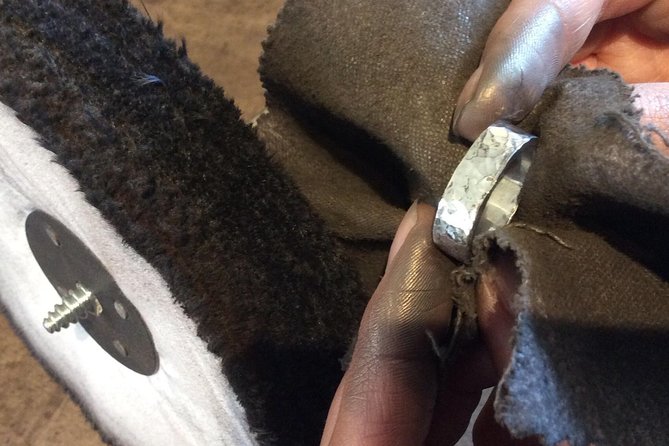
After soldering, you use metal files to clean the join. You also buff away scratches and polish the entire ring. This is the stage that produces the biggest visual change.
A rough band gradually becomes smooth and shiny. The transformation can feel surprising because the finished ring still carries the marks of your decisions, yet it has the clean surface of a piece bought in a shop.
Do not underestimate the finishing work. Filing and polishing take care and time, especially around the soldered join. Annie teaches you how to handle the tools so you can improve the surface without removing more metal than needed.
By the end, you can wear the ring home. That immediate result is a real strength of the workshop. You do not have to wait for a later delivery or wonder how much of the piece was actually made by you.
What is included, and what costs extra
Your booking includes Annie’s guidance, an apron, coffee or tea, and access to the workshop tools. The silver itself is not included.
Materials cost an additional £10 to £30 per ring, with £10 covering a basic ring. The final amount depends on the finished weight. Ask about the likely material cost at the start if you want to keep a close eye on your total.
At $131.95 per person before materials, this is not a low-cost souvenir activity. It makes better sense for someone who values private tuition and a lasting object. For a birthday, anniversary, Christmas present, or creative afternoon in Canterbury, the personal nature may justify the price.
You should also remember that the workshop is for beginners. If you already make jewellery or want to produce a complex design, you may find the class too limited. If you are starting from zero, the simple structure is a benefit.
Who will enjoy this Canterbury workshop
I would choose this experience for:
- Couples who want to make matching or complementary rings
- Friends or family members looking for a shared creative activity
- Anyone who likes handmade objects with a personal story
- Visitors seeking something different from Canterbury’s usual sightseeing
- Beginners who want patient instruction and a finished result
- People searching for a memorable gift rather than another purchased item
It can also work well for solo visitors. One participant described booking it during a short Canterbury stay and finding that the workshop became the main highlight of the visit. You do not need a partner to make the morning worthwhile.
The class may be less suitable if you dislike close work, tools, or a process that requires patience. The ring does not appear instantly. You need to complete each stage, and some parts may feel fiddly until you get used to the equipment.
Timing, location, and practical details
The meeting point is 76 Castle Street, Canterbury CT1 2QD. The activity finishes back at the same location. It is near public transportation, and a multi-storey car park is close by, which makes the start easier if you are driving into Canterbury.
Sessions are offered Thursday through Saturday from 10am to 1pm. The experience is conducted in English. It is a private activity, so only your group takes part rather than a large class.
Most people can participate, and service animals are allowed. Confirmation is sent within 48 hours of booking, subject to availability. Because the workshop is offered only on three days of the week and is often booked well ahead, plan early if your Canterbury dates are fixed. The average booking lead time is about 80 days.
You can cancel free of charge up to 24 hours before the start time for a full refund. Changes or cancellations made within 24 hours are not accepted for a refund, with cut-off times based on local time.
Should you book the silver ring workshop?
Book it if you want a personal Canterbury activity with a clear result. Annie’s patient teaching, the private setting, and the chance to handle every major stage make this much more than a quick craft demonstration.
Go in with a simple design, allow the full morning, and budget for the extra silver charge. You will not make a signet ring or a highly complex piece, but you can create a textured or stamped band that feels like your own work.
For couples, gift-givers, and curious beginners, this is an excellent use of three hours. If you only want the cheapest silver ring available, buy one in a shop. If you want to understand how that ring is made and wear a piece tied to your time in Canterbury, book the workshop.
FAQ
Where does the silver ring workshop take place?
The workshop takes place at 76 Castle Street, Canterbury CT1 2QD, England. The activity ends at the same meeting point.
How long does the workshop last?
Sessions for one or two people last about two to three hours. The listed experience duration is approximately three hours, from 10am to 1pm.
Is the silver included in the price?
No. Silver materials cost an additional £10 to £30 per ring, depending on the finished weight. The minimum charge for a basic ring is £10.
What will I learn to do?
You will learn to measure your finger, saw silver to length, add texture or stamped marks, anneal and forge the metal, solder the ring, file the join, buff scratches, and polish the finished piece.
Can I make a complex ring design?
No. This is a beginner workshop, so designs are kept simple. Signet rings are not included.
Is the workshop private?
Yes. Only your group takes part in the activity. It is offered in English, and coffee or tea plus an apron are included.
Just added around Canterbury
- Luxury Private Day Hire from & to London via Dover & Leeds Castle★ 5.0 · 14 reviews
- Leeds Castle, Canterbury and White Cliffs of Dover – Driver Guide★ 5.0 · 13 reviews
- Leeds Castle Canterbury and Dover Private Tour from London★ 5.0 · 68 reviews
- Christmas in Canterbury, Dover and Greenwich with Christmas Lunch★ 4.5 · 6 reviews
- Canterbury Cathedral, Leeds Castle and Dover Castle Private Tour★ 4.5 · 10 reviews
- Canterbury Cathedral Hever Castle and Dover Castle Private Tour★ 3.5 · 3 reviews
- Dover Cruise Ship to Leeds Castle via Canterbury, Villages & back★ 5.0 · 5 reviews
- Dover Shore Excursion:Post-Cruise Tour to London via Canterbury and Leeds Castle★ 4.5 · 62 reviews
Workshops, compared.

Fully Guided Tour of Warner Bros Studio Tour London – The Making of Harry Potter
Read our review →
Warner Bros. Studio Tour London – The Making of Harry Potter and Oxford Day Trip
Read our review →

London Traditional English Scone Making and Tea Workshop
Read our review →
Pasta Making with Unlimited Prosecco in London’s West End
Read our review →


Browse the lists this tour appears in