
Reviewed · BATH TOURS
Private Guided Tour of Jane Austen’s Bath
Bath makes sense as a Jane Austen destination once you see how much of her world still frames the city. This private walk connects the places tied to Austen’s family, letters, novels, and social life, from Bath Abbey and Sally Lunn’s to the Assembly Rooms and Sydney Place.
I like the small private format, which lets your group focus on Austen instead of following a large crowd. I also like the route’s mix of literary detail and social history, especially the explanation of Regency etiquette, dancing, shopping, and the way people were seen in public. The main drawback is that this is an outdoor walking tour, and several admission fees are not included.
Key details that shape the experience
- Ten Austen-related stops in 2.5 hours: The route covers Bath Abbey, Sally Lunn’s Museum, the Cross Bath, Queen Square, The Circus, Royal Crescent, the Assembly Rooms, Milsom Street, Pulteney Bridge, and Great Pulteney Street.
- A genuinely private tour: Your booking covers up to six people, so the guide can speak directly to your group rather than managing a large audience.
- Austen’s personal Bath appears alongside her fiction: You connect her family addresses and letters with scenes from Northanger Abbey and Persuasion.
- Theresa is one named guide: The tour is designed to be lively and well informed, with Theresa specifically praised for her enthusiasm and entertaining style.
- The route finishes at Sydney Place: This is useful if you want to continue toward Bathwick or Sydney Gardens after the tour.
- Admission is limited: Many stops are viewed from outside, and tickets for Bath Abbey, Sally Lunn’s Museum, the Cross Bath, and the Assembly Rooms are not included.
Why this private Austen walk works in Bath
Austen’s Bath is not confined to one museum or a single preserved house. Her connection to the city is spread across squares, churches, shopping streets, ballrooms, bridges, and family addresses. That makes a guided walk especially useful. You get a story that links the places together instead of seeing ten handsome buildings with no clear reason to connect them.
The tour also helps explain Bath as Austen would have known it: a social stage. In Regency England, where you went, who saw you, what you wore, and how you behaved all mattered. Bath’s public spaces were places to display status, find a marriage prospect, exchange gossip, and judge other people’s manners.
I like that the emphasis is not only on the novels. You also hear about Austen’s family, her letters, her parents’ marriage, her father’s burial place, and the addresses where she stayed. That gives the walk a more personal shape.
The private format matters here. With up to six people, you can ask about a particular novel, character, building, or detail without waiting for a large group to move on. It also makes the tour a sensible choice for families or friends who want one shared literary theme rather than a general Bath sightseeing walk.
A few more Bath days out to weigh up
- Walking Tour of Bath with Blue Badge Tourist Guide
★ 5.0 · 1,877 reviews - Roman Baths and Bath City Walking Tour
★ 4.5 · 762 reviews - Fully Guided Bath Ghost Tours
★ 5.0 · 539 reviews
Starting beside Bath Abbey
The tour begins outside the West Doors of Bath Abbey. This is a central and easy-to-recognize meeting point, close to many of Bath’s main sights.
The Abbey stop lasts about ten minutes, and admission is not included. You should treat it mainly as an introduction to Bath’s center and to the city’s role in Austen’s life, rather than expect a long interior visit as part of the guided time.
That short opening is practical. You start among one of Bath’s most recognizable buildings, then move quickly into the streets where Austen’s social world took shape.
Sally Lunn’s and the story of the Bath bun

Next comes Sally Lunn’s Museum, set in Bath’s oldest house. The stop focuses on the large, light, yeasty Sally Lunn bun, which is often confused with the Bath bun.
The story is tied to Solange Luyon, a young Huguenot refugee who is said to have brought the recipe to Somerset. Austen liked Sally Lunns enough to mention them in her letters, so this stop offers a small but memorable glimpse of ordinary pleasure in her life.
You will have about ten minutes here, and admission is not included. The short visit means the focus is likely to be explanation rather than an extended tea stop. If you want to eat at the tea room or explore the museum in detail, allow extra time and budget separately.
I like this stop because food gives Austen’s world a human scale. Grand balls and elegant squares tell only part of the story. A favorite bun mentioned in a letter can feel more immediate than another formal façade.
The Cross Bath and the Pump Room

The Cross Bath introduces Bath’s famous mineral-water tradition. The pool was rebuilt by Thomas Baldwin in 1789 in the style of Robert Adam, a designer closely associated with refined Georgian architecture.
Nearby, the Pump Rooms recall the social side of Bath’s spa culture. In Austen’s day, this was not simply a place to take the waters. It was a place to be seen, meet acquaintances, and observe the city’s social traffic.
The tour connects the Pump Room with Northanger Abbey, where Austen describes every creature in Bath appearing in the room at different parts of the fashionable hour. That idea is central to understanding Bath in Austen’s fiction. The setting mattered because the people mattered.
You spend about twenty minutes here, the longest stop so far, but admission is not included. The guide can explain the connection from outside, while a separate visit would be needed if you want to enter the paid sites.
Same part of England, a completely different sort of day:
- Best of Bath Walking Tours – Georgian Tour
★ 5.0 · 449 reviews - Bad of Bath fun Walking Tour of Bath
★ 5.0 · 402 reviews - Bath Tootbus Hop-on Hop-off Sightseeing Bus Tour
★ 4.5 · 247 reviews - Fun, Flexible Treasure Hunt Around Bath with Cryptic Clues & Hidden Gems
★ 5.0 · 208 reviews
Queen Square and Austen’s 1799 view
Queen Square is one of the most personal stops on the route. Austen stayed with her family at number 13 in 1799. From her bedroom window, she could look out over elegantly dressed people moving through a formal Georgian setting.
The square was built in the Palladian style by John Wood the Elder. Its broad arrangement and pale stone help explain why Bath felt so carefully designed and socially ordered. In the center is an obelisk erected by Beau Nash in honor of Frederick, Prince of Wales.
The guide uses the square to move from architecture into human stories. What happened behind the doors of these fashionable houses? Who lived there? What did an address communicate about a family’s place in Bath?
This is a free stop and lasts about ten minutes. Because you are looking at the exterior setting rather than entering Austen’s former rooms, the value comes from the guide’s storytelling and your ability to picture the view she had from above.
The Circus and the shape of Georgian ambition
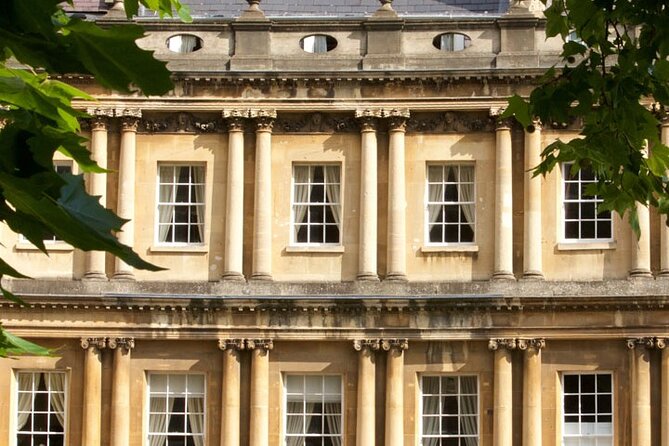
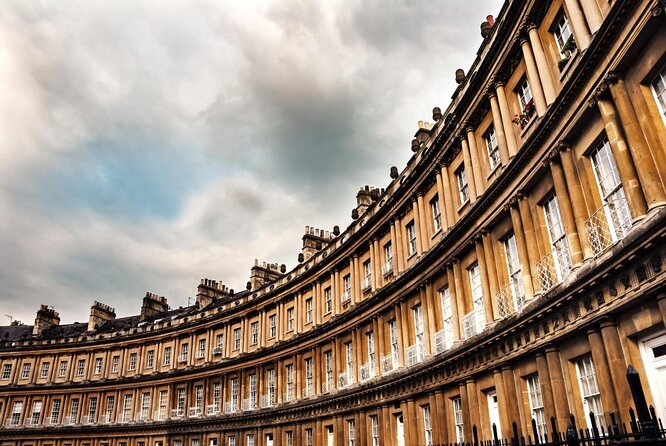
The Circus is one of Bath’s most impressive urban compositions. John Wood the Elder planned it as part of a grand effort to create a classical Palladian setting, with curved rows of townhouses enclosing a circular space.
The architecture is the attraction, but the Austen connection comes through the people who lived in such addresses and the social world they represented. The guide explains the notable residents and the kind of status attached to living here.
You have about fifteen minutes, and there is no admission charge. This is a good place to pause and look upward. The repeated façades, columns, and decorative details make clear that Bath was designed to impress from every angle.
I appreciate the way this stop supports the literary story without forcing a direct Austen claim onto every building. Austen’s Bath was also a real city of architecture, money, ambition, and display.
No. 1 Royal Crescent and Austen’s Bath
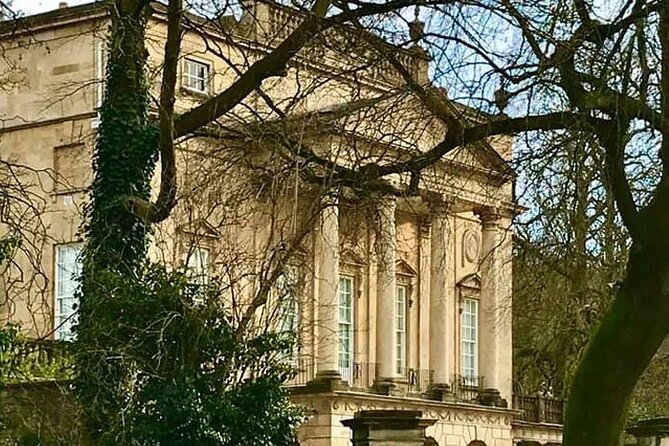
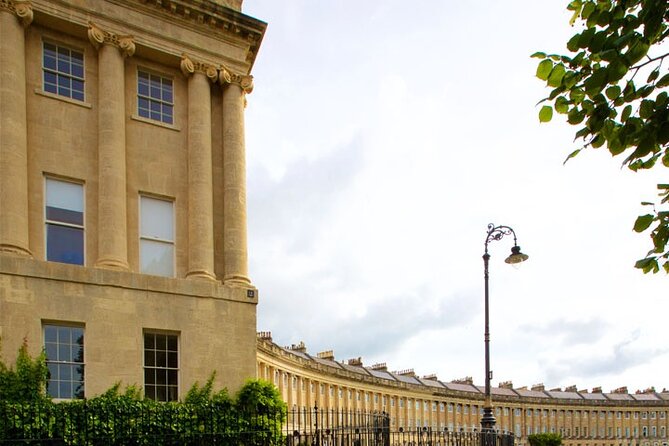
The Royal Crescent is among Bath’s most photographed sights, and for good reason. Thirty terraced houses sweep across the hillside in a broad curve, overlooking Royal Victoria Park. John Wood the Younger designed the crescent, which was built between 1767 and 1775.
The row remains much as it was when first built, giving you a strong sense of the setting Austen knew. The guide explains what this address and the surrounding street would have been like in her time.
The stop lasts about fifteen minutes and is free from the outside. Admission to No. 1 Royal Crescent is not listed as part of the tour, so you should not expect an interior visit to be included.
This is one of the tour’s strongest visual moments. If you care about Bath’s architecture as much as Austen’s writing, the Royal Crescent makes the private walk more than a book-themed outing.
The Assembly Rooms and the business of being seen

The Assembly Rooms bring Austen’s social life into sharper focus. Jane liked dancing, and these rooms hosted balls, concerts, and other gatherings where people met, watched, and assessed one another.
This is where the tour’s discussion of Regency etiquette becomes especially useful. A ball was not just a night of entertainment. It involved rules about introductions, dances, conversation, reputation, and social rank. Those rules help explain the tension and comedy in Austen’s novels.
The guide also shares the story of one of Austen’s uncles and the seventeenth-century investment plan that helped fund the Upper Rooms. That detail connects Austen’s family to the city’s development in a way that is easy to miss on a general sightseeing walk.
The stop takes about ten minutes. Admission is not included, so check the cost separately if you want to enter. The tour gives you the setting and the context, but not a full museum visit.
Milsom Street, shopping, and family connections
Milsom Street remains a shopping street and was a fashionable Georgian thoroughfare in Austen’s time. It appears in both Northanger Abbey and Persuasion, making it one of the clearest links between the physical city and the novels.
As you approach, you pass St Swithin’s Church. Austen’s parents were married there, and her father is buried there. That family connection gives this part of the walk a quieter tone after the social energy of the Assembly Rooms.
The stop lasts about ten minutes and is free. You will not spend long inside the church as part of the stated route, but the guide’s explanation helps you notice a place that could otherwise be easy to pass.
I like this section because it combines shopping, fiction, and family history in a small area. It shows how Austen’s Bath was both a real place in her life and a setting she reshaped on the page.
Pulteney Bridge and the River Avon
Pulteney Bridge is a striking change of scene. Designed by Richard Adam, it crosses the River Avon with shops running across the full span on both sides. It is one of only four bridges in the world built in this shop-lined form.
The stop lasts about ten minutes and is free. The guide can explain the bridge’s place in Bath’s expansion and the way it connected the city with the area beyond the river.
This is not the most direct Austen stop, so its value is broader. It shows the city’s commerce and movement, balancing the earlier focus on balls, squares, and fashionable addresses. You get a sense of Bath as a working city as well as a social resort.
Great Pulteney Street and the finish at Sydney Place
The final section follows Great Pulteney Street, a broad Georgian avenue created by Thomas Baldwin. It linked Bath with the River Avon, Bathwick, and Sydney Gardens, and it is lined with imposing townhouses.
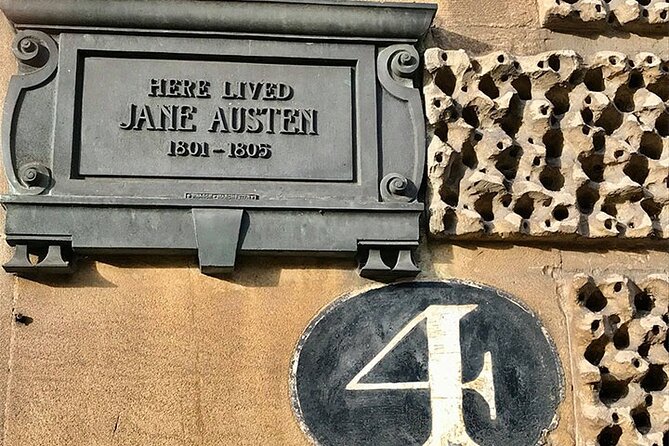
The walk continues to Sydney Place, where Austen and her family lived at number 4. Finishing here gives the tour a personal endpoint rather than ending at another famous architectural view.
The route ends on Sydney Place in Bathwick. That matters for planning. You finish away from the Abbey and central meeting point, so you should allow for the walk back if your next activity is in central Bath. At the same time, the ending works well if you plan to continue toward Bathwick or Sydney Gardens.
The final fifteen minutes also help show Bath as a connected city. The grand streets were not isolated showpieces. They linked homes, shops, social rooms, churches, bridges, and gardens.
What the $205.29 group price really buys
The listed price is $205.29 per group of up to six. For six people, that works out to roughly $34 per person. For two people, the per-person cost is much higher, so the value depends heavily on group size.
You are paying for a private guide and a carefully chosen Austen route, not for a package of entrance tickets. Several stops have no admission charge, while tickets for Bath Abbey, Sally Lunn’s Museum, the Cross Bath, and the Assembly Rooms are not included.
I think the price makes the most sense for a group of four to six people who want personal attention and already plan to see Bath’s paid attractions separately. It is less compelling if you want a low-cost general walk or prefer to spend time inside each site.
The advance booking pattern, about 78 days on average, suggests you should plan ahead if your dates are fixed. That is especially sensible for a private tour with limited group capacity.
Who should book this walk?
This tour suits Austen readers who want to see the real places behind Northanger Abbey and Persuasion. It also works for anyone interested in Georgian buildings, social rules, family history, and the way a city becomes material for fiction.
You do not need to be an Austen expert. The route covers enough architecture and local history to keep the experience useful even if you have read only one novel, or none at all.
I would choose it for:
- A group of up to six friends or relatives
- Readers who want literary context without a full museum tour
- First-time Bath visitors who want a focused introduction
- People interested in Regency manners and social life
- Visitors who prefer a private guide to a large group
You should think twice if you want extensive interior visits, a food-focused tour, or a slow architectural study. The schedule covers ten stops in two and a half hours, so the pace is purposeful.
The walk also requires decent weather. If poor weather causes cancellation, you are offered another date or a full refund. Wear comfortable shoes and plan around the fact that the route is conducted outdoors.
Should you book the Jane Austen Bath tour?
Book it if you want Bath explained through Austen’s eyes, with a private guide who can connect buildings, family addresses, novels, letters, and Regency behavior. The route is well chosen, and the small group size gives it a personal feel. Theresa is specifically known for an informed, enthusiastic, entertaining approach.
Skip it if your main goal is to tour interiors or keep costs as low as possible. The strongest value comes when several people share the group price and you appreciate guided context more than independent wandering.
For Austen fans, this is a focused way to see why Bath mattered to her. For general visitors, it offers a useful introduction to the city’s Georgian design and social traditions, with enough literary detail to give the streets a second layer.
FAQ
How long is the Private Guided Tour of Jane Austen’s Bath?
The tour lasts approximately 2 hours and 30 minutes.
How many people can join the private tour?
The price covers one private group of up to six people.
Where does the tour begin?
The meeting point is outside the West Doors of Bath Abbey in Bath.
Where does the tour end?
The tour ends at Sydney Place in Bathwick.
Is admission included at the stops?
Admission is not included for Bath Abbey, Sally Lunn’s Museum, the Cross Bath, or the Assembly Rooms. The listed stops at Queen Square, The Circus, No. 1 Royal Crescent, Milsom Street, Pulteney Bridge, and Great Pulteney Street are free to view from the route.
Does the tour include Sally Lunn’s Museum?
Sally Lunn’s Museum is part of the route, but admission is not included.
Is the tour available in poor weather?
The experience requires good weather. If it is canceled because of poor weather, you are offered a different date or a full refund.
Can service animals join the tour?
Yes. Service animals are allowed.
Can I cancel for a full refund?
Yes, if you cancel at least 24 hours before the experience start time. Changes or cancellations made less than 24 hours before the start time are not accepted for a refund.
Just added around Bath
- Heathrow Airport To Bath Private Airport Transfers★ 5.0 · 17 reviews
- Afternoon Bath City Tour – Private tour from Bristol with a local guide★ 5.0 · 7 reviews
- BATH: 2-Hour Bath Walking Tour of Bridgerton Filming Locations★ 5.0 · 99 reviews
- The Splendour of Georgian and Victorian Era Bath: A Self-Guided Audio Tour★ 4.0 · 3 reviews
- Wells, Cheddar Cheese and Cheddar Gorge – Private Day Trip from Bath★ 5.0 · 10 reviews
- Private Guided Ghost Tour of Bath★ 5.0 · 20 reviews
- Glastonbury, Wells Cathedral & Cheddar Gorge Day Trip from Bath★ 5.0 · 3 reviews
- Private Day Tour from Bath to Glastonbury and Wells with Pickup★ 5.0 · 14 reviews
Bath Tours, compared.
Walking Tour of Bath with Blue Badge Tourist Guide
Read our review →
Bath Tootbus Hop-on Hop-off Sightseeing Bus Tour
Read our review →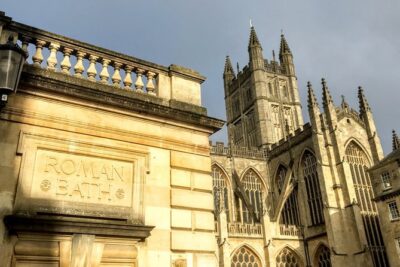
Fun, Flexible Treasure Hunt Around Bath with Cryptic Clues & Hidden Gems
Read our review →
Bridgerton Walking Tour of Filming Locations & Storylines – Bath
Read our review →Browse the lists this tour appears in