
Reviewed · JACK THE RIPPER TOURS
London Private Jack The Ripper Tour
Jack the Ripper’s London becomes far more unsettling when you are standing at the actual corners where the murders unfolded. This private walk takes you from Whitechapel Station through Hanbury Street, Mitre Square, Goulston Street, and Spitalfields, tracing both the crimes and the birth of a modern media mystery. I like the small private format and the way it lets you ask direct questions. I also like the focus on police work, inquests, and newspaper panic, not just grisly storytelling.
The main drawback is the walking pace and subject matter. You cover several stops in about two and a half hours, and some locations are now ordinary city streets with little left to see. You also pay for the London Underground connection between Whitechapel and Aldgate separately.
Key points to know before booking

- Eight stops trace the five canonical murders, plus an earlier possible crime linked to the Ripper.
- A private group of up to 15 gets more time for questions than a large public walk.
- The route begins near Whitechapel Station and finishes at Liverpool Street Station.
- The Underground fare is extra, for the section between Whitechapel and Aldgate.
- Comfortable shoes matter, since the tour moves through several East London streets.
- Guide Michael has been singled out for his detailed explanations and reassuring manner, especially for a solo woman on the tour.
Walking into the Whitechapel murder story
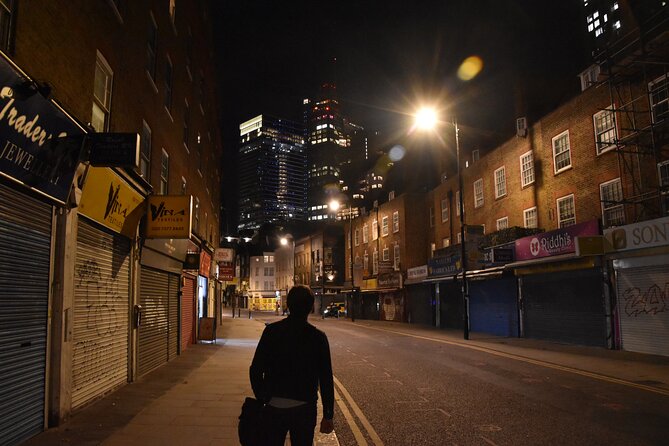
The tour starts at 277 Whitechapel Road, a short walk from Whitechapel Station. This is a useful starting point because you are immediately in the East London district connected with the case, rather than hearing a long introduction in a hotel lobby or coach.
The first stop concerns Polly Nichols, generally treated as the first canonical victim. Your guide explains what happened to her, how she was found, and why historians and investigators place her at the beginning of the accepted sequence.
That distinction matters. Jack the Ripper is not a neatly documented criminal case with a confirmed suspect and a complete list of victims. The phrase canonical five refers to the five women most commonly linked to the murderer: Polly Nichols, Annie Chapman, Elizabeth Stride, Catherine Eddowes, and Mary Jane Kelly.
I appreciate that this opening can give you the basic framework before the more disputed parts begin. You are not simply shown a plaque or pointed toward a dark alley. The guide is expected to explain how the case was assembled and why some murders are accepted while others remain uncertain.
More Jack the Ripper walks in London:
- London Jack the Ripper Guided Tour with Ripper-Vision
★ 4.5 · 4,840 reviews - London Jack The Ripper Guided Walking Tour
★ 5.0 · 3,131 reviews - Ultimate Jack the Ripper : Guided Tour of London
★ 5.0 · 1,495 reviews
Inquests at the Working Lads Institute
The second stop is outside the former Working Lads Institute, where inquests connected with the murders took place. The building and the Victorian setting help shift the tour from crime scene stories to the machinery of justice.
You hear how an inquest worked in the Victorian period, how witnesses were called, and how the proceedings into the Ripper murders developed. This is one of the more useful parts of the route because it shows how information was gathered before modern forensic systems and today’s investigative tools.
The stop lasts about 10 minutes, so expect a compact explanation rather than a full legal history lesson. Still, it gives the murders a civic context. The case was not solved in a vacuum. Police, coroners, witnesses, newspapers, and local residents all shaped what the public came to believe.
Hanbury Street and the panic after Annie Chapman
At 29 Hanbury Street, you reach the location associated with Annie Chapman, the second canonical victim. Her murder increased pressure on the police and helped fuel public alarm.
This is where the tour begins to examine the role of the press. Newspapers were not simply reporting a mystery. They were helping create its scale, its language, and its legend. The public wanted a name and an explanation, while the police faced pressure to produce results in a case that was rapidly becoming a citywide obsession.
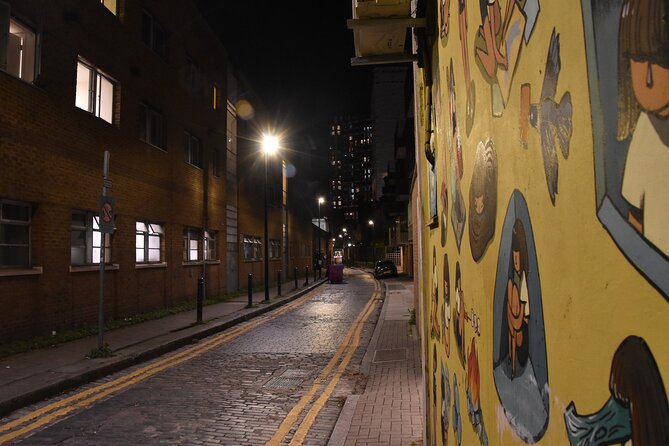
The present-day street may not look like the Victorian scene described by your guide. That is worth knowing before you book. The value here lies less in dramatic remains and more in connecting the location to the way fear spread through London.
If you enjoy the social side of crime history, this should be one of the stronger stops. You learn how a series of murders became a public story, and how that story began to take on a life of its own.
Henriques Street and the question of the third victim
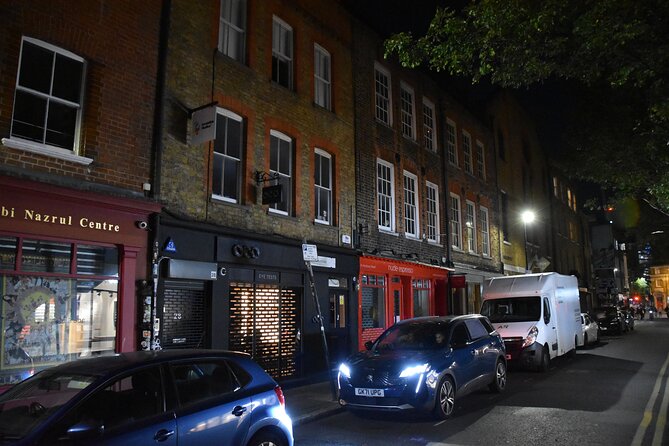
The fourth stop is Henriques Street, formerly Berner Street, where Elizabeth Stride was found. Stride’s case is especially important because she was not mutilated after her murder.
That missing feature has led to long arguments over whether she was killed by the same person. The tour uses her death to explain why the Ripper case contains so much disagreement. Even the accepted list is not based on an absolute answer to every question.
This is a good point to ask your guide about the limits of the evidence. A private tour gives you room to pause over questions that might get lost in a large group. You can ask why one victim is included, why another is left out, and how much weight should be given to the methods used in the murders.
Henriques Street is also part of what is known as the double event. The name refers to the murders of Stride and Catherine Eddowes on the same night. It is one of the case’s most important turning points.
A few more London days out to weigh up
- London Big Bus Hop-On Hop-Off Tour with Optional River Cruise
★ 3.5 · 10,803 reviews - London Small Group Tour of Historical Pubs
★ 5.0 · 10,422 reviews - Tower of London and Crown Jewels Exhibition Ticket
★ 4.5 · 6,677 reviews - Thorpe Park Admission Ticket
★ 4.0 · 5,915 reviews
Mitre Square and the double event
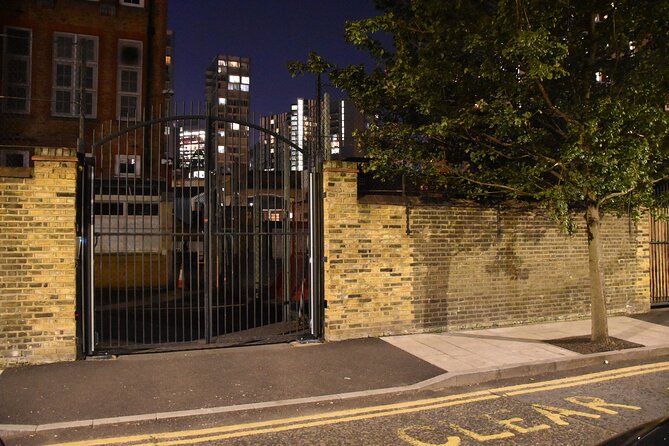
Mitre Square is the site linked to Catherine Eddowes, the fourth canonical victim. Her murder, occurring on the same night as Stride’s, intensified the hunt and helped push the case into a new phase.
At this stop, your guide explains how the two killings became known as the double event. You also hear how communications sent to the Central News Agency helped give the Whitechapel Murderer the name Jack the Ripper.
The naming story is valuable because it shows how the killer’s identity was partly shaped by communication and publicity. The name that became famous was not simply handed down from the crime scenes. It was connected to messages, newspapers, and public reaction.
Mitre Square also shows the limits of a modern walking tour. The current city has changed, and you should not expect a preserved Victorian crime scene. The guide’s explanation is the main attraction, with the location serving as a physical reference point.
Goulston Street and the clue that changed the investigation
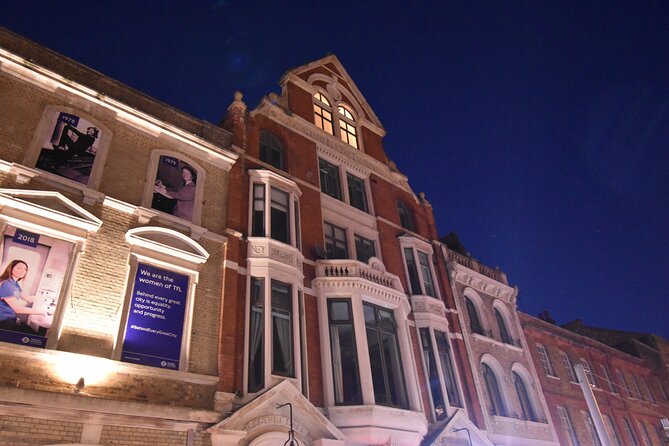
The walk continues to Goulston Street, where an important clue in the investigation was found. This stop focuses on how police tried to interpret evidence while working under intense pressure.
The clue matters because it connected the investigation to one of the most discussed pieces of evidence in the case. Your guide can explain its place in the wider inquiry and why it has continued to attract attention.
This is another location where questions are more valuable than photographs. You might want to ask how the clue was found, how investigators handled it, and how later interpretations have affected the Ripper story.
The tour’s emphasis on modern policing and forensic science becomes clearer as the route continues. You are encouraged to consider how today’s investigative methods might approach the same evidence, while remembering that modern tools cannot change what was or was not recorded in 1888.
Gunthorpe Street and an earlier possible murder
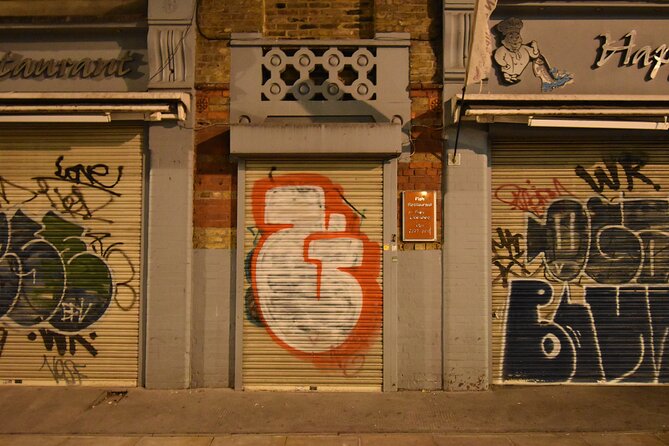
At Gunthorpe Street, the guide discusses an earlier possible murder that some people connect with the Ripper. This stop takes you outside the five canonical cases and into the much less certain edges of the story.
That uncertainty is part of the appeal, but it can also be frustrating. You will hear how the murder might have been the Ripper’s first, along with the reasons for doubt. The guide also explains how modern policing and forensic science have been applied to later investigations into the murders.
I like this stop because it challenges the idea that the case has one fixed version. The Ripper story has grown through evidence, speculation, newspaper coverage, books, films, and repeated attempts to name the killer. Gunthorpe Street gives you a chance to ask where responsible historical interpretation ends and guesswork begins.
The final question here is why these Victorian murders still hold attention. The tour connects that fascination to the unresolved suspect, the incomplete evidence, the brutal crimes, and the way the press turned a local investigation into an international mystery.
Spitalfields Market and Mary Kelly’s final stop
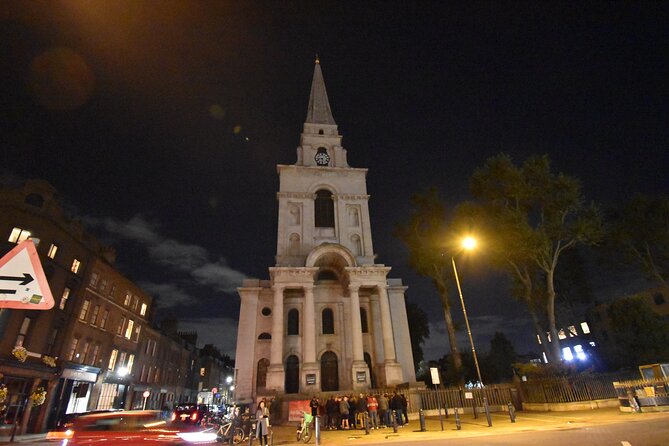
The last stop is at Old Spitalfields Market, near the site associated with Mary Kelly, the fifth and final canonical victim. Her murder completes the accepted sequence and brings the walk toward Liverpool Street Station.
Spitalfields gives the route a natural ending because it sits close to the modern city center while remaining tied to the old East End story. You can finish with the full five-victim framework in mind, along with the important gaps and disputes.
Your guide explains the circumstances surrounding Kelly’s death and why she is generally placed at the end of the canonical list. The stop also gives you a chance to look back at the route: Nichols, Chapman, Stride, Eddowes, and Kelly, alongside the police inquiries and press stories that shaped the case.
The tour ends at Liverpool Street Station. That is practical if you are continuing around London, catching a train, or heading toward the City. It also means the walk does not return you to Whitechapel, so plan your onward journey from Liverpool Street.
What the private format adds
The price is $246.91 per group of up to 15 people, not per person. That makes the value depend heavily on your group size.
For two people, it is a costly walking tour. For a family or group of friends, the arithmetic improves quickly. A full group of 15 would bring the cost to roughly $16.46 per person, before the Underground fare. The private arrangement also means the tour is limited to your own party, so you are not sharing the guide with an unrelated crowd.
That format is useful for this subject. The case invites questions about evidence, suspects, victims, and police decisions. You can ask for clarification without worrying about holding up a large group.
The strongest practical benefit is personal attention. One account describes Michael as detailed, reassuring, and willing to walk a solo woman to the Tube station at the end. That does not guarantee Michael will be assigned to every departure, but it gives you a useful sense of the service style to expect from the provider.
The tour is offered in English and includes a live guide. There is no separate admission fee at the stops, since they are public streets and outdoor locations.
Timing, walking, and the Underground connection
The advertised duration is about two hours and 30 minutes. The listed stops are each around 10 minutes, but the route also includes walking between locations and a London Underground trip between Whitechapel and Aldgate.
That Underground journey is not included in the price. Carry a valid way to pay for London public transport, and remember that the route finishes at Liverpool Street rather than returning to the starting point.
Wear comfortable shoes. The route crosses several streets and requires a moderate level of physical fitness. Service animals are allowed, and the meeting point is near public transportation.
The subject matter is grim. The guide discusses murders and mutilation, so this is not a light sightseeing walk. You should choose it because you want historical and investigative context, not simply a spooky evening out.
Who will get the most from this tour
I would recommend this experience to you if you enjoy unsolved crimes, Victorian London, newspaper history, or the development of police work. It also suits people who prefer questions and discussion over a fixed script.
The private setup works well for families with older children, couples, and small groups of friends who already share an interest in the case. It is also a sensible choice if you are uneasy about joining a large night walk, since your group remains together with a dedicated guide.
You may want to skip it if you dislike grisly subjects or expect preserved buildings and untouched crime scenes. Much of the original setting has changed, and the tour’s value depends on the guide’s explanation.
Book at least 24 hours ahead if your plans might change. Cancellations made at least 24 hours before the start time receive a full refund. Changes or cancellations inside that window are not accepted for a refund.
Should you book the Whitechapel Ripper walk?
Book it if you want a private, detailed route through the evidence and the public panic that shaped the Jack the Ripper story. The best reasons are the chance to ask questions, the thoughtful treatment of disputed victims, and the easy route from Whitechapel to Liverpool Street.
For the best value, bring a group rather than booking as a couple. Wear good shoes, budget for the Underground, and arrive ready for a serious subject. If you want a more personal look at one of London’s most enduring mysteries, this tour is a strong choice.
FAQ
Where does the Jack the Ripper tour start?
The tour starts at 277 Whitechapel Road, London E1 1BY, near Whitechapel Station.
Where does the tour finish?
The tour finishes at Liverpool Street Station, London EC2M 7QA.
How long does the tour last?
The experience lasts approximately two hours and 30 minutes.
How many people can join the private tour?
Your private group can include up to 15 people.
Is the tour offered in English?
Yes. The tour includes a live English-speaking guide.
Is the London Underground fare included?
No. Travel on the London Underground between Whitechapel and Aldgate is not included in the tour price.
Which murders are covered?
The route covers the five canonical victims commonly linked to Jack the Ripper: Polly Nichols, Annie Chapman, Elizabeth Stride, Catherine Eddowes, and Mary Kelly. It also discusses an earlier possible murder at Gunthorpe Street.
Do I need to pay admission at the stops?
No separate admission tickets are required for the listed stops. Guiding fees are included in the tour cost.
Is the tour suitable for someone traveling alone?
Yes. It is a private activity, so only your group participates. The tour requires a moderate level of physical fitness, and service animals are allowed.
Can I cancel for a full refund?
Yes, if you cancel at least 24 hours before the experience start time. Cancellations made less than 24 hours ahead are not refunded.
Just added around London
- Private Spy Walking Tour of London★ 5.0 · 6 reviews
- Private Shoreditch Street Photography Workshop★ 4.5 · 4 reviews
- Private Sightseeing Walking Tour of The City Of London★ 5.0 · 3 reviews
- Private 2.5 Hour Taxi Tour of London – London’s Greatest Bits!★ 5.0 · 4 reviews
- Shakespeare London Walking Tour★ 5.0 · 26 reviews
- Private Round Trip Transfer between London Airports and Hotel★ 3.5 · 56 reviews
- Private Prison Van Escape Game – London Immersive Experience★ 4.0 · 15 reviews
- Private Rock ‘n’ Roll Music Tour of Central London★ 5.0 · 7 reviews
Jack the Ripper Tours, compared.
London Jack the Ripper Guided Tour with Ripper-Vision
Read our review →
Ultimate Jack the Ripper : Guided Tour of London
Read our review →
London Jack The Ripper Small-Group Walking Tour
Read our review →

The Original Jack the Ripper Coach Tour of Haunted London
Read our review →
Browse the lists this tour appears in