
Reviewed · SELF-GUIDED TOURS IN LONDON
London Charles Dickens Puzzle Questo and Self-Guided Tour
Charles Dickens’s London comes alive as a trail of clues, old streets, pubs, theaters, and literary landmarks. This self-guided puzzle walk begins at his former home on Doughty Street and ends near Fleet Street, tracing the city that shaped his work and his imagination.
I like the low price and the freedom to start whenever you want. I also like the well-judged clues, which are meant to make you look closely without turning every stop into a head-scratching contest. The main drawback is simple: there is no human guide, so you need a charged phone, a little patience, and an interest in solving things for yourself.
Key Points
- Charles Dickens Museum start: Begin outside his former home at 48 Doughty Street, where he lived from 1837 to 1839.
- A flexible one-hour route: Start at any time, pause for food or a pub, and resume later.
- Offline play: Once set up, the city game does not require an internet connection.
- Literary London beyond Dickens: The route also includes Dr Johnson’s House, Lincoln’s Inn Fields Theatre, the Maughan Library, and Ye Olde Cheshire Cheese.
- A clever pub stop: One historic inn was renamed the Three Cripples by Dickens and became Bill Sykes’s favorite haunt in Oliver Twist.
- A budget alternative: At $8.33 per person, this is far cheaper than most guided walking tours, though admission fees and refreshments are not included.
Starting at Charles Dickens’s Doughty Street Home
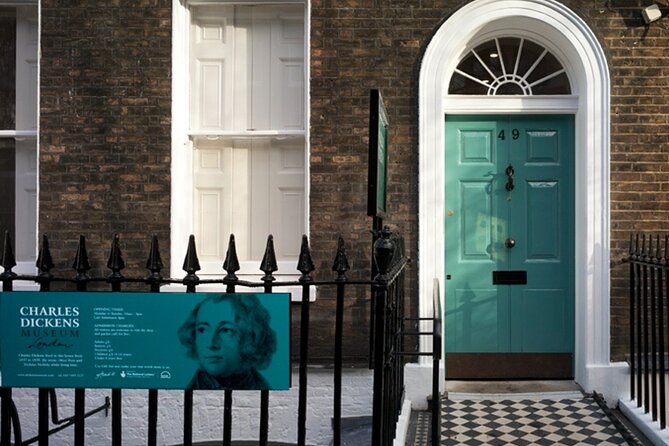
The walk begins at 47 Doughty Street, next to the Charles Dickens Museum at number 48. This Georgian terraced house was Dickens’s home from March 1837 until December 1839, a key period soon after his marriage and during the early rise of his literary career.
You are asked to look around the area and find the answer to the first challenge. That approach sets the tone for the whole experience. You are not simply being led from plaque to plaque. You are using the street itself as part of the game.
The museum is the natural anchor for the route, even if your ticket is for the puzzle walk rather than the house museum. If you want to go inside, check admission separately, since entry is not listed as part of this experience. The game can still begin at the meeting point without a physical guide.
This opening stop works well because it gives the story a personal starting point. Dickens lived here, rather than merely passing through, and the house helps connect the author to an actual neighborhood. You get a sense of the man before following the wider trail through central London.
More Self-Guided Tours in London
- Public BucketRace – Scavenger Hunts with a Twist
★ 5.0 · 32 reviews - Covent Garden’s Hidden Gems: A Self-Guided Walking Tour
★ 3.5 · 29 reviews - Private Bespoke Scavenger Hunts
★ 5.0 · 26 reviews
Vine Street and the City Dickens Knew

The route then moves toward Vine Street, a road laid out around 1686. Older maps show it running from Piccadilly toward Warwick Street, and in the early eighteenth century the street included a brewery and a carpenter’s yard.
This is the sort of stop that can be easy to miss on a conventional sightseeing walk. There may be no grand monument demanding your attention. Instead, the puzzle asks you to inspect the setting, search for a detail, and use it to continue.
That makes the stop useful for understanding how the game works. You are looking at London as a collection of clues, not just as scenery between major attractions. You also get a brief glimpse of the city’s working past, when breweries, workshops, and small businesses formed much of the urban fabric.
The route is not limited to famous Dickens addresses. It uses older streets and surviving buildings to show the city around his stories. If you prefer a tour that explains every detail through a guide’s commentary, this section may feel light. If you enjoy noticing things for yourself, it adds variety.
The Inn Behind Bill Sykes’s Drinking Place
One of the most memorable stops is a stylish inn dating from 1759. Its Dickens connection came in 1838, when he changed its name to the Three Cripples and used it as Bill Sykes’s favored drinking place in Oliver Twist.
This is a strong example of the tour’s method. You are standing at a real London inn while connecting it to a fictional setting. Dickens took recognizable streets and places and reshaped them for his novels, often giving them a darker or more dramatic role.
The stop also gives the route a welcome bit of atmosphere. It is one thing to read about London pubs in a book. It is another to pause outside an old inn and consider how such places fed Dickens’s pictures of crime, poverty, ambition, and urban life.
You can stop for a drink if you wish, but remember that the cost of refreshments is separate. The flexible format makes this easy. You can pause the game, take a break, and continue when you are ready.
Staple Inn and London’s Surviving Old Streets
Staple Inn dates from 1585 and takes its name from its earlier role as a wool staple, where wool was weighed and taxed. The building survived the Great Fire of London, suffered heavy damage from a Luftwaffe bomb in 1944, and was later restored.
This is one of the route’s best architectural pauses. The building links several periods of London’s past, from the wool trade to wartime damage and modern preservation. You are not seeing a place frozen in time. You are seeing a survivor that has changed and been repaired.
The puzzle format encourages you to look at details that a fast walk might ignore. Since the instructions ask you to search the location for an answer, plan to slow down here rather than treating Staple Inn as a quick photo stop.
The route’s historical range is one of its strengths. Dickens provides the main thread, but the walk also shows you buildings that belong to earlier centuries and later events. That makes the experience feel broader than a narrow author biography.
Same part of England, a completely different sort of day:
- London Big Bus Hop-On Hop-Off Tour with Optional River Cruise
★ 3.5 · 10,803 reviews - London Small Group Tour of Historical Pubs
★ 5.0 · 10,422 reviews - Tower of London and Crown Jewels Exhibition Ticket
★ 4.5 · 6,677 reviews - Thorpe Park Admission Ticket
★ 4.0 · 5,915 reviews
Lincoln’s Inn Fields Theatre

The next stop recalls Lincoln’s Inn Fields Theatre, which operated from 1661 until its demolition in 1848. It began as the Duke’s Theatre, created by converting Lisle’s Tennis Court in 1695.
Today, the important point is the story of the site rather than a surviving theater interior. The stop asks you to imagine a London entertainment district that has largely disappeared. Buildings can vanish, but the street plan and historical record keep their traces alive.
This is a good place to remember that the tour is not a museum visit. You are following a route through present-day London while learning about places that may have been altered or removed. Some stops offer a clear building to inspect. Others depend more on the puzzle and the story attached to the location.
For me, that mix keeps the route from becoming repetitive. It also means you should not expect a major Dickens display at every stop. The experience works best when you enjoy historical clues and urban observation.
The Maughan Library’s Grand Setting
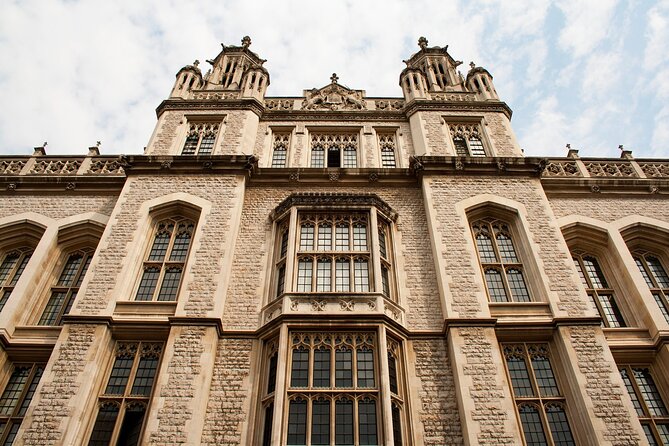
The Maughan Library occupies a Grade II listed building designed by Sir James Pennethorne. Construction began in 1851, with later extensions added between 1868 and 1900. A £35 million renovation turned it into the largest new university library in the United Kingdom since the Second World War.
This stop shifts the focus from Dickens’s domestic world to the institutions of learning and public life that shape central London. The building’s scale and long construction history give the route another change of pace.
You may find this stop especially appealing if you like architecture. It is not included simply because Dickens lived there. Instead, it helps show the layered character of the district, where literary memory sits alongside legal, academic, religious, and civic buildings.
The puzzle gives you a reason to examine the exterior and surroundings. As with the other locations, do not assume that a tour ticket provides access to the library itself. The value here lies in the setting and the historical information tied to it.
Dr Johnson’s House and the Life of a Dictionary Maker
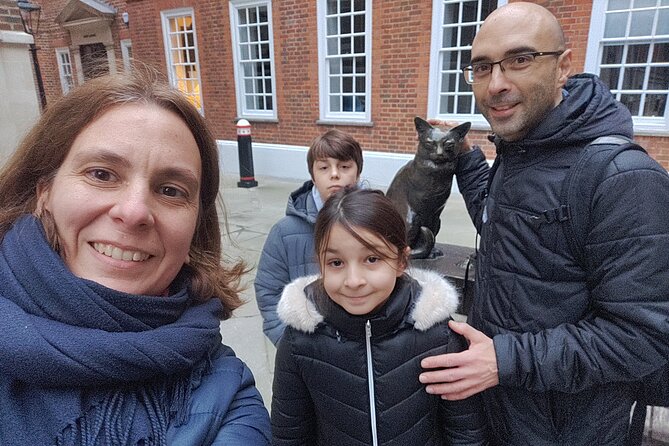
Dr Johnson’s House was probably built for a City merchant. Its best-known resident was Samuel Johnson, who rented the house from 1748 to 1759.
This is one of the route’s clearest literary connections outside Dickens. Johnson was one of the leading figures in English literary life, and the house offers a link to the world of writers, dictionaries, debate, and publishing.
The stop helps place Dickens within a much longer London tradition. Authors did not work in isolation. They rented rooms, met publishers, walked the same streets, and depended on the city’s coffeehouses, theaters, printers, and booksellers.
If you want a full visit to Dr Johnson’s House, you would need to check its separate opening arrangements. The puzzle walk itself uses the location as a challenge point, not as a guided interior tour.
Ye Olde Cheshire Cheese After the Great Fire
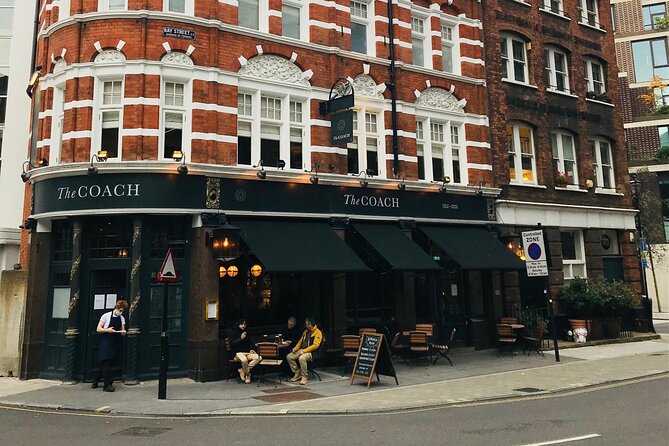
Ye Olde Cheshire Cheese was first built in the 1530s, but the original pub was destroyed in the Great Fire of London in 1666. The current building dates from 1667, making it one of the first London buildings reconstructed after the fire.
This stop gives you another chance to connect a real pub with the city’s disasters and rebuilding. It is also a practical break point. You can pause the game here and have a drink or meal, then continue later.
The pub is especially well suited to this experience because the route is designed around old London places rather than a strict timetable. A traditional walking tour might keep you moving. Questo lets you decide if the pub is a quick look or a longer stop.
Do not treat the one-hour estimate as a command. It is a guide to the puzzle route itself. If you stop at several pubs, take photos, or spend time reading about each location, the outing can stretch well beyond an hour.
A Church with Italian and Irish Connections
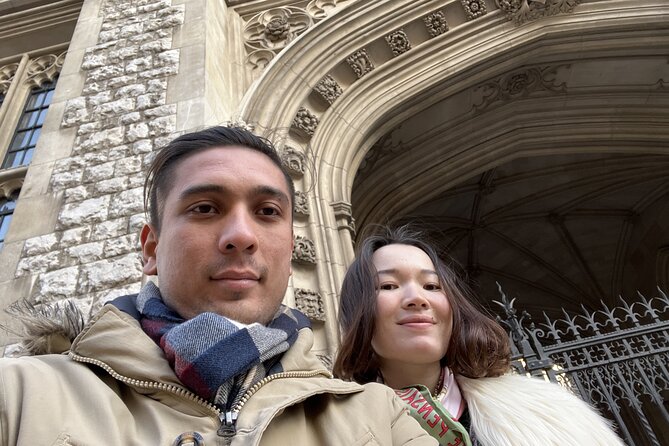
Another stop is a church consecrated in 1863 as the Church of St Peter of All Nations. At the time, it was the only basilica-style church in the United Kingdom. Its organ was built in 1886 by the Belgian maker Anneesen.
The building also carries a wartime story. During the Second World War, when Italian immigrants were interned, Irish Pallottines used the church.
This stop broadens the walk again. You move from authors and pubs to migration, religion, music, and wartime experience. It is a useful reminder that London’s story is made up of many communities, not only its famous writers.
The route does not promise a service, interior tour, or organ performance. You are there to solve the challenge and learn the story connected with the site. Keep that distinction in mind when deciding how much time to allow.
The Royal College of Surgeons
The Royal College of Surgeons traces its early origins to the 1540s, when the Company of Barbers and the Fellowship of Surgeons joined to form the Company of Barber-Surgeons. By the eighteenth century, medicine had become a more academic field, and surgeons sought greater recognition for their skills.
This is a striking subject for a Dickens-themed walk because it shows another side of nineteenth-century London. Dickens wrote about social conditions, work, illness, poverty, and the institutions that shaped ordinary lives. A medical body such as this helps fill out that setting.
The stop is more about the institution’s development than about a single Dickens event. You get a short lesson in how a trade developed into a recognized profession. That variety keeps the walk from feeling like a string of author memorials.
As always, look carefully for the puzzle answer before moving on. The challenge gives you a practical reason to pause, even when the stop is not a major attraction you planned to visit.
St Dunstan-in-the-West and the Romanian Orthodox Chapel
The final stop is St Dunstan-in-the-West, which shares its building with the Romanian Orthodox community and St George Church. A chapel beside the main altar is closed off by an iconostasis that came from Antim Monastery in Bucharest and was dedicated in 1966.
This is a particularly interesting finish because it shows how an older London church can serve more than one tradition. The Romanian Orthodox chapel adds a clear international connection to the route and gives you a final change of subject before reaching Fleet Street.
The walk ends at 145 Fleet Street. Ending here makes geographic sense, since Fleet Street has long been linked with newspapers, publishing, and London’s literary life, even though the tour’s supplied route information does not promise a separate Fleet Street attraction or interior visit.
How the Puzzle Format Works
Questo sends you from one location to the next by asking you to find answers at each stop. You need to observe the surroundings, enter the solution, and then receive the next location and its story.
The clues are designed to be neither obvious nor punishing. That balance matters. If every answer were immediate, the walk would feel like a list of directions. If the puzzles were too hard, the literary material would get buried under frustration.
You can play offline, so you do not need a live internet connection while moving through the route. You will still want your phone ready before starting, and a charged battery is sensible for any app-based walk.
There is no physical guide and no contact with a tour group. Only your own party takes part. That gives you privacy and control, but it also means you cannot ask a guide to explain a difficult clue or add context on the spot.
Price, Timing, and Who Gets the Best Value
At $8.33 per person, this is a low-cost way to spend roughly an hour in central London. The price is especially attractive for couples, families, and small groups that want an activity without paying a full walking-tour rate.
The value comes from combining a game with a self-guided history walk. You are paying for the route, the clues, and the information delivered through the app. You are not paying for museum admission, food, drinks, or a live guide.
I would allow more than the advertised hour if you want to enjoy the stops properly. The one-hour figure makes sense for completing the game at a steady pace, but the flexible design invites pauses. A sunny day, a pub stop, or a closer look at Staple Inn and the historic buildings can easily lengthen the outing.
The route is available every day and can be started at any hour. That makes it useful on a busy London schedule, especially if you have an open slot between other plans. Group discounts are also available, though the exact saving is not specified.
Practical Details Before You Go
You receive confirmation at booking, and the activity is listed as suitable for most participants. Service animals are allowed, and the route is near public transportation.
The start point is 47 Doughty Street, London WC1N 2LW. The finish is 145 Fleet Street, London EC4A 2BU. Since this is a point-to-point walk, think about what you want to do after the final challenge rather than expecting to return to the start.
The experience is private, so only your group participates. It is also designed without human contact, which can help if you prefer a quiet activity with no crowd or fixed meeting time.
You can cancel for a full refund if you do so at least 24 hours before the scheduled start. Cancellations or changes made within 24 hours are not refunded or accepted.
Should You Book This Dickens Walk?
Book it if you like literary London, historic pubs, old buildings, and small puzzles. The strongest parts are the freedom to start and stop, the offline play, the low price, and the way the route links Dickens with Samuel Johnson, theater history, churches, medicine, and London’s rebuilt streets.
Skip it if you want a guide delivering detailed commentary at every stop, or if you prefer to go inside each attraction. This is a route-based game, not a museum tour or a traditional guided walk.
For most people, I would treat it as an inexpensive way to add structure to a few hours in central London. Bring a charged phone, allow extra time for breaks, and keep an eye out for the man in black* clue that gives the game a playful Dickensian finish.
FAQ
How long does the London Charles Dickens Puzzle Questo tour take?
The estimated duration is about one hour. You can make it longer by pausing, stopping at pubs, or taking extra time at the historic locations.
Where does the tour start?
It starts at 47 Doughty Street, London WC1N 2LW, beside the Charles Dickens Museum at 48 Doughty Street.
Where does the tour end?
The route ends at 145 Fleet Street, London EC4A 2BU.
Is a physical guide included?
No. This is a self-guided experience played through the Questo app, and no physical tour guide is provided.
Do I need an internet connection?
No. The city game can be played offline, so you do not need an internet connection during the walk.
Can I start the tour at any time?
Yes. It is available 24 hours a day, every day of the week, and you can start at any hour.
What is the cancellation policy?
You can receive a full refund if you cancel at least 24 hours before the scheduled start time. Cancellations or changes made less than 24 hours before the start are not refunded or accepted.
Just added around London
- London Private Jack The Ripper Tour★ 5.0 · 9 reviews
- Private Spy Walking Tour of London★ 5.0 · 6 reviews
- Private 2.5 Hour Taxi Tour of London – London’s Greatest Bits!★ 5.0 · 4 reviews
- Private Shoreditch Street Photography Workshop★ 4.5 · 4 reviews
- Private Sightseeing Walking Tour of The City Of London★ 5.0 · 3 reviews
- Private Round Trip Transfer between London Airports and Hotel★ 3.5 · 56 reviews
- Shakespeare London Walking Tour★ 5.0 · 26 reviews
- Private Prison Van Escape Game – London Immersive Experience★ 4.0 · 15 reviews
Self-Guided Tours in London, compared.

Covent Garden’s Hidden Gems: A Self-Guided Walking Tour
Read our review →

Notting Hill Self-Guided Walking Tour with an APP
Read our review →
London Walks – 12 Self-Guided Audio Walking Tours
Read our review →

Browse the lists this tour appears in