

Reviewed · CITY TOURS
London Self Guided City Tour With an App
London Self Guided City Tour With an App turns a short walk into a compact lesson in the city’s past and present. You begin near the Monument and Tower of London, then follow the Thames west toward Borough Market, Shakespeare’s Globe, Tate Modern, the Millennium Bridge, and St Paul’s.
I like the low $9.99 price, and I like having the whole route available offline. The blend of major sights and less obvious stops, such as All Hallows by the Tower and the Tower Hill sundial, gives you more than a standard photo walk.
The main catch is the advertised one to two hours. With more than 30 narration points, food at Borough Market, and time inside any attraction, you should plan on several hours or even a full day. The phone map can also take some getting used to.
Key points before you set out
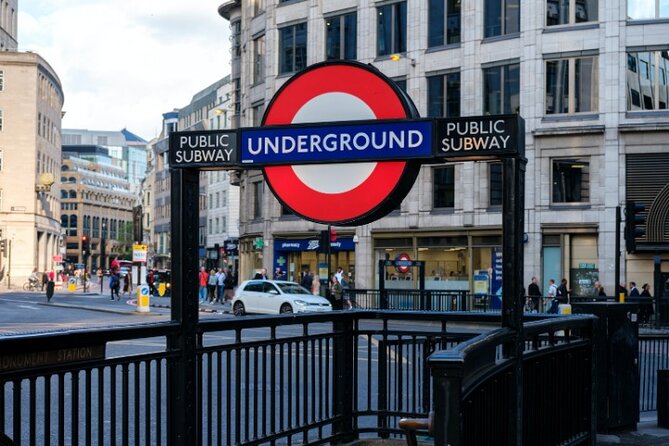
- Begin at Monument Station: The route starts at Monument Station and finishes at 100 St. Paul’s Churchyard.
- Use the Trippy Tour Guide app: There is no live guide. Audio, directions, and route tracking all come through your phone.
- Download everything first: Save the tour before leaving Wi-Fi and allow GPS access so the app can track your position.
- Expect more than 30 audio points: The route covers major sights, small historical stops, and riverside landmarks.
- Treat two hours as a fast estimate: You can walk the route quickly, but exploring it properly takes much longer.
- Pay for no private transport: This is a walking tour, with no car, taxi, or other private transportation included.
A low-cost route through London’s oldest quarter

At $9.99 per person, this is one of the cheaper ways to organize a private London walk. You are not paying for a guide’s time or a small group. Instead, you get an app with audio commentary, directions, and an offline map.
That price makes sense if you want structure without joining a scheduled group. You can pause when you like, stop for lunch, or skip a place that does not interest you. The tradeoff is that you must manage the route yourself. If you miss a turn, have trouble reading the map, or forget to activate GPS, nobody is there to put you back on course.
The route is also useful for first-time visitors who want to connect several central London sights in one outing. You get architecture, churches, theatre, food, art, and river views rather than a single narrow theme.
I would not book it expecting a polished private guide or a perfectly guided Google Maps walk. The app can feel confusing until you understand how the map and audio work together. Download the tour before you begin, check that GPS permission is enabled, and spend a minute getting familiar with the route at Monument Station.
More Self-Guided Tours in London
- Public BucketRace – Scavenger Hunts with a Twist
★ 5.0 · 32 reviews - Covent Garden’s Hidden Gems: A Self-Guided Walking Tour
★ 3.5 · 29 reviews - Private Bespoke Scavenger Hunts
★ 5.0 · 26 reviews
Monument Station and the Walkie-Talkie
The meeting point is Monument Station on King William Street. From here, the route points you toward the Sky Garden, located at the top of 20 Fenchurch Street, better known by its informal Walkie-Talkie nickname.
The building’s curved shape is hard to miss. The commentary explains how its height was limited in part to protect views toward St Paul’s Cathedral. That detail gives you a useful lesson in London’s constant argument between new construction and old city views.
The Sky Garden combines planting with wide views over central London. The stop is listed with free admission, but the tour price does not include paid tickets for attractions. If you want to enter a venue rather than simply see it from the route, check its own entry arrangements before setting off.
Allow about 15 minutes here if you are making a quick exterior or orientation stop. You will need longer if you plan to linger and take in the view.
The Monument and a dramatic fire story
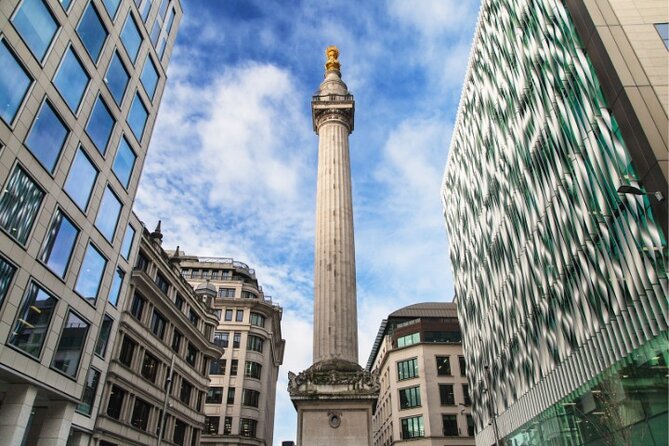
The Monument to the Great Fire of London is only a short distance from the start. Sir Christopher Wren designed this tall Doric column to mark the disaster of 1666, when much of the medieval city burned.
The audio explains the symbolic meaning of its location and design. The Monument also has 311 steps leading to a viewing platform and provides a commemorative certificate for those who make the climb. The route itself does not include a paid climb, so treat that as a separate option.
This is a good stop for anyone who likes London’s major events tied to physical places. You are not simply hearing about the Great Fire in the abstract. You are near the spot where the story began, with the rebuilt City around you.
The suggested stop is about 15 minutes, enough for the outside and the commentary. The climb, if available and open when you visit, would change the timing considerably.
All Hallows by the Tower and the Tower Hill sundial
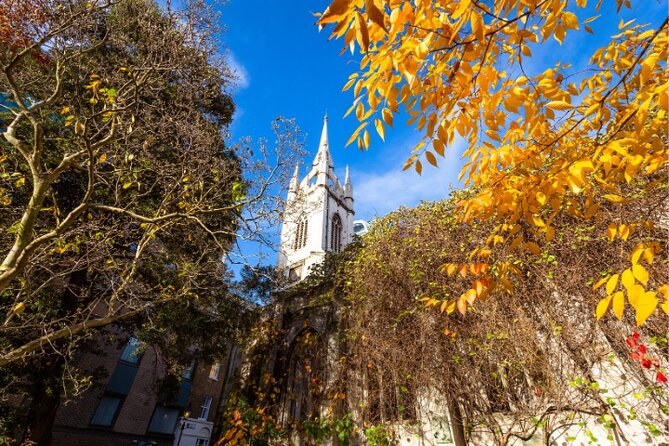
All Hallows by the Tower gives the walk a quieter turn. Dating to 675 AD, it is described as London’s oldest church and one of the few churches in this part of the city to survive the Great Fire.
Inside, you can find medieval remains from the 13th and 14th centuries, along with a Roman road hidden beneath the church. The church’s location near the Tower of London also brings in stories linked to Henry VIII and the darker side of Tudor London. John Quincy Adams is another notable name connected with the church.
The suggested stop is only 10 minutes, but that is a brisk visit. If the church is open and you want to look at the surviving material, allow extra time. This is exactly the sort of stop a self-guided route can add to your day, since it is easy to pass by when you are focused only on the Tower of London.
Next comes the sundial at Tower Hill Underground Station. It is not just a device for telling the time. Its bronze plaques mark major stages in London’s story, from the Roman invasion through the end of World War II.
The app uses the sundial to connect the changing position of the sun with the city’s past. It is a clever stop, though its full meaning may take a little attention. The suggested 20 minutes gives you time to examine the plaques rather than simply snap a photograph.
Same part of England, a completely different sort of day:
- London Big Bus Hop-On Hop-Off Tour with Optional River Cruise
★ 3.5 · 10,803 reviews - London Small Group Tour of Historical Pubs
★ 5.0 · 10,422 reviews - Tower of London and Crown Jewels Exhibition Ticket
★ 4.5 · 6,677 reviews - Thorpe Park Admission Ticket
★ 4.0 · 5,915 reviews
Tower Bridge and the Queen’s Walk
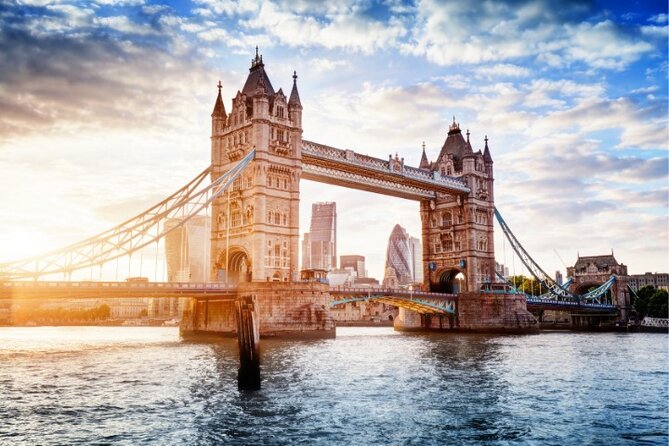
Tower Bridge is one of London’s most recognizable sights, and the route gives it useful context. Its combination of bascule and suspension design allows ships to pass along the Thames. It is often confused with London Bridge, but the two are separate crossings.
The commentary also includes the memorable story of a bus driver who jumped the opening bascules in 1952. That sort of detail helps keep the architecture from feeling like a dry engineering lesson.
You may want to pause here for photographs, especially with the river and the Tower of London nearby. The bridge itself is a major attraction, but the route does not include entry to its high-level walkways or exhibition.
From Tower Bridge, you continue along the Queen’s Walk. This riverside path links views of old London with newer sights such as the London Eye. The commentary traces changes along the Thames, from 15th-century activity to grand houses built after Henry VIII’s reign and the destruction caused by the Great Fire.
This portion works best at an easy pace. You can keep walking to maintain the route’s flow, or pause for river views and photographs. The app gives you freedom, but the clock is yours to manage.
The Shard, London Bridge, and Borough Market
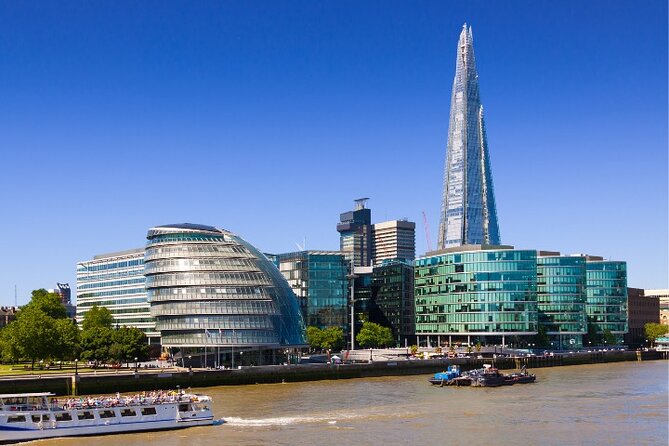
The Shard provides a sharp change of mood. At 310 meters, it represents London’s modern skyline and is described as Western Europe’s tallest building. Its glass form rises above Southwark, an area with older links to inns, theatres, and Shakespeare.
The audio does a good job of connecting the tower to the ground beneath it. Southwark was once a major entertainment and lodging district, and Shakespeare’s Globe Theatre grew from that setting.
London Bridge comes next, with a reminder that it was once far more than a crossing. In the 15th century, it carried shops, homes, and even a chapel. Thinking of the bridge as a crowded street helps explain why the river crossing mattered so much to daily life.
Borough Market is one of the best places to pause. Its trading history reaches back to 1014, and its position near London Bridge made it an important place for food and commerce. The suggested stop is 20 minutes, but that is enough only for a quick look.
I would plan a meal here if your schedule allows. The market gives you a practical break from the walking and adds a local food stop to what could otherwise become a long chain of monuments. Just remember that eating and browsing will push the tour well beyond the stated one to two hours.
Shakespeare’s Globe and Tate Modern
The modern Shakespeare’s Globe opened in 1997 as a recreation of the Elizabethan theatre. Actor-director Sam Wanamaker drove the project, and the building uses traditional materials such as unseasoned oak and thatch.
The stop is listed as five minutes, which is enough for the outside and the app’s explanation. It is not enough for a performance or a full theatre visit. You should regard the audio stop as an introduction, not a substitute for a ticketed tour or show.
The commentary explains how the Globe’s design restores some of the relationship between actors and audience found in Elizabethan theatre. That matters because the building is not only a replica to photograph. It represents a different way of watching a play, with a more active audience role.
Tate Modern gives the route another strong contrast. The gallery occupies a former power station designed by Sir Giles Gilbert Scott. Architects Herzog and de Meuron converted it for art use in 2001, preserving the huge industrial spaces while adding contemporary elements.
The turbine hall is the most striking part of the building, and upper levels offer views across the Thames. Admission to the main Tate Modern collection is free, though special exhibitions may have separate arrangements. The walking tour does not include those tickets.
The suggested 20 minutes works for a quick orientation. If you want to see the collection, use the café, or explore the building properly, allow much longer. Tate Modern is one of the easiest places on the route to turn a short walk into a half-day visit.
The Millennium Bridge and the final walk toward St Paul’s
The Millennium Bridge connects Tate Modern with the north bank of the Thames. It became famous for an unexpected wobble shortly after opening in 2001, but it was later made stable.
Crossing the bridge gives you a strong view toward St Paul’s Cathedral and a clear sense of how the route moves from Southwark back into the City. The bridge is both a practical crossing and a good closing stretch for the riverside section.
The tour finishes at 100 St. Paul’s Churchyard. The final destination matters because St Paul’s ties together several themes introduced earlier: fire, rebuilding, church design, and London’s changing skyline.
The route information also lists more than 30 narration points, while the named stops account for only part of the walk. That means the app may offer extra commentary between the larger landmarks. Do not assume that every point will be a full attraction or a place where you need to stop for a long time.
How long should you allow?
The stated duration of one to two hours is realistic only for a quick walk with limited stops. One person managed about 14 of the 31 points during a morning, which is a useful warning for anyone trying to squeeze the whole route into a narrow gap.
For a fast overview, allow two hours. For photographs, church visits, Borough Market, and Tate Modern, plan on several hours. If you want to explore each place properly and stop for food, a full day is more comfortable.
This is not a flaw in the route itself, but the timing needs to be understood. The app gives you a long chain of options. It does not force you to complete every one in a single push.
Getting the app to work properly
The tour operates through the Trippy Tour Guide app and is offered in English. You receive access to the audio points, detailed directions, and an offline map.
The most important preparation is technical:
- Download the full tour before you arrive at Monument Station.
- Allow the app to use your phone’s GPS.
- Confirm that the audio and map load before leaving Wi-Fi.
- Bring enough phone battery for the walk and navigation.
Once downloaded and set up correctly, the tour does not need Wi-Fi or mobile data. That is useful in a crowded city where signal can be patchy, and it avoids unexpected data use.
The map is not quite the same as following a standard Google Maps route. If you are not comfortable reading streets on a phone, give yourself time to understand the directions before walking away from the start.
Who will get the most from this walk?
I would recommend this route to a first-time London visitor who wants a broad introduction at a very low price. It also suits history fans who like moving from Roman remains to the Great Fire, Tudor stories, medieval bridges, Shakespeare, industrial architecture, and modern towers.
It works well for a small private group because only your party uses the tour. Colleagues used it as a shared morning activity, and the format can suit a family or group of friends who prefer to pause and talk rather than keep up with a guide.
It is less suitable if you want a live person answering questions or if you need very clear turn-by-turn guidance. It is also a poor fit for anyone with only 90 minutes who expects to visit every point.
The route is near public transport, begins at Monument Station, and most people can take part. No private transport is included, so you need to be comfortable walking between the stops.
Is $9.99 good value?
At $9.99, the price is easy to justify if you use the app as a framework for your own day. You get audio, directions, offline access, and a route that links sights you might otherwise visit separately.
The value drops if you fail to download the content or cannot follow the map. Since there is no live guide, the success of the tour depends partly on your preparation.
Also keep the ticket wording clear in your mind. The app access is included, but that does not mean entry to every London attraction is included. The named stops are presented as free stops, while any optional paid entry, such as an observation deck, exhibition, or theatre visit, should be checked separately.
Free cancellation is available if you cancel at least 24 hours before the start time. Changes or cancellations inside that window are not refunded.
Should you book it?
Book this self-guided walk if you want an inexpensive, flexible introduction to central London and you are willing to handle your own phone navigation. The strongest parts are the offline access, the wide mix of sights, and the freedom to spend more time at Borough Market, Tate Modern, or the riverside.
Do not book it as a tightly timed one to two hour tour. Think of that figure as a brisk route estimate. If you download the content, enable GPS, and allow half a day or more, this can be a smart way to connect the Monument, Tower Bridge, Southwark, the Thames, and St Paul’s without paying for a private guide.
FAQ
Where does the London self-guided tour begin?
The tour begins at Monument Station, Underground Ltd, King William Street, London EC4R 9AA.
Where does the tour finish?
The final stop is at 100 St. Paul’s Churchyard, near St Paul’s Cathedral.
How long does the tour take?
The stated duration is about one to two hours, but completing the audio points and properly exploring the stops can take several hours or a full day.
Is there a live guide?
No. This is a private, self-guided activity operated through the Trippy Tour Guide app. Only your group participates.
What language is available?
The tour is offered in English.
Does the tour work without Wi-Fi?
Yes. You need to download the full tour first. After that, the map and audio are designed to work offline without Wi-Fi or mobile data.
Do I need to allow GPS access?
Yes. GPS permission is needed so the app can identify your position, guide you to the starting point, and play the correct content along the route.
Is transportation included?
No. Private transportation is not included. The experience is designed as a walking route near public transport.
Are attraction tickets included?
The app access is included, but the tour price does not include paid attraction tickets. The listed stops are described as free stops, while optional entry to venues or exhibitions should be checked separately.
Can I cancel for a full refund?
Yes, if you cancel at least 24 hours before the experience start time. Cancellations or changes made less than 24 hours before the start time are not refunded.
Just added around London
- London Private Jack The Ripper Tour★ 5.0 · 9 reviews
- Private Spy Walking Tour of London★ 5.0 · 6 reviews
- Private Shoreditch Street Photography Workshop★ 4.5 · 4 reviews
- Private Sightseeing Walking Tour of The City Of London★ 5.0 · 3 reviews
- Private 2.5 Hour Taxi Tour of London – London’s Greatest Bits!★ 5.0 · 4 reviews
- Private Round Trip Transfer between London Airports and Hotel★ 3.5 · 56 reviews
- Shakespeare London Walking Tour★ 5.0 · 26 reviews
- Private Prison Van Escape Game – London Immersive Experience★ 4.0 · 15 reviews
City Tours, compared.

Liverpool City Sights Hop On Hop Off City Tour – 24hr Ticket
Read our review →
City Sightseeing London Hop-On Hop-Off Bus Tour & Bookable Extras
Read our review →

City Sightseeing Oxford Hop-On Hop-Off Bus Tour
Read our review →
Extended: Oxford University & City Tour With Christ Church
Read our review →
City Sightseeing Stratford-upon-Avon Hop-On Hop-Off Bus Tour
Read our review →
City Sightseeing Cambridge Hop-On Hop-Off Bus Tour
Read our review →Browse the lists this tour appears in