
Reviewed · JACK THE RIPPER TOURS
Jack the Ripper: Night Murder Mystery Walking Tour in London
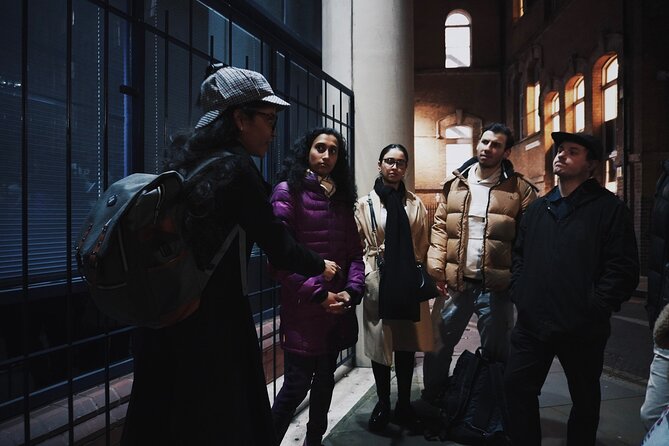
The most gripping part of this Jack the Ripper walking tour is the setting. After dark, narrow Whitechapel streets, old alleys, and church walls give the case a physical shape. You are not just hearing dates in a room. You are following a route through the places tied to the murders.
I like two things here. First, the guide puts the victims and their difficult lives into the story, rather than treating Jack the Ripper as a folk hero. Second, the walk follows the events in sequence, which makes the case easier to understand. The drawback is simple: this is a full two-and-a-half-hour walk, with little chance to sit until the end, and cold or wet weather can make it tiring.
Key points to know before you book
- Seven Whitechapel stops: Follow the route through Brick Lane, Princelet Street, Puma Court, the Ten Bells, Gunthorpe Street, Goulston Street, and St Botolph without Aldgate.
- A serious look at the victims: The tour gives time to the women’s lives, poverty, and lack of support in Victorian London.
- Strong guide-led storytelling: Guides including Kory, Tyson, Hadi, Dougal, Korhan, and Anahita are praised for clear explanations, humor, and careful handling of grim material.
- Interactive mystery element: You will examine crime scenes, clues, and competing theories about the killer’s identity.
- Small enough to follow: The group can include up to 25 people, so you are not dealing with a huge crowd.
- Good value at $22.93: For a long evening walk with a specialist subject and seven stops, the price is fair, especially if dark history is your idea of a good night out.
Why Whitechapel works better at night

Jack the Ripper’s crimes are often reduced to a few famous names and lurid details. This tour does more when it shows you the streets where the story unfolded. Whitechapel was crowded, poor, and difficult for vulnerable women. The setting helps explain why the murders caused such fear and why the police struggled to control the area.
Night adds atmosphere, but it does not turn the walk into a haunted-house show. The best guides keep the tone respectful. Hadi, for example, has been praised for handling the subject with care and for using humor only when it helps the group keep going through a heavy story. That balance matters.
You should expect a mix of verified facts, open questions, and theories. The guide presents the known sequence of events, then explains where the evidence becomes uncertain. That is a better way to approach the case than pretending every mystery has a clear answer.
The group size can reach 25 people. That is large enough to provide energy but still manageable on narrow streets. One practical concern is sound. A guide may be easy to hear at one stop and harder to hear when turning toward another part of the group, so stay close and position yourself where you can see the guide’s face.
More Evening Experiences in London
- London by Night Bus Tour with Christmas Lights and Live Guide
★ 4.5 · 2,040 reviews - London by Night Sightseeing Tour – Open Top Bus
★ 4.5 · 1,060 reviews - London by Night Sightseeing Open Top Bus Tour with Live Guide
★ 4.5 · 977 reviews
Brick Lane and the world behind the murders
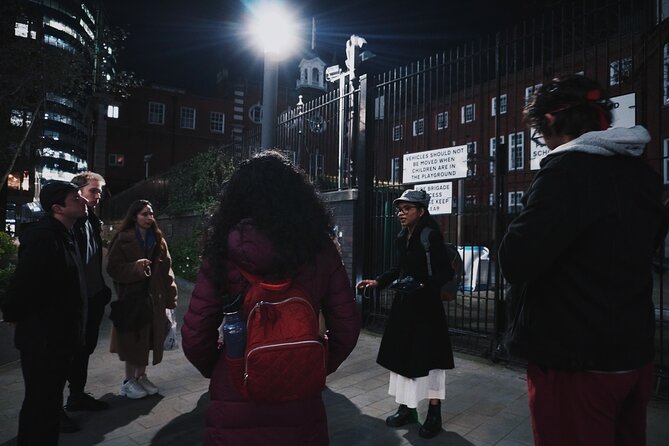
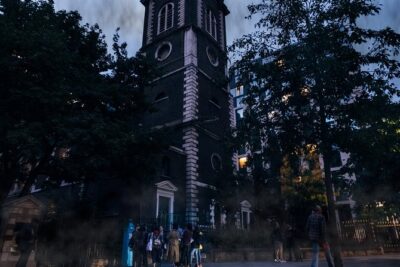
The walk begins at St Mary’s Whitechapel Church Memorial, near the Brick Lane area. Brick Lane today is known for food, street art, and nightlife, but the tour first asks you to picture its Victorian past.
This is where the guide explains poverty, overcrowding, and desperation. Those conditions are not background decoration. They are central to understanding why women could be left exposed, why lodging was unstable, and why the police had such difficulty gathering reliable information.
I like this opening because it gives the case social context before moving into the crime details. You learn about the neighborhood rather than treating it as a stage set for one killer. The stop lasts about 17 minutes, enough time for a clear introduction without turning into a long lecture.
Brick Lane can also be busy, even at night. Keep an eye on the group and do not expect a quiet, empty street. The contrast between the present-day area and the Victorian story is part of the point.
Princelet Street and Annie Chapman’s difficult world
Princelet Street is narrower and quieter. Here the tour turns toward the conditions faced by women such as Annie Chapman. The focus is not only on what happened to her, but on the limited choices available to women living with poverty and insecurity.
This is one of the more reflective stops. You may find the story less about solving a puzzle and more about understanding how ordinary hardship shaped the lives of the victims. The guide connects the street to the wider Whitechapel community and explains why the area could offer both shelter and danger.
The guide-led format helps here. A good storyteller can take a short stretch of pavement and explain how housing, work, drink, and poverty affected daily life. Kory has been especially praised for adding details about the buildings and neighborhood, while also discussing his own theory about the killer.
The street itself is quiet, but the subject is not. If you prefer a light evening activity, this may feel intense. If you like social history tied to a real place, it is one of the tour’s strongest sections.
Puma Court and the power of a narrow passage
Puma Court has changed little since the nineteenth century, according to the tour material. It is the kind of location where the physical space does much of the work. A narrow route, poor visibility, and nearby shadows make it easier to understand how someone could vanish quickly.
The guide explains what is known about the area and invites you to consider the clues and theories. This is where the interactive side of the tour becomes more useful. You are not simply given a conclusion. You are asked to think about movement, opportunity, and the limits of the evidence.
Do not expect theatrical effects. The atmosphere comes from the street itself and from the guide’s description of the period. Dougal has been praised for painting a detailed picture of London in the 1800s, and that kind of storytelling suits this stop.
As with the other locations, the stop lasts about 17 minutes. You will be standing on a public street, so conditions can vary. Wear shoes suited to walking and bring a coat, especially for a late autumn or winter departure.
More Walking Tours in London
- Tour for Muggles The Ultimate Harry Potter Walking Tour in London
★ 5.0 · 4,684 reviews - London Jack The Ripper Guided Walking Tour
★ 5.0 · 3,131 reviews - Changing of the Guard Guided Walking Tour in London
★ 5.0 · 1,793 reviews - The Great British Rock and Roll Walking Tour
★ 5.0 · 1,371 reviews
The Ten Bells and the women behind the legend
The Ten Bells is perhaps the most recognizable pub connection on the route. Many of the victims are believed to have visited the pub before their deaths, which helped make it part of the Jack the Ripper story.
The group stops outside to discuss the women’s final hours and the pub’s role in the case. The point is not to turn the location into a souvenir photo opportunity. It is to show how a working neighborhood, a public house, and a set of tragic events became tied together in popular memory.
This stop also helps correct the way the case is often told. The killer’s nickname has become famous, while the women are too often reduced to names in a list. The tour gives more attention to their lives, poverty, and vulnerability. That human focus is one of the most valuable aspects of the experience.
You finish the tour near the Whitechapel and Aldgate area, but the Ten Bells appears as a stop along the route rather than a guaranteed indoor pub visit. Plan on learning outside its doors. The tour does not promise a drink or a reserved seat.
Gunthorpe Street and Martha Tabram’s place in the case
Gunthorpe Street is linked to the murder of Martha Tabram, who may have been Jack the Ripper’s first victim. The word may matters. Her death is included in some theories, but the connection is not accepted as settled fact.
This is a useful stop for understanding how the case grew. The guide explains the evidence and why some experts include Tabram among the victims, while others separate her murder from the better-known series.
The location is a narrow passage, and the physical setting makes the discussion direct. You can see why an isolated route would be important when examining the crime. At the same time, the tour does not need to force a definite answer. The uncertainty is part of the history.
If you enjoy true crime, this stop gives you a chance to weigh competing ideas. If you want a clean beginning, middle, and end, the competing theories may feel frustrating. The guide’s job is to explain the possibilities without pretending the mystery is solved.
Goulston Street and the apron clue
Goulston Street brings one of the case’s most famous clues into view. This was associated with a bloody piece of apron belonging to Catherine Eddowes. A chalk message nearby added another layer of controversy.
The guide explains why the message caused fear and confusion, as well as the theories that still surround it. This stop shows how quickly a clue can become a public problem. Was the writing connected to the killer? Was it unrelated? What should police do with a message that might inflame hostility?
The value here is not simply the shock of the clue. It is the chance to see how evidence, rumor, press coverage, and public anxiety can merge. The tour presents the uncertainty and lets you consider the arguments.
Kory and other guides have used period news reports and old photographs to help picture the neighborhood as it was. Those details can make this section especially effective, though the quality of the presentation will depend on your guide and how clearly the group can see any materials.
St Botolph without Aldgate and the wider failure
At St Botolph without Aldgate, the story turns toward refuge and social failure. The church was known as a place where vulnerable women sought help. The stop asks you to think about what support existed, what was missing, and why so many women were left at risk.
This is the tour’s most openly reflective moment. The case is not only about a murderer. It is also about a society that offered few safe choices to poor women, and about how those women were later remembered mainly through the violence done to them.
I appreciate the pause here. A murder mystery can easily become entertainment at the expense of real people. The church stop gives the guide a chance to restore some dignity to the story.
The route remains chronological, which helps keep the facts in order. Tyson has been praised for maintaining a positive attitude in heavy rain and for guiding the group through the sequence clearly. That matters on a long walk, when concentration can fade.
Ending near Mitre Square
The route ends at Mitre Square, where the tour connects the final section of the story to the death of Mary Jane Kelly in the supplied tour information. The location gives the experience a clear stopping point and lets the guide bring together the clues, names, dates, and theories discussed along the way.
The advertised end point is not simply a return to where you began. You finish in a different part of the City of London, so you should be ready to plan your onward route from there. The tour does not include transport back to the starting point.
There is also a small factual caution worth keeping in mind. The Jack the Ripper case contains disputed details, and locations and victim connections are sometimes presented differently by historians. Listen for the guide to separate established evidence from theory. That distinction is one of the marks of a good tour.
What the guides add to the walk
The guide is the main reason this experience works. The route itself is interesting, but the streets will not explain the case without a strong narrator.
Several guides are specifically praised for different strengths. Kory and Korey are described as excellent storytellers with strong knowledge of London as well as the murders. Tyson is praised for humor, energy, and keeping the group together in bad weather. Dougal is noted for creating a detailed picture of nineteenth-century life. Hadi receives credit for calm, respectful delivery and for making each participant feel welcome at the start.
You may be led by one of these guides or by another member of the team. The common qualities to look for are clear speaking, control of the group, and a willingness to discuss theories after the formal walk ends. One guide has been described as staying behind to chat about possible suspects, which is useful if you want more than the standard presentation.
Do not assume every stop will be equally easy to hear. Keep near the front if you can, and tell the guide if the group has spread out. The experience is outdoors, and city noise can interfere.
Price, pace, and practical comfort
At $22.93 per person, this is reasonably priced for a two-hour-30-minute guided walk through seven locations. You are paying for the route and the guide’s research, storytelling, and organization, not for museum entry or indoor attractions.
The value is strongest if you already enjoy crime history, Victorian London, or guided walks with a strong narrative. You cover a lot of ground and gain a sense of how the locations relate to one another. Compared with a short, one-hour talk, this gives you more time to see the area and follow the sequence.
The price is less appealing if you dislike standing, walking, or grim subject matter. There is no mention of regular seating during the route, and one account describes the walk as tiring in poor weather. Wear comfortable shoes, dress for the forecast, and bring water.
Confirmation is provided when you book. The tour is offered in English, uses a mobile ticket, allows service animals, and can take up to 25 people. Most people can participate, but the length and outdoor format are worth considering before you reserve.
Free cancellation is available up to 24 hours before the start time. Cancel later than that and you should not expect a refund.
Who should book this London night walk
You should book if you like dark social history, true crime, old neighborhoods, and guides who explain how much is known and how much remains uncertain. It suits adults and older children who can handle descriptions of murder and difficult living conditions.
It is also a good choice if you want to see a part of London you might not visit on a standard sightseeing route. Brick Lane, Princelet Street, Puma Court, Goulston Street, and the area around St Botolph without Aldgate reveal a side of the city that is easy to miss when you stay with the main sights.
I would skip it if you want a relaxed pub evening, a seated presentation, or a tour free of disturbing material. The walk is serious, sometimes chilling, and dependent on the weather and the guide’s ability to project clearly.
Should you book the Jack the Ripper walking tour?
For about $23, this is a strong choice for anyone who wants a well-organized evening walk with a clear story and a serious look at the victims. The best part is not guessing the killer’s name. It is seeing how poverty, crowded streets, weak support systems, police pressure, and newspaper fascination shaped the case.
Book it for the chronological route, thoughtful guides, and real Whitechapel locations. Go prepared to walk for two and a half hours, stand outside, and hear unsettling material. If that sounds like a good London night to you, this tour offers solid value and a more human account than the usual Jack the Ripper legend.
FAQ
How long does the Jack the Ripper walking tour last?
The tour lasts approximately two hours and 30 minutes.
How much does the tour cost?
The listed price is $22.93 per person.
Where does the tour begin?
The tour begins at St Mary’s Whitechapel Church Memorial, on an unnamed road in London E1 1FE.
Where does the tour end?
The advertised end point is Mitre Square, London EC3A 5DE.
What locations does the walk visit?
The route includes Brick Lane, Princelet Street, Puma Court, the Ten Bells, Gunthorpe Street, Goulston Street, and St Botolph without Aldgate.
Is the tour offered in English?
Yes. The tour is offered in English.
How many people can join the tour?
The maximum group size is 25 people.
Can I cancel for a refund?
Yes. You can cancel at least 24 hours before the start time for a full refund. Cancellations made less than 24 hours before the tour are not refunded.
More Jack the Ripper Walks in London
- London Jack the Ripper Guided Tour with Ripper-Vision
★ 4.5 · 4,840 reviews - Ultimate Jack the Ripper : Guided Tour of London
★ 5.0 · 1,495 reviews - The Original Jack the Ripper : Guided Tour
★ 5.0 · 1,264 reviews - London Jack The Ripper Small-Group Walking Tour
★ 5.0 · 1,013 reviews
Just added around London
- London Private Jack The Ripper Tour★ 5.0 · 9 reviews
- Private Spy Walking Tour of London★ 5.0 · 6 reviews
- Private Shoreditch Street Photography Workshop★ 4.5 · 4 reviews
- Private Sightseeing Walking Tour of The City Of London★ 5.0 · 3 reviews
- Private 2.5 Hour Taxi Tour of London – London’s Greatest Bits!★ 5.0 · 4 reviews
- Private Round Trip Transfer between London Airports and Hotel★ 3.5 · 56 reviews
- Shakespeare London Walking Tour★ 5.0 · 26 reviews
- Private Prison Van Escape Game – London Immersive Experience★ 4.0 · 15 reviews
Jack the Ripper Tours, compared.
London Jack the Ripper Guided Tour with Ripper-Vision
Read our review →
Ultimate Jack the Ripper : Guided Tour of London
Read our review →

London Jack The Ripper Small-Group Walking Tour
Read our review →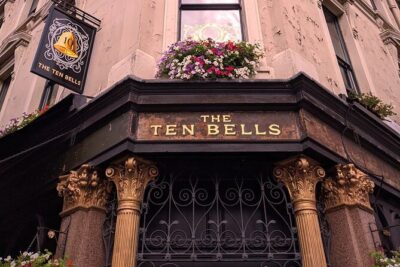

The Original Jack the Ripper Coach Tour of Haunted London
Read our review →
Browse the lists this tour appears in