
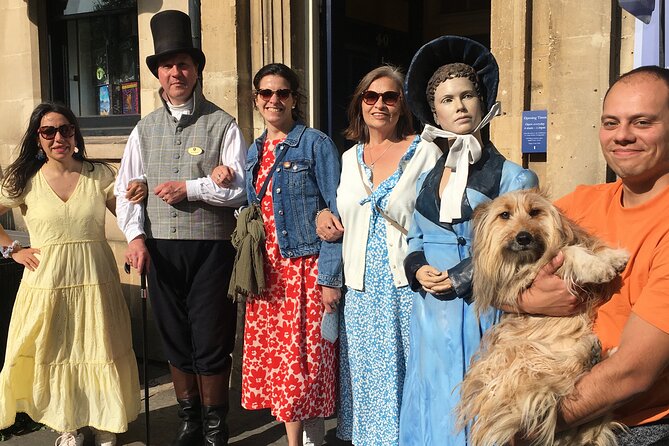
Reviewed · HISTORICAL TOURS
Jane Austen’s Bath And History Trail
Bath makes a fine stage for Jane Austen, but this walk gives you more than literary landmarks. With guide Ulrich Wenske, you connect Austen’s homes and fictional world with grand Georgian streets, Roman springs, medieval religion, and the social life of the Regency period. The route begins at Pulteney Bridge and ends there, helping you get your bearings in the city.
I like two things especially: the tour explains how Bath shaped Austen’s writing, rather than simply pointing out plaques, and it gives you a useful first look at many major sights. The small group, capped at 10 people, can also make the conversation feel personal. The catch is simple: this is a walking tour with uphill sections and steps, and most museum admissions cost extra.
Key points to know before you book

- Jane Austen’s Bath in real places: See No. 4 Sydney Place, where Austen lived, and No. 13 Queen Square, linked to her short stay in 1799.
- A broad city introduction: The route adds Bath Abbey, the Circus, the Assembly Rooms, thermal springs, the Roman Baths area, and the Pump Room.
- A small-group format: The maximum group size is 10, and the guide is Ulrich Wenske, offering the tour in English or German.
- The Jane Austen Centre is only partly included: You may enter and visit the book shop, but the Centre’s internal guided tour is separate.
- Plan for walking: The tour lasts about 2 hours and 30 minutes, with uphill stretches and some steep steps.
- Admissions can add up: No. 1 Royal Crescent, Bath Abbey, and the Roman Baths are not included, so treat the walk as an outdoor overview with optional paid visits.
Starting at Pulteney Bridge and Great Pulteney Street
You meet outside the Pulteney Bridge Coffee Shop at 17 Pulteney Bridge. This detail matters. The tour does not begin at the Jane Austen Centre, despite the prominent Austen imagery associated with the experience. Check the map before you leave your hotel, and arrive at the bridge rather than walking to the Centre first.
Pulteney Bridge is a graceful 18th-century crossing designed in 1769, with shops built along both sides. Its design recalls Florence’s Ponte Vecchio, giving you an immediate talking point about Bath’s taste for grand European models. From here, the route continues along Argyle Street toward Laura Place and Great Pulteney Street.
Great Pulteney Street is one of Bath’s best places to read the Georgian city through its buildings. Its wide scale, repeated town houses, and polished fronts show how the city presented itself to wealthy residents and fashionable visitors in the 18th and 19th centuries. Ulrich also points out famous residents and the Holburne Museum of Art, visible from this area.
You may walk along Pulteney Street toward the museum and see the front of No. 4 Sydney Place. A plaque marks Jane Austen’s first home in Bath. There is no admission to the house on this tour, but the stop has real value because it turns Austen from a name on a sign into a person who actually lived in these streets.
More historical tours in Bath:
- Roman Baths and Bath City Walking Tour
★ 4.5 · 762 reviews - Roman Baths Entry and Walking Tour with Blue Badge Tour Guide
★ 5.0 · 58 reviews - Bath: Local Pubs & Historic Sights Walking Tour (3h)
★ 5.0 · 31 reviews
Seeing Austen’s homes without pretending they are museums
The Austen theme works best when the tour shows you the city Austen knew, not just a collection of literary references. No. 4 Sydney Place marks her first Bath dwelling, while No. 13 Queen Square connects to her short residence in 1799. These addresses help you picture her movements through a city built for social visits, shopping, balls, and public display.
You should keep your expectations clear. The tour does not provide entry to private interiors at these residences. You see the buildings and hear how they fit into Austen’s life. For many readers, that is enough to make Northanger Abbey and Persuasion feel less detached from the real city.
This is also where Ulrich’s wider approach helps. He links Austen to Bath’s architecture, local customs, and social setting. Several tour comments praise the mix of Austen material with English history and building design, and that balance is useful if you are interested in Bath but do not want a narrowly literary walk.
The Jane Austen Centre and what your ticket covers
The Jane Austen Centre is an obvious stop, and the tour includes entry to the Centre and a visit to its book shop. That gives you a chance to browse Austen titles and see a snapshot of Regency life without paying the separate admission for the Centre’s internal tour.
The important distinction is that the Centre’s own guided experience is not included. If you want the full museum presentation, you book that separately. The walking tour instead uses the Centre as one part of a larger Bath story, moving you on to architecture and public buildings rather than spending the whole session indoors.
This arrangement can be good value for readers who want context and a quick Austen connection. If your main aim is a detailed museum visit, allow extra time and budget for the Centre itself. The walk’s strength is the way it places Austen among the streets and institutions that shaped her work.
Bath Abbey, thermal springs, and the Roman past

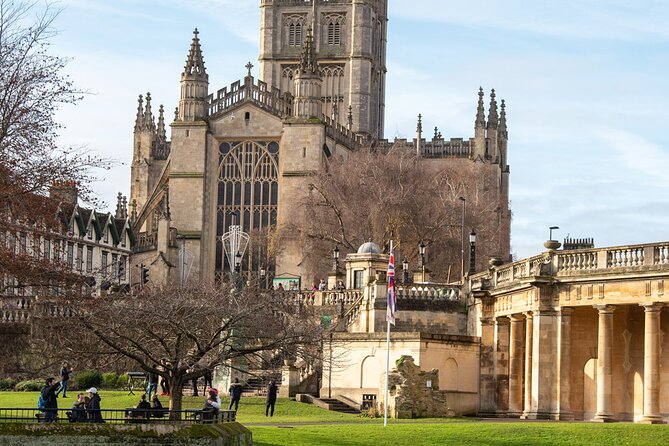
Bath Abbey gives the route a very different mood. The building began as a grand medieval cathedral in the early 12th century, and later restoration began under Bishop Oliver King in 1499. Completion took place under Elizabeth I in 1611. Inside, you can look at memorials and wall plaques while hearing about the Abbey’s long place in Bath’s story.
The Abbey is also linked with the crowning of Edgar, described here as the first King of England, in 977. The details matter because they show Bath as more than a Georgian resort. Before Austen’s fashionable city, there was a medieval religious center and, long before that, a Roman settlement built around hot springs.
The thermal water remains one of Bath’s defining features. The tour explains the Hetling Spring, Cross Spring, and King’s Spring, whose origins are described as reaching back 10,000 years. It also covers the modern opportunity to swim in natural thermal water at roughly 35 degrees Celsius, including a rooftop pool open in summer and winter.
The wording of the experience does not promise entry to a thermal spa, so think of this as an explanation and sightseeing stop rather than a bathing session. If you want to use a pool, arrange that separately.
The Roman Baths area is another major landmark on the route. The site dates from the 1st century AD and includes the Roman temple of Sulis Minerva and the ancient pools. You can see the area as part of the walk, but the Roman Baths admission and audio tour are not included. The audio tour is recommended as a separate booking before or after the walk.
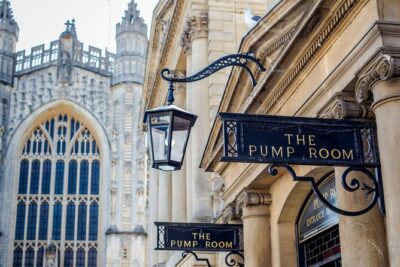
Next door, the Pump Room recalls Bath’s Georgian golden age. This was where fashionable society gathered for balls, tea, and the ritual of taking the waters. It also connects directly to Austen’s fiction, since Catherine and Isabella meet there in Northanger Abbey. That is a small but satisfying link between the physical city and the novels.
A few more Bath days out to weigh up
- Walking Tour of Bath with Blue Badge Tourist Guide
★ 5.0 · 1,877 reviews - Fully Guided Bath Ghost Tours
★ 5.0 · 539 reviews - Best of Bath Walking Tours – Georgian Tour
★ 5.0 · 449 reviews - Bad of Bath fun Walking Tour of Bath
★ 5.0 · 402 reviews
No. 1 Royal Crescent and the city’s grandest address

No. 1 Royal Crescent is one of Bath’s most photographed buildings. The crescent was built in the second half of the 18th century and contains 30 terraced houses joined by a sweeping Ionic facade. Its scale gives you a clear sense of how Georgian Bath used architecture to turn private homes into a public display of status.
From outside, the crescent is impressive enough. The tour explains its design and place in Bath’s development, then gives you the option of visiting No. 1, which is operated as a museum. The museum admission is not included, so you can decide based on your time, budget, and interest in period interiors.
I would treat this as a useful choice point. If you have already seen several Georgian interiors elsewhere, the exterior explanation may be enough. If you want to know how these houses functioned inside, No. 1 Royal Crescent is one of the better optional additions to your Bath day.
The Circus, where planning becomes performance

The Circus is one of the most memorable stops because its design is so unusual. The John Wood architects began work in 1754, drawing on prehistoric stone circles and shaping the complex to echo the Colosseum in Rome. Three curved blocks form a powerful urban space, and the repeated columns reward a slow look upward.
This stop is free and takes about 20 minutes. Ulrich explains what makes the layout different from a normal square or street, including details about the central trees and the way sound behaves there. You may even try the echoing trees in the middle, a small, playful moment that breaks up the architectural talk.
The Circus is also a good example of why this tour is not only for Austen specialists. You get literary context, but you also learn how Bath’s planners used classical ideas, ancient monuments, and geometry to shape the city. That wider view helps the rest of the walk make sense.
Assembly Rooms and the social world behind Austen’s novels

The Assembly Rooms were the places to see and be seen during the Regency period. Their grand public rooms included the ballrooms, Octagon, card room, and tea room, and they still host events.
The tour explains how fashionable people socialized here, which gives useful background for Austen’s scenes of introductions, dances, rivalries, and carefully managed manners. The building is especially helpful if you want to understand why Bath’s social life mattered so much in her fiction.
Admission is not included. You can visit the rooms separately if the interiors appeal to you, but the walking tour gives you the essential setting and social context from outside and along the route. Be realistic about timing if you plan to enter several paid sites on the same day. The walk itself already uses most of a morning or afternoon.
What the walking pace and group size feel like

The stated duration is about 2 hours and 30 minutes, though some descriptions from past departures put the walk closer to two hours. Either way, plan for a substantial outing rather than a quick photo stop. You will cover the main landmarks, and the route includes uphill sections and steep steps.
Wear comfortable shoes and bring water. That advice is not decorative. The route moves through a compact city, but Bath is not flat everywhere, and the combination of stops, standing, and walking can leave your feet tired.
The group limit is 10 people. That is small enough for questions, and Ulrich’s style appears conversational and flexible. He has been described as willing to stop for questions and to adjust his approach when conditions are poor. In very small groups, including one-person departures, the walk can feel almost like a private introduction to Bath.
The guide offers the experience in English or German. Ulrich has a German accent, which one past comment found occasionally difficult to follow, and another comment noted that he sometimes spoke quickly or was hard to hear. Most of the available feedback praises his preparation, friendliness, and willingness to explain, but it is sensible to stay near him in busy areas and ask him to repeat anything you miss.
Price, inclusions, and the real value
At $40.24 per person, this is not the cheapest way to walk around Bath, but the price can make sense if you want a guide to connect many separate sights. In 2.5 hours, you cover Austen’s residences, the Jane Austen Centre area, Bath Abbey, the springs, Royal Crescent, the Circus, the Assembly Rooms, the Roman Baths area, and the Pump Room.
The price does not cover the major museum admissions. Add separate costs if you plan to enter No. 1 Royal Crescent, Bath Abbey, the Jane Austen Centre’s internal tour, or the Roman Baths. The best value comes when you use this walk as your city orientation, then choose only the paid interiors that match your interests.
I would not book it solely for museum access. I would book it for the connections: Austen and Bath’s social life, Roman springs and Georgian fashion, grand architecture and everyday movement through the city. That is harder to assemble from guidebook paragraphs while walking alone.
The tour is often booked well ahead, around 40 days in advance on average. That suggests planning ahead is sensible, especially if your Bath visit has fixed dates. Free cancellation is available until 24 hours before the start time. If poor weather cancels the experience, you are offered another date or a full refund.
Who should book this Bath walk?
I would recommend it to first-time Bath visitors who want a strong orientation and to Austen readers who want to see real addresses rather than only visit a museum. It also suits anyone who enjoys architecture, city planning, and stories about how public places shaped private lives.
It is less suitable if you want a slow indoor museum tour, dislike hills and steps, or need every admission included in the upfront price. It is also not the right booking if you are likely to confuse the Jane Austen Centre with the meeting point. Go directly to the Pulteney Bridge Coffee Shop at 17 Pulteney Bridge.
Should you book Jane Austen’s Bath and History Trail?
Book it if you want Bath explained as a whole city, with Jane Austen as the thread running through it. Ulrich Wenske brings together Austen’s homes, Regency society, Roman springs, medieval religion, and Georgian architecture in one compact route.
Skip it if you prefer to explore at your own pace and enter several museums without watching the clock. For most visitors with half a day in Bath, though, the walk offers a useful start, good context, and plenty of landmarks before you choose where to spend the rest of your time.
FAQ
Where does the tour begin?
It begins at the Pulteney Bridge Coffee Shop, 17 Pulteney Bridge, Bath BA2 4AY, UK.
Where does the tour end?
The activity ends back at the meeting point on Pulteney Bridge.
How long does the tour last?
The stated duration is approximately 2 hours and 30 minutes.
Is the Jane Austen Centre admission included?
Entry to the Jane Austen Centre and a visit to its book shop are included. The Centre’s internal guided tour is not included and must be booked separately.
Are museum entrance fees included?
No. Entrance fees for museums, including No. 1 Royal Crescent, are not included. Bath Abbey and the Roman Baths also require separate admission.
Is the tour suitable for people who do not want much walking?
The tour requires a fair amount of walking and includes uphill sections and some steep steps. Comfortable shoes and water are recommended.
Just added around Bath
- Heathrow Airport To Bath Private Airport Transfers★ 5.0 · 17 reviews
- Afternoon Bath City Tour – Private tour from Bristol with a local guide★ 5.0 · 7 reviews
- Wells, Cheddar Cheese and Cheddar Gorge – Private Day Trip from Bath★ 5.0 · 10 reviews
- BATH: 2-Hour Bath Walking Tour of Bridgerton Filming Locations★ 5.0 · 99 reviews
- The Splendour of Georgian and Victorian Era Bath: A Self-Guided Audio Tour★ 4.0 · 3 reviews
- Private Guided Ghost Tour of Bath★ 5.0 · 20 reviews
- Glastonbury, Wells Cathedral & Cheddar Gorge Day Trip from Bath★ 5.0 · 3 reviews
- Private Day Tour from Bath to Glastonbury and Wells with Pickup★ 5.0 · 14 reviews
Historical Tours, compared.
Stonehenge and Bath Day Trip from London with Optional Roman Baths Visit
Read our review →
Shadows of York: Ghost Walk and Horrible History.
Read our review →
Fascinating Walking Tours Of Roman Chester With An Authentic Roman Soldier
Read our review →
A Walk Through Time: History of Liverpool Walking Tour
Read our review →
Royal Historic Pubs Walking Guided Tour in London
Read our review →Browse the lists this tour appears in