
Reviewed · WALKING TOURS
Fascinating Walking Tours Of Roman Chester With An Authentic Roman Soldier
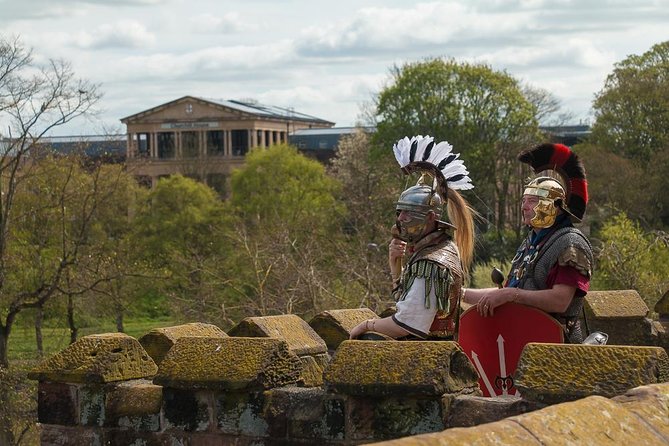
Chester’s Roman past is not locked away in a museum. It sits beneath cafes, beside busy streets, and in the thick stonework of the city walls. This 90-minute walk brings those remains together with a guide dressed as a Roman soldier, giving you a clear picture of life inside the old fortress.
I like the tour for two reasons: the archaeological remains are woven into the modern city, and the guide can explain details that are easy to miss on your own. I also like the relaxed question-and-answer style, with guides such as Marcus, Julius, Gaius, Faustus, and Tiberius bringing different personalities and stories to the walk.
The main consideration is the weather. This is an outdoor walking tour, and one section may involve a cellar or basement, so the route is not perfect for every mobility level. The group is capped at 15 people, which helps, but comfortable shoes and a rain jacket are sensible in Chester.
Key points about the Roman Chester walk

- Britain’s largest Roman amphitheater: Learn how the arena was used and what archaeological evidence reveals about the people who fought and died there.
- Roman fortress walls still visible: Some surviving sections rise more than 5 meters above ground.
- Roman Gardens with original stones: See pila stones from a hypocaust system and reconstructed elements of a military bath.
- A guide in Roman military dress: Ask about uniforms, ranks, wages, hygiene, living quarters, and the work of a legionary.
- Unexpected remains beneath a modern cafe: The route includes a memorable look at Roman columns and other remains preserved below street level.
- Short, good-value format: At about 90 minutes and $16.64 per person, the tour fits neatly into a day of sightseeing in Chester.
Why Roman Chester is best understood on foot

Chester can appear thoroughly modern at first glance. Shops fill the center, traffic runs around the old core, and the city’s timbered buildings draw the eye. Yet the Roman fortress shaped much of the street plan beneath it.
That is why a walking tour works so well here. You are not simply looking at one isolated ruin. You are moving between fragments of a military settlement and seeing how later Chester grew over the earlier city.
Your guide provides the missing connections. A stone wall may look like a medieval defense until you learn that it was built on Roman foundations. A column below a cafe may seem like an old architectural feature until you understand that it belonged to the headquarters of a major fortress.
I particularly like the way this experience links large public remains with small human details. You can hear about Roman ranks and military pay, then move on to personal hygiene, sleeping arrangements, and the trades soldiers learned. Those details make the fortress feel less like a diagram and more like a working town filled with people.
More historical tours in Chester:
- Medieval Walking Tour of Chester
★ 5.0 · 155 reviews - London Small Group Tour of Historical Pubs
★ 5.0 · 10,422 reviews - Stonehenge and Bath Day Trip from London with Optional Roman Baths Visit
★ 5.0 · 2,028 reviews
Starting at Chester Town Hall
The meeting point is listed at Chester Town Hall on Northgate Street. This is a practical place to begin because it is central and easy to find while exploring the city.
The tour is conducted in English and uses a mobile ticket. Confirmation arrives when you book, so you can keep the details on your phone rather than carrying printed paperwork.
From the start, look for the Roman soldier-guide. The guide’s name and character can vary. Past tours have featured Marcus, Julius, Gaius, Faustus, Hippolyta, Tiberius, and others. The Roman clothing is not just a photo prop. It gives the guide a natural way to explain equipment, status, and military life.
The guides also bring different styles. Marcus has been praised for his humor and for allowing plenty of questions. Julius is described as an engaging historian, while Gaius and Tiberius have been especially good at holding children’s attention. Hippolyta’s presentation focused on the surprising presence of women connected with the Roman military world.
You should expect a lively interpretation rather than a silent march from one ruin to the next. That works well for families, curious first-time visitors, and anyone who prefers stories to long blocks of dates.
Chester Roman Amphitheater and the lives behind the arena
The first major stop is Chester Roman Amphitheater. It is described as Britain’s largest Roman amphitheater, and its scale helps you understand that Chester was not a minor outpost.
The arena was tied to military life and public entertainment. Here, the guide explains the people who fought and died in the space, using surviving remains and archaeological evidence to build the story.
The value of this stop is not only the size of the structure. It is the chance to think about what an amphitheater meant in a Roman fortress. Soldiers stationed far from Rome still had access to organized entertainment, public spectacle, and the social rituals that helped hold the military community together.
You will spend about 15 minutes here. That is enough time for an explanation and questions, though you should not expect an extended archaeological lecture. The admission is included, with no separate ticket required.
I would pay close attention to the guide’s explanation of evidence. Roman sites often tempt people into filling gaps with imagination. A strong guide separates what survives from what archaeologists infer, making the visit more trustworthy.
The open-air setting also means this is one of the places most affected by rain. The tour can be canceled in poor weather, with a choice of another date or a full refund. If the forecast looks uncertain, bring waterproof clothing instead of assuming the weather will clear.
Roman fortress walls rising above the modern city
The walk continues along sections built on the foundations of the walls of Britain’s largest Roman fortress. Some original Roman wall sections survive to more than 5 meters in height.
This is where the tour’s setting becomes especially useful. You are seeing ancient masonry in the middle of a living city, not behind a distant fence. The guide can point out what belongs to the Roman period and explain how later construction used or altered the earlier defenses.
I like this part because it rewards looking up and looking down. Large wall sections show the military scale of Chester, while smaller stones and changes in construction reveal how the city developed over time.
The guide may also take you to parts of the wall that are easy to overlook when walking alone. One of the repeated strengths of this experience is its ability to reveal remains that sit just outside the usual sightseeing path.
This portion requires walking through the city rather than standing in one place. Most people can take part, and the group size is limited to 15, but you should still expect ordinary urban walking and occasional stops on uneven historic surfaces.
More walking tours in Chester:
- The Heart of Chester Walking Tour – Guided Walk
★ 5.0 · 83 reviews - Haunted Chester and its Ghosts: A Self-Guided Walking Tour
★ 5.0 · 19 reviews - Hello Chester! Private Walking Tour
★ 5.0 · 3 reviews - Oxford University Walking Tour With University Alumni Guide
★ 5.0 · 6,905 reviews
Roman Gardens and the hypocaust system
The Roman Gardens provide a useful change of pace. Here, you see a reconstructed hypocaust system, a Roman underfloor heating method.
The display uses original pila stones, along with reconstructed or mosaic flooring found during excavations connected with the Roman military baths. The guide explains how the system worked and why these pieces were moved to the gardens.
A hypocaust can be hard to understand from a written description. The pila stones supported a floor above a hollow space. Hot air from a furnace passed beneath the floor, warming rooms above. Seeing the stones arranged as part of a reconstruction makes the engineering easier to grasp.
This stop also opens a larger question about Chester’s military baths. Roman soldiers needed places to wash, exercise, socialize, and maintain their routines. The baths were practical, but they were also social centers within the fortress.
You will spend around 15 minutes in the Roman Gardens. The stop is compact, yet it gives the guide a clear object to explain rather than relying only on spoken history.
One difficult piece of Chester’s story is that large portions of the Roman baths were lost to later development. A shopping project destroyed important remains after only a short period of basic archaeological investigation. That loss is a useful reminder that what survives in Chester is valuable partly because so much else has gone.
The modern cafe with Roman remains beneath it
One of the most memorable moments on the walk may come in an unexpected place: the basement of a modern cafe. Roman remains, including Principia columns, are preserved beneath the building.
The Principia was the fortress headquarters, so these columns offer a direct link to the administrative heart of Roman Chester. You are not just seeing a loose stone in a display case. You are seeing part of a larger complex in the place where it once served the military community.
This stop gives the tour its best surprise. Chester’s Roman remains are not confined to the amphitheater or gardens. They can turn up below ordinary businesses, and you might walk past them without realizing what is under your feet.
The basement section may not suit every visitor. One person using an electric wheelchair missed only this part while the rest of the tour remained accessible. If you have mobility concerns, contact the provider before booking and ask about the current route.
What the Roman soldier-guide adds
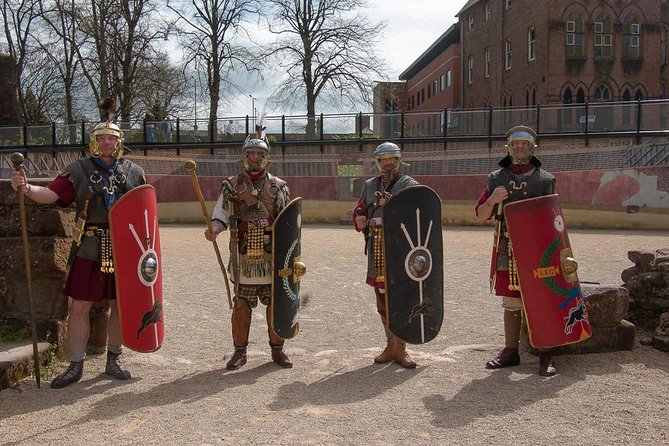
A costumed guide can sometimes feel like a gimmick. Here, it has a practical use when the guide handles the subject well.
The uniform creates a starting point for questions. You can ask about the equipment, fabric, rank markings, and the cost of military life. One guide has also allowed visitors to handle reproduction items and real artifacts, adding a tactile element that you will not get from simply reading signs.
The tour covers everyday subjects that many short Roman walks skip:
- Soldier ranks and responsibilities
- Pay and the risks of military service
- Personal hygiene and bathing
- Living quarters
- The trades soldiers were taught
- Clothing and military equipment
- The place of women in and around the Roman military world
The discussion of women is particularly striking. The tour includes the point that some people connected with the military came from areas that are now Ukraine and Russia. It also addresses the restrictions placed on women, including the claim that women connected with the fortress had to sleep outside its walls.
That kind of detail helps you avoid the simple picture of Roman Chester as a camp occupied only by men from Italy. The empire moved people over huge distances, and Chester was part of that wider system.
The best guides also keep the tone light. Puns, jokes, and playful exchanges help the material land, especially with children. At the same time, the tour has enough substance to interest someone with a serious background in ancient history.
A good choice for families and mixed-age groups
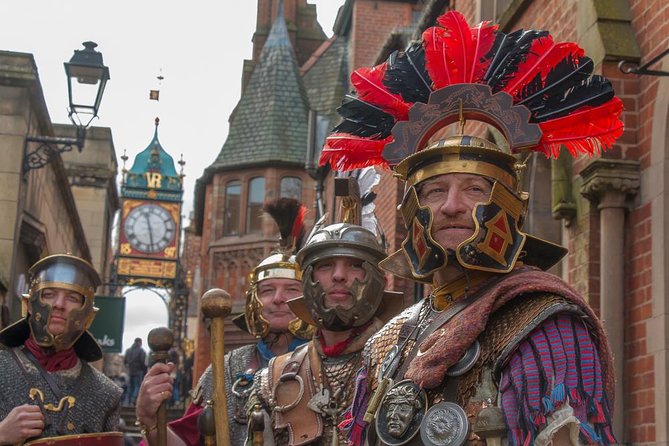
The 90-minute length is one of the tour’s strongest features. It is long enough to cover several sites but short enough for children and for adults combining it with other Chester plans.
You can ask questions as you go, which makes the experience easier for mixed groups. Children may focus on weapons, uniforms, and arena combat, while adults can follow the archaeology and city planning.
The walk has also worked well for a family with a baby, and service animals are allowed. Most people can participate, but this is still an outdoor walk with historic surfaces and at least one basement or cellar section.
The group limit of 15 matters here. A smaller group makes it easier to hear the guide and ask questions. It also gives the presentation a more personal feel than a large city tour.
Is $16.64 good value for 90 minutes?
At $16.64 per person, this is a reasonably priced way to make sense of several Roman sites in one outing. You are paying less for a formal admission package and more for interpretation, route planning, and access to places you might otherwise pass without understanding.
The value is strongest if this is your first visit to Chester. You get a basic map of the Roman city, then you can return to the sites that interest you most.
It is also good value for repeat visitors. Even if you know the amphitheater and walls, the basement remains, military details, and archaeological explanations can add a new layer to familiar streets.
The tour is not designed as a long specialist seminar. If you want extensive discussion of excavation methods, inscriptions, or the full history of Chester from Roman times to today, you will need additional reading or a museum visit. For a focused introduction with strong visual stops, the price is fair.
Timing, weather, and practical planning
The experience lasts about 1 hour and 30 minutes. It is booked, on average, 14 days ahead, so reserve early if your Chester visit falls on a busy date.
The listed meeting point is Chester Town Hall. The information also gives an end address at 23 Little St John Street, while the tour notes say the walk terminates at the Roman Amphitheater and the guide will direct you to your next destination. Because those details do not fully match, check the current end point before you set a tight restaurant, train, or attraction schedule.
Wear shoes suited to city walking. You will spend time outdoors and may encounter uneven ground around historic remains. A waterproof layer is sensible, since the tour requires good weather and may be canceled if conditions are poor.
Free cancellation is available until 24 hours before the start time for a full refund. Cancellations or changes made within 24 hours are not accepted for a refund.
Who should book this Roman Chester tour?
I would choose this walk if you want a compact introduction to Roman Chester, prefer stories to self-guided plaques, or are curious about how ancient remains fit into a modern city.
It suits families, couples, solo visitors, local residents who want to see familiar streets differently, and history fans who enjoy asking questions. The strong guides are a major part of the experience, and names such as Marcus, Julius, Gaius, Faustus, Hippolyta, and Tiberius have all been associated with memorable presentations.
I would think twice if you dislike outdoor tours, need a fully step-free route, or want a long academic treatment of Roman archaeology. The basement section may be difficult for some mobility needs, and the weather can affect the schedule.
Should you book it?
Book this tour if you want 90 minutes of clear, lively Roman history without committing to a full-day activity. The amphitheater, fortress walls, Roman Gardens, hypocaust remains, and basement columns give you a strong range of sights for the price.
The biggest reason to go is the guide. A good Roman soldier-guide turns scattered stones into a story about pay, work, bathing, rank, danger, and daily life. That human detail is what makes Chester’s ancient past easier to remember.
FAQ
Where does the tour start?
The meeting point is Chester Town Hall on Northgate Street, Chester CH1 2HJ, United Kingdom.
How long does the walking tour last?
The tour lasts approximately 1 hour and 30 minutes.
What language is the tour offered in?
The tour is offered in English.
How much does the tour cost?
The listed price is $16.64 per person.
What main Roman sites are included?
The walk includes Chester Roman Amphitheatre, sections of the Roman fortress walls, and Chester Roman Gardens. It also includes explanations of Roman bath remains and a visit to Roman remains beneath a modern cafe.
Is the amphitheater admission included?
Yes. Admission to the Chester Roman Amphitheatre is listed as free.
How many people can join the tour?
The activity has a maximum group size of 15 people.
Can I cancel for a full refund?
Yes. You can cancel at least 24 hours before the start time for a full refund. If poor weather causes the provider to cancel, you will be offered another date or a full refund.
Just added around Chester
- Private Chester Self-Guided Tour★ 4.0 · 23 reviews
- Hello Chester! Private Walking Tour★ 5.0 · 3 reviews
- Haunted Chester and its Ghosts: A Self-Guided Walking Tour★ 5.0 · 19 reviews
- CHESTER: North Wales Adventure – Sightseeing Day Trip Tour★ 4.5 · 137 reviews
- North Wales and Caernarfon Castle day tour from Chester★ 5.0 · 11 reviews
- Medieval Walking Tour of Chester★ 5.0 · 155 reviews
- City Sightseeing Chester Hop-On Hop-Off Bus Tour★ 4.5 · 147 reviews
- Chester Food Tour: Unique Food With Drinks & Sightseeing★ 5.0 · 152 reviews
Walking Tours, compared.

Oxford University Walking Tour With University Alumni Guide
Read our review →
Tour for Muggles The Ultimate Harry Potter Walking Tour in London
Read our review →

Cambridge University Walking Tour by Alumni™ Kings College Option
Read our review →
Blackbeard to Banksy – The Ultimate Walking Tour of Bristol
Read our review →
Air Raid Shelter + St. Nicholas Market Walking Tour
Read our review →
Walking Tour of Bath with Blue Badge Tourist Guide
Read our review →
Changing of the Guard Guided Walking Tour in London
Read our review →Browse the lists this tour appears in