
Reviewed · ATTRACTION TICKETS IN LONDON
Royal Observatory Greenwich & Prime Meridian Entry Ticket London
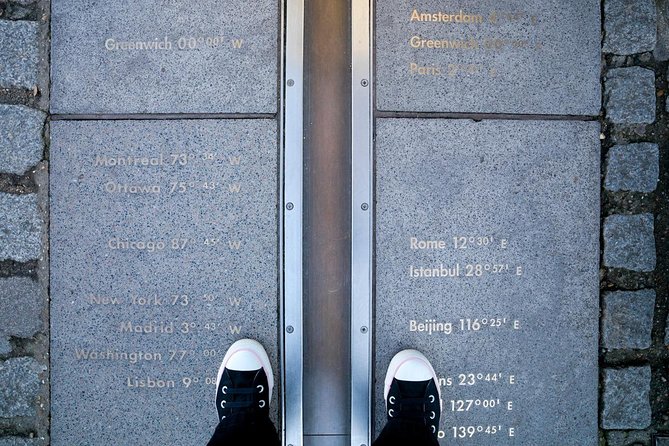
The main attraction here is wonderfully simple: you can stand with one foot in the eastern hemisphere and one in the western hemisphere on the Prime Meridian Line. Then you can step into the observatory where timekeeping, astronomy, and the practical problem of finding your position at sea come together.
I like the strong mix of photo opportunity and serious history. Harrison’s clocks explain how accurate time changed navigation, while the hilltop setting gives you sweeping views across Greenwich Park, the River Thames, and London. The main drawback is the steep walk uphill, followed by stairs and some areas with limited accessibility.
Key points to know before you go

- Stand on the Prime Meridian: Pose in the Meridian Courtyard with one foot east and one west.
- Follow the story of time: See Harrison’s clocks, the Shepherd Gate Clock, and the famous red Time Ball.
- Use the audio guide: The self-guided format lets you move at your own pace and learn about the observatory’s scientists and inventions.
- Allow more than two hours: The observatory itself takes about two hours, but Greenwich Park, the Queen’s House, the National Maritime Museum, and Cutty Sark are close by.
- Prepare for a hill: The observatory sits on a high point in Greenwich Park, and the climb is a real consideration for anyone with limited mobility.
- Book carefully: Admission costs about $33.90 per person, and some people have had trouble with mobile vouchers or barcode scanning at the entrance.
The Prime Meridian is the star of the visit
Start in the Meridian Courtyard, where a metal line marks the historic reference point for longitude. This is the place for the classic photograph, but it is also worth pausing to understand what the line means.
The Prime Meridian divides east from west at longitude zero. Greenwich Mean Time became the reference for world timekeeping, and the observatory helped give the world a common way to measure both time and position. You do not need a specialist interest in astronomy to enjoy this part. The physical act of standing across the line makes an abstract idea easy to grasp.
The courtyard can become crowded, especially soon after opening. If the photograph matters to you, go there first rather than waiting until the end. You can then explore the indoor displays without feeling that you still need to return for the main photo.
The observatory is on a hill in Greenwich Royal Park. The approach gives you excellent views, but the route is steeper than some people expect. The walk from the river can be long, and the final climb may be tiring. If you have mobility concerns, contact the attraction before your visit to discuss the route and available assistance.
More Attraction Tickets in London
- Tower of London and Crown Jewels Exhibition Ticket
★ 4.5 · 6,677 reviews - Thorpe Park Admission Ticket
★ 4.0 · 5,915 reviews - The London Eye Entry Ticket
★ 4.0 · 3,498 reviews
Flamsteed House and the Astronomers Royal

Your ticket takes you into Flamsteed House, the oldest part of the observatory complex. Here you follow in the footsteps of the Astronomers Royal and see the rooms connected with the work of measuring time and studying the sky.
The Octagon Room, designed by Sir Christopher Wren, is one of the best-preserved Wren interiors in London. Its value is not only architectural. This is where the observatory’s work feels connected to real people, instruments, and daily scientific practice rather than just dates on a wall.
The displays introduce major figures linked with the observatory, including John Harrison, Isaac Newton, Edmond Halley, James Bradley, Annie Maunder, George Airy, and Albert Einstein. You will not get the same kind of live, continuous tour you would find at a fully guided attraction. Instead, the audio guide supplies the explanation while you move through the rooms.
That arrangement works well if you prefer to stop when something catches your attention. I also like it for families because you can move at different speeds without holding up a group. The downside is that you must take responsibility for your own visit. If you want a guide who answers questions at every stage, this is not that kind of experience.
Harrison’s clocks explain why time mattered
The clocks made by John Harrison are among the strongest parts of the visit. Their story shows why accurate time was not merely a matter of keeping appointments.
For sailors, knowing the exact time at a known reference point helped calculate longitude. That meant better navigation and fewer risks at sea. Harrison’s inventions helped solve one of the most difficult technical problems of the age, and the displays make the link between clocks, ships, maps, and global travel clear.
I would give these clocks more time than you might expect. The Prime Meridian is the obvious headline, but the clock collection provides the deeper reason Greenwich became so important. The audio guide helps explain how the technology developed and why precision mattered.
Outside, look for the Shepherd Gate Clock. Mounted on the observatory, it was the first clock to show Greenwich Mean Time publicly. It is an easy detail to miss if you are focused only on the indoor rooms, but it helps connect the observatory’s scientific work with ordinary public life.
Time Ball and Great Equatorial Telescope
The bright red Time Ball on top of Flamsteed House is one of the world’s earliest public time signals. It was first used in 1833 and still operates today.
The ball is a practical reminder that the observatory did not keep time only for astronomers. Its signal helped people nearby set their own clocks. Look up as you move around the grounds, since the Time Ball is most impressive when seen as part of the building rather than as an isolated object.
The Great Equatorial Telescope sits inside the observatory’s large onion-shaped dome. It gave astronomers new views of the universe more than a century ago, and the scale of the instrument helps you understand the work that went into observing the sky before modern equipment.
The telescope is also one of the most memorable visual moments of the visit. I would not expect a modern planetarium show from this ticket, however. The main focus is the historic observatory, its instruments, and the development of time measurement. If you want a planetarium experience, check what is separately available before you arrive.
A few more London days out to weigh up
- London Big Bus Hop-On Hop-Off Tour with Optional River Cruise
★ 3.5 · 10,803 reviews - London Small Group Tour of Historical Pubs
★ 5.0 · 10,422 reviews - London Jack the Ripper Guided Tour with Ripper-Vision
★ 4.5 · 4,840 reviews - Tour for Muggles The Ultimate Harry Potter Walking Tour in London
★ 5.0 · 4,684 reviews
The audio guide keeps the visit flexible
The ticket includes a free downloadable audio guide in multiple languages. The supplied information lists 10 languages, while the on-site visit details also describe seven available languages, so check the current options when you arrive.
This is a self-guided experience. You can listen as you walk, pause when you want a closer look, and skip sections that do not interest you. That is useful in crowded rooms, where an audio system can be easier to follow than trying to hear a guide over nearby groups.
Some parts of the observatory may also have volunteer talks or staff explanations. These can add warmth and detail, but they should be treated as an extra rather than the core of the booking. Your reliable plan is the included audio guide and the displays.
Download or open the guide before you are ready to enter if possible. A charged phone and headphones will make the visit easier, especially if you plan to spend the whole day in Greenwich.
London views are part of the ticket

The hilltop position is not just a logistical nuisance. It gives you some of the best open views in this part of London.
From the observatory and Greenwich Park, you can look toward the City of London, the River Thames, and the wider city. On a clear day, the view may be as memorable as the indoor displays. On a wet day, the exposed walk and outdoor sections become less pleasant, so weather matters here more than at a fully indoor museum.
I would plan this visit for a dry or reasonably bright day if you have any choice. Comfortable shoes help, and the walk up from the river should not be treated as a quick level stroll. Once you reach the top, the setting rewards the effort.
The park also gives children room to move after the indoor exhibits. That makes the observatory a better family stop than its technical subject might suggest, provided everyone can manage the climb.
Make it a full Greenwich day

The observatory is only one part of Maritime Greenwich, a UNESCO World Heritage Site. The National Maritime Museum and the Queen’s House are both within a short walk and free to enter.
The National Maritime Museum fits naturally with the observatory because it adds the naval and seafaring side of the story. The Queen’s House brings art and royal history into the same day. You can also visit Cutty Sark, the surviving tea clipper that now operates as a museum and visitor attraction.
A sensible plan is to visit the observatory first, then walk down through Greenwich Park toward the other sights. This gives you the best chance of taking the Prime Meridian photograph before the courtyard grows busy, and it leaves the free museums for later.
You could easily spend a full day in the area rather than treating the ticket as a quick two-hour stop. Add lunch at a Greenwich pub or another local place, then allow time to explore the park and riverside. The observatory ticket gives you a reason to come to Greenwich, but the surrounding sights make the journey more worthwhile.
Getting there and handling the ticket

Transportation to and from the attraction is not included. The observatory is near public transportation, but the final walk still includes the hill. Some people find the route from the river longer and steeper than expected, so allow extra time rather than arriving at the last minute.
The listed price is about $33.90 per person. That is not a bargain if you only want a quick photograph beside the line. It becomes better value when you use the audio guide, explore the historic rooms, see the clocks and telescope, and combine the visit with the free National Maritime Museum and Queen’s House.
The attraction is popular, and advance booking can help you secure entry. However, there have been problems with mobile vouchers, barcode readers, and ticket apps. A few people have had to buy another ticket at the box office after their phone voucher could not be scanned. That is a serious practical concern.
Keep your confirmation available, make sure your phone is charged, and allow time to resolve an issue if the barcode does not read. If the booking platform gives you a choice between a mobile ticket and another delivery method, choose the option you can access easily. The attraction itself has received praise for its staff, but a ticketing problem can sour the start of the visit.
Accessibility, children, and the pace of the visit
Children under four enter free, and children must be accompanied by an adult. Most people can take part, but the hill and stairs deserve careful thought.
Some parts of the attraction are not fully accessible. There is a small lift outside covering one short set of steps, but internal access is limited, and the observatory is not generally an easy wheelchair visit. Contact the attraction before booking if you need assistance planning the route.
For most visitors, two hours is a reasonable estimate for the observatory itself. I would add time for the view, the Prime Meridian photograph, and any outdoor exhibits. If you are interested in clocks, astronomy, or the history of navigation, you may want longer.
The self-guided format suits couples, families, and solo visitors who like to set their own pace. It is less suitable if you want a polished, fully narrated group tour with a guide beside you throughout.
Should you book the Royal Observatory ticket?
Book it if you want to stand on the Prime Meridian and understand why Greenwich became the world’s reference point for time. The strongest parts are the Meridian Courtyard, Harrison’s clocks, the Octagon Room, the Time Ball, and the Great Equatorial Telescope.
I would also book it if you plan to spend a day in Greenwich. The nearby free museums, Queen’s House, Cutty Sark, park, and riverfront make the ticket part of a larger outing rather than an isolated attraction.
Think twice if you have limited mobility, dislike steep hills, or expect a planetarium show or a live guide. Also take care with the mobile voucher and leave room for ticket problems at the entrance.
For most people, the combination of a famous line, strong London views, and real scientific history makes this a worthwhile stop. Just arrive prepared for the climb, use the audio guide, and give the clocks more attention than a quick photograph alone.
FAQ
How long does the Royal Observatory visit take?
The visit lasts approximately two hours. You may want additional time for Greenwich Park, the views, the nearby free museums, and Cutty Sark.
Is the Prime Meridian included in the ticket?
Yes. Admission includes access to the Meridian Courtyard, where you can stand on the Prime Meridian Line with one foot in the eastern hemisphere and one in the western hemisphere.
Is the tour guided by a person?
The experience is mainly self-guided. A free downloadable audio guide is included, and some volunteer talks or staff explanations may be available during your visit.
In which languages is the audio guide available?
The included information describes a multilingual audio guide in up to 10 languages. The on-site details also refer to seven available languages, so check the current language options when you arrive.
Are children under four admitted free?
Yes. Children under four enter free, and children must be accompanied by an adult.
Are the National Maritime Museum and Queen’s House included?
They are not part of the paid observatory admission, but both are nearby and free to visit.
Is transportation included?
No. You must arrange your own transportation to and from the Royal Observatory Greenwich.
Can I cancel for a full refund?
Yes, if you cancel at least 24 hours before the experience start time. Cancellations or changes made less than 24 hours in advance are not eligible for a refund.
Just added around London
- Private Spy Walking Tour of London★ 5.0 · 6 reviews
- London Private Jack The Ripper Tour★ 5.0 · 9 reviews
- Private Shoreditch Street Photography Workshop★ 4.5 · 4 reviews
- Private Sightseeing Walking Tour of The City Of London★ 5.0 · 3 reviews
- Private 2.5 Hour Taxi Tour of London – London’s Greatest Bits!★ 5.0 · 4 reviews
- Private Round Trip Transfer between London Airports and Hotel★ 3.5 · 56 reviews
- Shakespeare London Walking Tour★ 5.0 · 26 reviews
- Private Prison Van Escape Game – London Immersive Experience★ 4.0 · 15 reviews
Attraction Tickets in London, compared.

Tower of London and Crown Jewels Exhibition Ticket
Read our review →




Buckingham Palace Entrance Ticket & Changing of the Guard Tour
Read our review →
London Eye River Cruise and London Eye Ticket Option
Read our review →
Westminster Guided Walking Tour with Abbey Entry
Read our review →Browse the lists this tour appears in