
Reviewed · STRATFORD-UPON-AVON TOURS
The WalkTalkShow.co.uk – Guided Tour of Stratford upon Avon
Stratford-upon-Avon’s story is much bigger than Shakespeare, and this 1.4-kilometre walking tour makes that clear. In about 90 minutes, you move from the Royal Shakespeare Theatre through Tudor streets, old market sites, Shakespeare’s family world, John Harvard’s birthplace, and the medieval Guild Chapel.
I like the way the tour gives you a quick town-wide orientation instead of stopping at one famous house. I also like the guides’ lively approach. Dwayne, Marcus, Glinda, and Krista are praised for clear storytelling, humour, local suggestions, and patience with questions.
The trade-off is simple: this is an introduction, not a full Shakespeare pilgrimage. You see Shakespeare’s New Place and Schoolroom from the outside unless you pay separately for admission, and one review wished the route included Hall’s Croft and more buildings.
Key points at a glance
- Fourteen centuries in 90 minutes: The route connects Stratford’s medieval beginnings, Tudor trade, Shakespeare’s life, and the modern theatre town.
- A compact 1.4km route: You cover many central sights without needing transport, though the tour involves standing and walking on town streets.
- Strong guides make the difference: Dwayne, Marcus, Glinda, and Krista are noted for humour, storytelling, local knowledge, and helpful suggestions after the walk.
- Free sights and paid interiors: The Guild Chapel is free to enter, while Shakespeare’s New Place and Shakespeare’s Schoolroom require separate admission.
- A good first look at Stratford: The tour helps you decide which museums, houses, pubs, and theatres deserve more of your time.
- Small enough to stay personal: The group limit is 24 people, and guides make time for questions.
Why this short walk works in Stratford-upon-Avon
Stratford can feel like two towns at once. One is the Shakespeare pilgrimage, with birthplace museums, theatre crowds, and souvenir shops. The other is an old market town shaped by trade, religion, schooling, farming, and local families.
This WalkTalkShow route links both sides. You hear about William Shakespeare, but you also see where John Shakespeare traded gloves, where livestock was sold, and where John Harvard was born before his name became attached to America’s most famous university.
That wider frame is the tour’s main strength. Shakespeare did not appear in an empty town. He grew up in a prosperous Tudor household, attended the local school, and lived in a place already shaped by several centuries of civic life.
You begin and end at the Royal Shakespeare Theatre on Waterside. That makes the route easy to find and easy to fit into a day of sightseeing. You can also use the walk to decide what to visit next, since the guide explains the importance of sites that you might otherwise pass without noticing.
A few more England days out to weigh up
- Shakespeare Distillery Tour – 1pm Ticket
★ 5.0 · 598 reviews - Shakespeare’s Globe Guided Tour
★ 4.5 · 481 reviews - From London: Shakespeare’s Stratford-upon-Avon Day Trip by Coach
★ 4.5 · 352 reviews
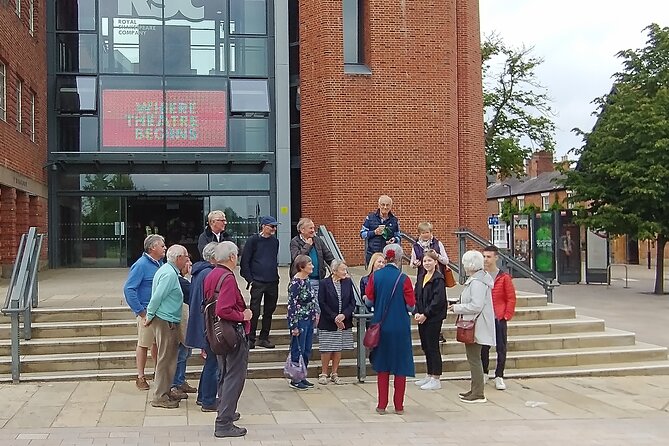
Starting beside the Royal Shakespeare Theatre
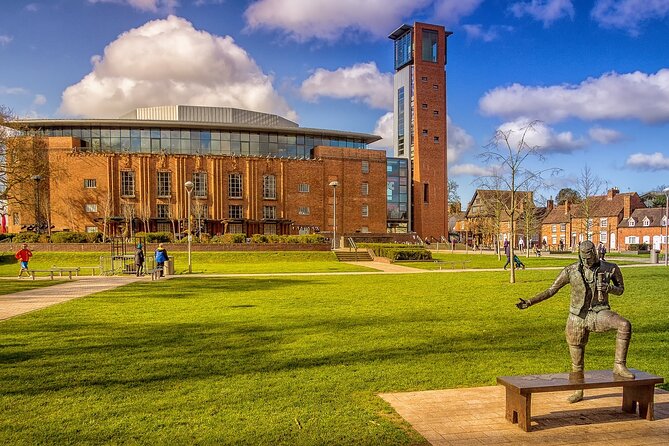
The Royal Shakespeare Theatre is more than a meeting point. It gives the tour a useful opening view of Stratford’s modern identity and its long connection with performance.
The theatre is considered by many actors to be one of the highest points of a stage career. Your guide explains how the theatre complex developed and sets it against the older town around it.
The opening ten minutes are used to introduce Stratford and the overall route. That matters because the tour moves at a brisk pace. You are not given a long museum-style lecture at every stop. Instead, the guide builds a connected story while you walk.
The tour finishes here too. At that point, you can ask questions and get suggestions for the rest of your visit. Guides such as Dwayne and Glinda have been praised for offering ideas about food, drinks, and places to see after the walk.
Market Cross and John Shakespeare’s working town
At Market Cross, you see one of Stratford’s original market halls, dating from about 1500. This is where John Shakespeare, William’s father, traded his artisan gloves.
That small detail helps turn Shakespeare’s family into real people. John was not simply the father of a famous writer. He was a tradesman operating in a busy market town, and the family’s social position was tied to commerce and civic life.
You spend only about five minutes here, so do not expect an in-depth study of the building. The value comes from the connection between the physical site and the family story. You are seeing the sort of place where business was done, goods changed hands, and local reputation mattered.
Shakespeare’s Birthplace and the Tudor family setting
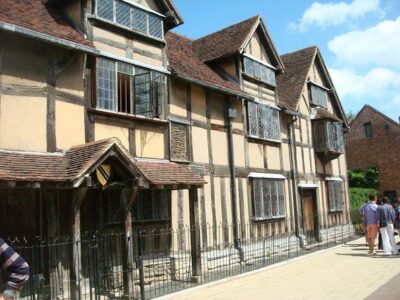
The third stop is Shakespeare’s Birthplace, a house dating from the early 1500s. The tour explains the living conditions of the young William Shakespeare and the advantages of being born into a prosperous Tudor family.
This is an exterior introduction rather than a full museum visit. Admission to the house is not included in the walking tour, so you will need a separate ticket if you want to go inside.
That arrangement is useful if you are still deciding how much time and money to spend on Shakespeare sites. The guide gives you the background first. You can then choose to return for the interior, rather than paying for every attraction without knowing what it adds.
The stop also places Shakespeare in a family and town setting. You learn about his home, his father’s trade, and the social world around him, rather than treating him as an isolated literary figure.
Same part of England, a completely different sort of day:
- Stonehenge, Windsor Castle, and Bath from London
★ 4.5 · 18,662 reviews - London Big Bus Hop-On Hop-Off Tour with Optional River Cruise
★ 3.5 · 10,803 reviews - London Small Group Tour of Historical Pubs
★ 5.0 · 10,422 reviews - Beatles Magical Mystery Tour
★ 5.0 · 9,266 reviews
The American Fountain and Stratford’s market origins
At the American Fountain, the story moves well before Shakespeare. This junction marks the site of Stratford’s livestock market from 1196, when the settlement became a market town.
That date gives you a sense of the town’s age and purpose. Stratford grew through trade and local commerce long before its association with theatre became its main calling card.
Two pubs with Tudor-era origins are also located at this junction. The tour uses them to show that Stratford’s old streets were places for work, food, drink, and social contact, not just preserved backdrops.
The stop lasts about five minutes. It is a quick explanation, but it helps connect the town’s medieval foundation with the buildings and streets you are seeing today.
Bell Court and the everyday side of the town

Bell Court is a brief stop with a simple visual detail: a bell hangs in the main entrance. It was used to call people to the artisan markets.
Today, Bell Court has dining and drinking venues. That contrast makes the site easy to understand. A device once used to draw shoppers toward local markets now sits in a modern commercial setting.
This part of the walk is less about a major monument and more about showing how Stratford continues to adapt. You see the old market function and the current town economy in the same place.
Because this is a short tour, these brief stops work best if you enjoy small details. If you want long periods inside historic buildings, you should allow extra time before or after the walk.
History Corner, Harvard House, and the Garrick Inn

Near the top of Sheep Street, your guide points out what the tour calls History Corner. Several buildings from different centuries are visible from this junction.
The most distinctive connection is John Harvard’s birthplace. Harvard later became the founding figure associated with Harvard University in the United States. Seeing his family home adds another international thread to Stratford’s local story.
You also see the Garrick Inn, a Tudor-era pub. The guide uses the area to explain how several centuries of architecture and town life overlap in a small space.
This is one of the tour’s most useful stops for orientation. You are not only looking at a single famous building. You are learning how to read the street, compare periods, and notice the relationship between homes, pubs, trade, and public life.
The stop lasts around ten minutes, giving the guide more time to answer questions. Marcus is especially noted for turning this kind of historical explanation into an entertaining part of the walk.
Shakespeare’s New Place and the story of success
Shakespeare’s New Place was originally built in 1483. Shakespeare bought the large house in 1597, using it as a retirement home and, according to the tour, the largest house in town.
The building itself no longer survives in its original form, but the site carries an important part of Shakespeare’s story. It shows him not only as a young playwright, but as a successful man with property, status, and a connection to his home town.
The stop lasts about five minutes. Admission is not included, so you should treat this as an introduction to the site. If your main interest is Shakespeare’s personal life, you may want to plan a separate visit.
I find this stop valuable because it complicates the usual image of Shakespeare. You are not only following the writer’s early years. You are also seeing the result of his career and the place he chose to return to.
The Guild Chapel and Shakespeare’s education
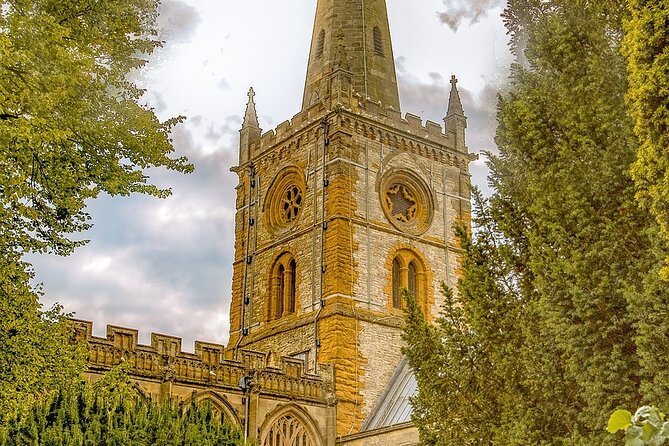
Near the end of the route, you visit the Guild Chapel, which dates from 1269 and formed part of the town’s original seat of power.
The chapel is free to enter, making it one of the strongest included stops for visitors watching their budget. It also offers a change of mood after the busy commercial streets. The guide explains its place in Stratford’s civic and religious story.
Next door is Shakespeare’s Schoolroom and Guildhall. The local guild was founded in 1269 and established a school in 1295. William Shakespeare attended the school in the late 1500s, receiving the education that shaped his early life.
Admission to the Schoolroom is not included. The tour shows you the location and explains why it matters, while a separate visit lets you explore the living museum inside.
The school connection is one of the clearest ways the walk links Shakespeare to Stratford. You see where his education fitted into the town’s existing institutions, rather than treating his childhood as a collection of isolated biographical facts.
Chapel Lane and the school that continues today
The walk pauses briefly on Chapel Lane to look at King Edward the Sixth Grammar School.
The present school is modern, but it represents the continuation of the institution that began with the Guild school in 1295. That gives you a useful link between medieval Stratford, Shakespeare’s education, and the town today.
This is a quick stop, not a school tour. You will not be entering the school as part of the experience. Still, it helps explain that Shakespeare’s educational connection is not only a museum display. The school has continued in another form.
The Swan Theatre and the return to Waterside
The final major stop is the Swan Theatre. Your guide explains the history of the theatre complex and why only the facade of the original Shakespeare Memorial Theatre survives.
That detail brings the story full circle. You began at the Royal Shakespeare Theatre, a modern institution with an international reputation, and now you are looking at the remains of an earlier stage in the town’s theatre history.
The stop lasts about ten minutes. It is a good place to ask about performances, the theatre complex, and how Stratford’s modern cultural identity grew from its Shakespeare connection.
You then return to the Royal Shakespeare Theatre, where the activity ends. The walk covers roughly 1.4 kilometres, so the route is compact rather than strenuous, but you should still wear comfortable shoes and be ready to keep moving between stops.
What the guides add to the experience
The guide is the most important variable on this tour. The named guides include Dwayne, also spelled Duane in some comments, Marcus, Glinda, and Krista.
Dwayne is praised for humour, energy, and a gift for making Shakespeare’s family feel less distant. Marcus brings a strong command of Stratford and wider British history, while Glinda is described as warm, entertaining, attentive to questions, and good at managing a group on crowded streets. Krista is praised for keeping the information clear and holding attention.
The consistent pattern is storytelling with humour rather than a dry list of dates. That suits Stratford, where the best information often comes from linking a building to a person, trade, school, or event.
You should also feel free to ask questions. Several guides are noted for taking time with them and giving suggestions for what to do after the tour. That can be especially useful if this is your first visit and you have not yet decided which Shakespeare attractions deserve an admission fee.
Price, group size, and practical value
At $16.47 per person, the tour is inexpensive for a 90-minute guided introduction. You are paying for a central route, a live guide, and context that would take time to assemble on your own.
The value is strongest if you are new to Stratford. In a short period, you get a map of the town’s main stories and a better sense of where to spend the rest of your day.
The group maximum is 24 people. That is not a private tour, but it is small enough for a guide to keep the group together and handle questions. One guide has been praised for managing streets packed with visitors, which matters in the central areas.
The tour has a mobile ticket, and service animals are allowed. It is near public transportation, and most people can take part. Good weather is required. If poor weather cancels the walk, you are offered another date or a full refund.
You can cancel for a full refund up to 24 hours before the start time. Changes or cancellations inside that period are not accepted, so check your plans before the deadline.
Who should book this Stratford walking tour?
I would choose this tour if you want a first look at Stratford before committing to several paid attractions. It suits history fans, Shakespeare newcomers, families with mixed interests, and anyone who prefers a guide to explain what they are seeing as they walk.
It is also a good fit if your time in town is limited. The route is short, central, and focused. You see many key locations without spending half a day inside one museum.
I would be more cautious if you want extensive interior visits. The Birthplace, New Place, and Schoolroom are introduced but not included as admission experiences. You should add separate visits and extra time if those are central to your plans.
The tour may also feel too compressed if you prefer slow photography stops or long discussions at each building. The short route covers a lot, but it does not attempt to include every historic house. Hall’s Croft and other sites are outside the route, so you should plan them separately.
Should you book it?
Book it if you want an affordable, lively orientation that connects Shakespeare with the older town around him. The strongest reasons are the compact route, the range of subjects, and guides such as Dwayne, Marcus, Glinda, and Krista, who bring humour and useful local context.
Skip it only if you already know Stratford well or want a tour devoted almost entirely to interiors and Shakespeare’s plays. For most first-time visitors, this is a sensible way to get your bearings, learn which sites matter, and make the rest of your Stratford visit more rewarding.
FAQ
How long does the Stratford walking tour last?
The tour lasts approximately 1 hour and 30 minutes.
Where does the tour start and finish?
It starts at the Royal Shakespeare Theatre on Waterside in Stratford-upon-Avon and ends back at the same meeting point.
How far does the walking route cover?
The route is approximately 1.4 kilometres and includes about a dozen stops.
Is admission to Shakespeare’s Birthplace included?
The tour introduces Shakespeare’s Birthplace from the outside, but admission to the house is not included.
Are any attractions included at no extra cost?
The Guild Chapel is free to enter. Admission to Shakespeare’s New Place and Shakespeare’s Schoolroom is not included.
What happens if the tour is canceled because of bad weather?
You are offered a different date or a full refund if poor weather causes the tour to be canceled.
Just added around England
- London Private Jack The Ripper Tour★ 5.0 · 9 reviews
- Private Spy Walking Tour of London★ 5.0 · 6 reviews
- Private Shoreditch Street Photography Workshop★ 4.5 · 4 reviews
- Private Sightseeing Walking Tour of The City Of London★ 5.0 · 3 reviews
- Private 2.5 Hour Taxi Tour of London – London’s Greatest Bits!★ 5.0 · 4 reviews
- Private Round Trip Transfer between London Airports and Hotel★ 3.5 · 56 reviews
- London to Southampton Cruise Port Including Stonehenge★ 5.0 · 13 reviews
- Shakespeare London Walking Tour★ 5.0 · 26 reviews
Stratford-upon-Avon Tours, compared.

Shakespeare’s Stratford-upon-Avon Day Trip by Coach
Read our review →
The Sinister Side of Shakespeare’s Stratford Walking Tour
Read our review →
City Sightseeing Stratford-upon-Avon Hop-On Hop-Off Bus Tour
Read our review →
Shakespeare’s Schoolroom & Guildhall Entry Ticket and Tour
Read our review →
Private Day Tour to Stratford-Upon-Avon – All things Shakespeare
Read our review →Browse the lists this tour appears in