
Reviewed · MUSEUMS
Explore Biblical Artifacts at the British Museum
The most useful thing about this British Museum tour is the link between objects and text. Instead of seeing an Assyrian king, a Roman coin, or an Egyptian statue as an isolated museum piece, David places it in a Bible timeline and points you to the related passage. Moses, Jonah, Hezekiah, Jesus, and Paul become part of a visible historical setting.
I like the small group size, capped at 10, and the practical study help: a Google Doc with notes and Bible verses, plus advice on using a Bible app offline. I also like the optional folding stools, since three or four hours on hard museum floors can wear you down. The main drawback is focus: this is a Bible-centered tour, not a broad British Museum highlights tour, and the price is $77.50 even though museum admission itself is free.
Key points to know before you book
- David connects artifacts directly to Bible passages, using a clear timeline rather than presenting random objects.
- The route covers Egyptian, Assyrian, Greek, Roman, Persian, and Babylonian material, with the final galleries shaped by time and group interest.
- The maximum group size is 10, which helps with questions and movement through busy rooms.
- Plan on three to four hours, though a small group with many questions may stay longer.
- Folding stools are available, a useful detail for anyone who dislikes standing through a long museum visit.
- The $77.50 fee pays for interpretation and structure, not museum entry, which is free.
Why the biblical approach changes the museum visit
The British Museum can feel like a huge collection of disconnected civilizations. You may see Egypt in one room, Assyria in another, Greece around the corner, and Rome upstairs, with little sense of how those worlds relate to the Bible.
David’s method gives you a thread to follow. He begins with a historical framework, then moves through the displays in an order that helps you place rulers, empires, prophets, and New Testament figures. This matters because biblical names and events can feel distant when read on a page. An inscription, statue, coin, or relief gives that reading a physical setting.
The tour is especially useful if you already read the Bible and want more historical context. You will frequently stop to look up a passage, connect it to an object, and discuss what the museum can show and what it cannot prove. That distinction matters. The experience uses artifacts to illuminate the world of the Bible, but it is not an archaeology lecture designed to settle every question of faith or history.
It also works for people who are curious about biblical culture without sharing the guide’s religious viewpoint. David presents the museum through a biblical lens, so you should expect Scripture to remain central throughout. If you prefer a strictly secular or art-history tour, this will not be the right fit.
More museums and galleries in London:
- Tower of London and Crown Jewels Exhibition Ticket
★ 4.5 · 6,677 reviews - Chelsea FC Stadium Tours and Museum
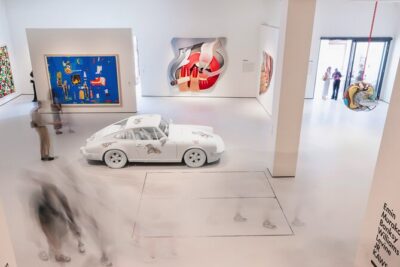
★ 5.0 · 1,908 reviews - Official tickets: Moco Modern & Contemporary Art Museum
★ 4.5 · 1,157 reviews
Egyptian galleries: beginning with Joseph and Moses
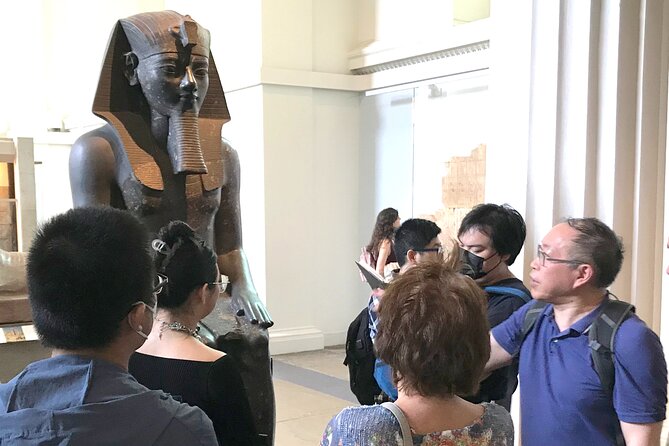
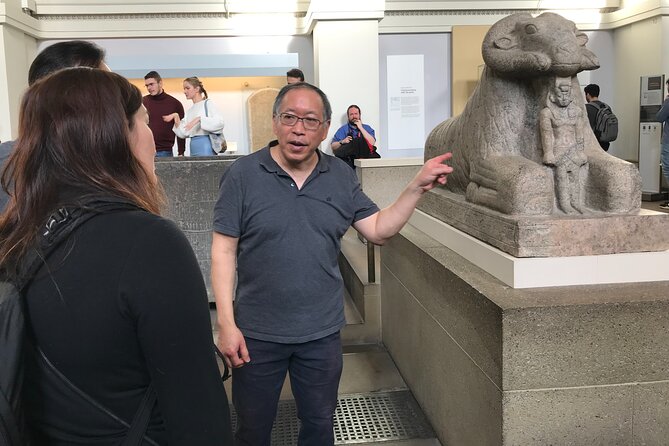
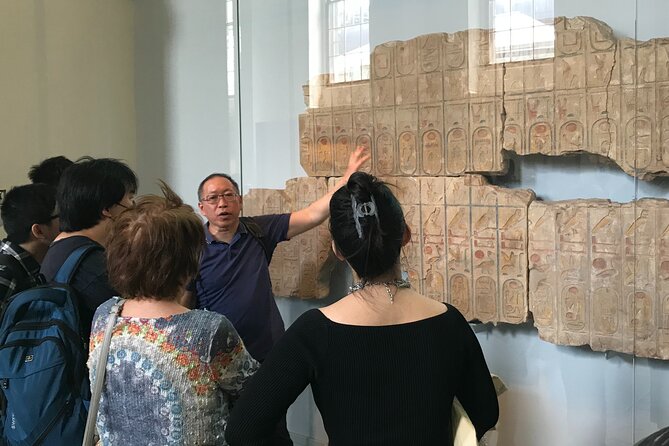
The tour starts on the ground floor in the Egyptian galleries. This is a strong opening because the displays provide an early setting for stories connected with Joseph and Moses.
You will see statues of famous pharaohs and other large Egyptian objects while David explains where Egypt fits into the wider Bible timeline. The value here is not just the size or age of the statues. It is the attempt to place the biblical narrative beside the political and cultural world of ancient Egypt.
David’s preparation appears to be especially useful at this point. Before or around the start of the tour, you receive access to study notes and Bible references. A Bible app that works without an internet connection, such as YouVersion, is recommended. That is practical inside a museum, where you do not want to rely on a signal every time you need to check a passage.
This portion may appeal most to readers who like names, dates, and sequence. It gives you a base for understanding how later Assyrian, Babylonian, Persian, Greek, and Roman material fits into the story. You are not simply looking at Egypt as a separate culture. You are seeing it as one part of the historical setting in which biblical events are placed.
Assyrian lamassu and the world of Jonah and Hezekiah
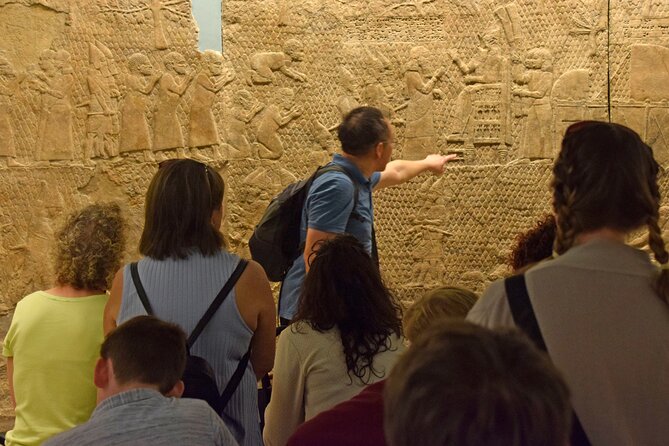
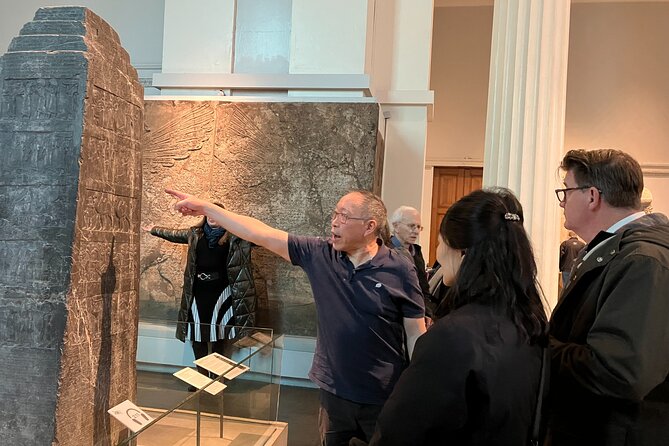
The Assyrian galleries offer some of the tour’s most memorable sights. The 40-ton lamassu, winged human-headed beasts, are hard to ignore. Their scale gives you an immediate sense of Assyrian power, even before David explains the political world behind them.
This is where the tour connects museum objects with figures such as Jonah, Ahab, and Hezekiah. The Assyrian displays can make the Old Testament’s references to kings and empires easier to picture. Names that once seemed like a long list begin to represent actual rulers, armies, and imperial ambitions.
David’s strength, as described by the experience, is his ability to make a timeline understandable. He does not just point at a relief and recite its label. He explains how different rulers fit together and how their actions relate to biblical passages.
Pay attention to the smaller details as well as the grand sculptures. The tour can include features such as writing direction, details on bronze bands from city gates, and other points you might pass without noticing on your own. Those details are useful because they show how much context a guide can add to a museum visit.
This section may be the best match for you if Old Testament history is your main interest. It can also be intense. The museum has many objects, and the guide covers a lot of material. Bring the study notes, listen for the main timeline, and do not worry if you cannot retain every name.
Greek galleries and the setting of Paul’s world
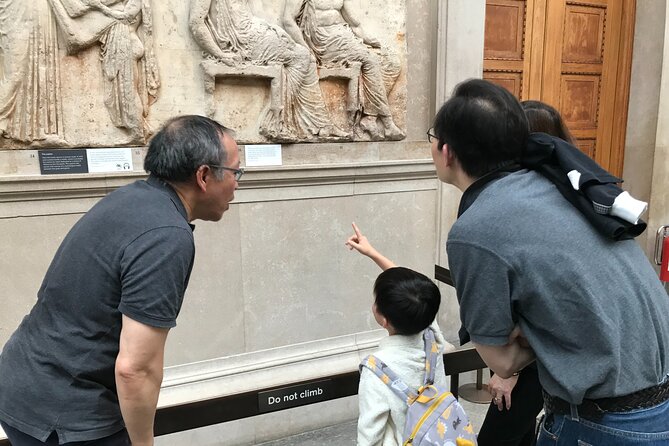
The Greek galleries bring a different tone to the tour. Here you see the Parthenon sculptures from Athens and consider the wider Greek world connected with Paul.
The sculptures are famous for their artistic importance, but this tour asks you to consider them as part of the cultural setting in which the New Testament developed. Greek language and culture shaped the eastern Mediterranean, and Paul’s travels took place across a world where Greek influence remained important.
The focus is not a standard art-history talk about the Parthenon. You will hear how Greek objects fit into the biblical timeline and how Paul relates to the Greek world. That approach can be particularly helpful if you know Paul mainly through his letters and want a better sense of the civilizations surrounding his work.
The Greek galleries also show the limits of a half-day visit. The British Museum contains far more than any guide can cover in several hours. David has to choose what supports the biblical theme, so you will not receive an even survey of every Greek display.
I see that as a fair trade if your goal is Scripture and ancient history. If your priority is Greek sculpture, Egyptian art, or the Parthenon marbles alone, a specialist art tour would likely serve you better.
A few more London days out to weigh up
- London Big Bus Hop-On Hop-Off Tour with Optional River Cruise
★ 3.5 · 10,803 reviews - London Small Group Tour of Historical Pubs
★ 5.0 · 10,422 reviews - Thorpe Park Admission Ticket
★ 4.0 · 5,915 reviews - London Jack the Ripper Guided Tour with Ripper-Vision
★ 4.5 · 4,840 reviews
The break and the move upstairs to Rome
After the ground-floor galleries, the group takes a break before heading upstairs to the Roman rooms. This pause is welcome. Three hours in a museum requires a little pacing, especially if you are standing, reading labels, and following a detailed explanation.
The optional folding stools are one of the smartest practical features. You can find them at the museum and take one along if you prefer to sit while David speaks. I would use one. It lets you pay attention to the explanation instead of thinking about your feet, and it can help older children or anyone who tires easily.
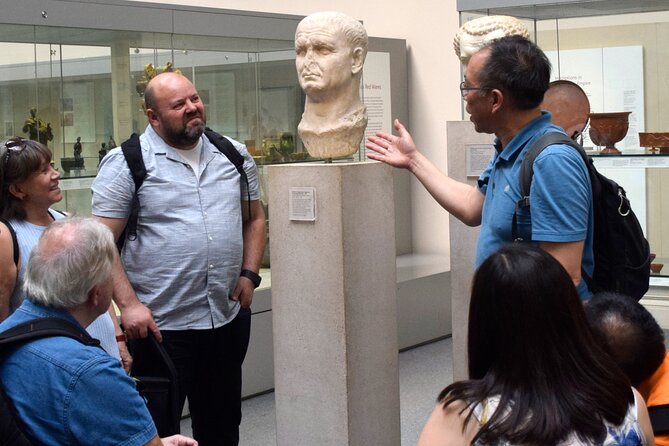
The route then shifts to the Roman galleries. This part focuses on Roman emperors and objects connected more directly with Jesus and Paul. The transition from Old Testament kingdoms to Roman rule gives the tour a clear historical arc.
The Roman material can make the New Testament feel more concrete. You may see coins showing the faces of rulers who were present in the political world surrounding Jesus’ crucifixion. The point is not that a particular coin proves every detail of a Gospel account. The value is that Rome becomes a physical society with named emperors, money, power, and public imagery.
For many people, this is the emotional high point of the tour. The earlier galleries establish the Old Testament setting, while Rome brings you closer to the world of Jesus and Paul. David also uses the Roman rooms to show how the biblical timeline progresses rather than treating the Old and New Testaments as separate subjects.
Persia and Babylon when time allows
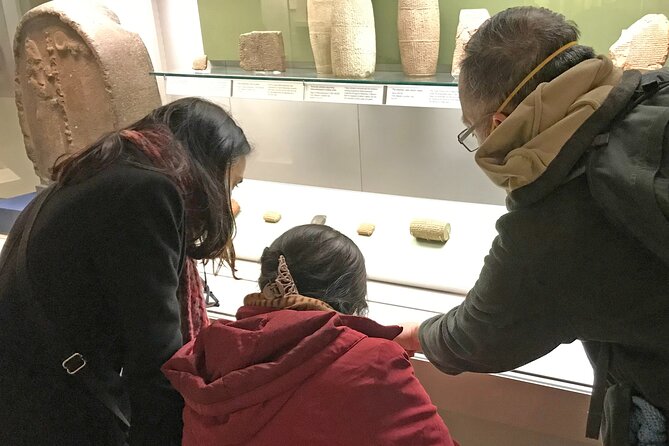
Persia and Babylon may be added if time permits and if the group wants them. That flexibility is helpful because it lets David respond to the pace of the group, gallery hours, and the interests of the people in front of him.
The Persian and Babylonian material helps fill in important sections of the Old Testament timeline. It also gives you a chance to see how different empires replaced one another. If you are especially interested in exile, kings, and the shifting power of ancient Near Eastern states, ask about these rooms early.
Do not assume you will receive equal time in every culture. The advertised experience lasts roughly three to four hours, so the exact balance depends on the group and the available time. One small group stayed close to five hours because of questions and discussion, but that should be treated as an unusually long visit rather than the standard schedule.
This is one reason the tour is best placed as a half-day activity. You can give it a morning or afternoon, then leave the rest of your day open for another part of London. If you want a full museum day, you may need to return later on your own.
David’s teaching style and the value of preparation
David is the named guide, and the experience places a great deal of weight on his teaching. He is described as funny, energetic, articulate, and strongly informed about both Scripture and the museum collection. He also sends practical information before the tour and may provide follow-up material afterward.
That preparation is not busywork. Read the Google Doc if you have time. It contains study notes and related Bible verses that give you a basic map before you enter the museum. You do not need to memorize it. Even a quick look can help you recognize the names and passages David refers to.
Bring or download a Bible app that works in airplane mode. The tour may involve looking up passages as you stand beside an object, and offline access removes one small but needless problem.
The small group limit of 10 is important. You can ask questions without turning the tour into a lecture for a crowd, and David can adjust the route or explanation to the group’s interests. That also helps with museum movement, though the British Museum can still be busy and some rooms may feel warm.
The tour may suit older children and teenagers, especially those who enjoy stories, history, or clear connections between objects and texts. Younger children may find three or four hours tiring. The warm galleries and long period on foot are worth considering for any child.
Is $77.50 a fair price?
The British Museum does not charge general admission, so the $77.50 price is for the guided experience, planning, interpretation, and small-group format. That makes the fee a serious purchase rather than an automatic bargain.
I think the value depends on how you would use the museum without a guide. If you are comfortable planning a route, reading labels, checking Bible passages, and building your own timeline, you can visit the museum free of charge and spend nothing beyond your time.
If you want someone to connect the objects for you, the fee is easier to justify. The tour turns several separate gallery visits into one organized narrative. It also saves you from trying to locate the most relevant objects in a very large museum.
Group discounts may improve the value for families or church groups. The maximum group size is 10, and the experience is offered in English with mobile ticketing. Free cancellation is available up to 24 hours before the start time, but changes or cancellations inside that window are not accepted for a refund.
Book it for a day when you are rested. The tour is not recommended immediately after a long-haul flight, and that advice makes sense. You need enough attention to follow names, dates, Bible references, and movement through several galleries.
Who will get the most from this tour?
You are a strong match if you want to:
- Connect Bible passages with real objects from ancient Egypt, Assyria, Greece, Persia, Babylon, and Rome.
- See the British Museum through a Christian or biblical framework.
- Study the Old Testament timeline and the world of Jesus and Paul.
- Ask questions in a small group rather than follow a large guided walk.
- Use a half-day in London for a focused cultural experience.
- Bring older children or teenagers who can handle several hours of museum time.
You may want a different visit if you prefer to wander without a set theme, concentrate on art rather than Scripture, or see a wider range of the British Museum’s collection. This tour leaves many famous galleries untouched because it follows a specific purpose.
The meeting point is the British Museum on Great Russell Street, and the tour finishes there. The museum is near public transportation, service animals are allowed, and most people can participate. You should still plan for a long period indoors and consider using a folding stool.
Should you book Explore Biblical Artifacts?
Book this tour if the Bible is central to your interest in ancient history and you want help turning museum objects into a connected story. David’s timeline, Scripture references, and close knowledge of the displays are the main reasons to choose it.
I would not book it simply because you want a quick first look at the British Museum. For that, free entry and a self-guided route may be enough. But if you want to understand how Egyptian, Assyrian, Greek, and Roman objects relate to biblical people and events, the focused approach can make a huge museum far easier to follow.
Allow at least three to four hours, read the study notes first, download an offline Bible app, and arrive rested. If those conditions suit you, this is a thoughtful way to spend half a day in London.
FAQ
How long does the tour last?
The experience lasts approximately three to four hours. A small group with many questions may spend longer, but that is not the standard planned duration.
What does the $77.50 price include?
The price is for the guided experience. General admission to the British Museum is free, so the fee pays for David’s guidance, planning, interpretation, and small-group format.
Who leads the tour?
The guide is David. He leads the route, explains the historical timeline, connects objects with Bible passages, and provides study material before the visit.
Which museum galleries are included?
The planned route begins with the Egyptian, Assyrian, and Greek galleries on the ground floor, then continues upstairs to the Roman galleries. Persia and Babylon may be included if time and group preference allow.
Is the tour suitable for children and teenagers?
The experience can work for older children and teenagers. The full visit lasts several hours, and some galleries may feel warm, so younger children or anyone who tires easily may find it demanding.
Can I sit during the tour?
Optional folding stools are available at the museum for you to take along. They can make the long period of standing more comfortable.
What is the cancellation policy?
You can cancel up to 24 hours before the start time for a full refund. Cancellations or changes made less than 24 hours before the start time are not accepted for a refund.
Just added around London
- London Private Jack The Ripper Tour★ 5.0 · 9 reviews
- Private Spy Walking Tour of London★ 5.0 · 6 reviews
- Private Shoreditch Street Photography Workshop★ 4.5 · 4 reviews
- Private Sightseeing Walking Tour of The City Of London★ 5.0 · 3 reviews
- Private 2.5 Hour Taxi Tour of London – London’s Greatest Bits!★ 5.0 · 4 reviews
- Private Round Trip Transfer between London Airports and Hotel★ 3.5 · 56 reviews
- Shakespeare London Walking Tour★ 5.0 · 26 reviews
- Private Prison Van Escape Game – London Immersive Experience★ 4.0 · 15 reviews
Museums, compared.

Tower of London and Crown Jewels Exhibition Ticket
Read our review →
Official tickets: Moco Modern & Contemporary Art Museum
Read our review →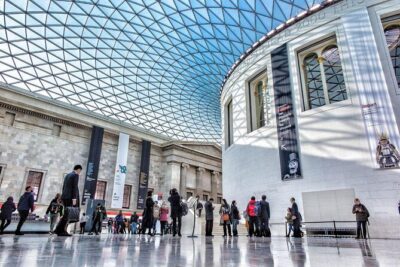
British Museum London Guided Tour Semi-Private 8ppl Max
Read our review →
The British Museum London – Exclusive Guided Museum Tour
Read our review →
Skip the Line: Liverpool Beatles Museum – The perfect tribute to the Beatles
Read our review →Browse the lists this tour appears in