
Reviewed · HISTORICAL TOURS
History of London Photography Tour
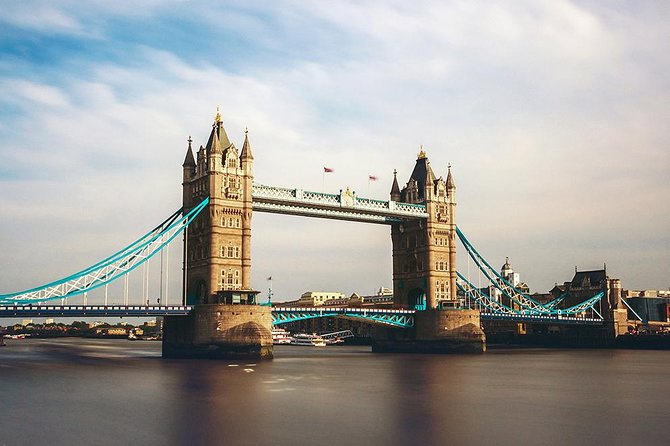
London is at its most rewarding when you stop chasing postcard views and start noticing how old churches, financial buildings, memorials, and bridges fit together. This two-hour photography walk moves from St. Mary Woolnoth through the City of London to Tate Modern, with St. Paul’s Cathedral, Millennium Bridge, and Tower Bridge providing the big visual moments.
I like the practical camera coaching, especially for beginners who need help leaving automatic settings behind. I also like the mix of familiar landmarks and less obvious street views, plus the historical detail that gives each photograph a reason to exist. The main drawback is pace: ten stops in about two hours leaves limited time for patient tripod work, long exposures, or a truly offbeat route.
Key points to know
- Start at St. Mary Woolnoth: Meet outside this historic church in the financial district, close to Bank station and public transport.
- Richard may lead the walk: He has helped photographers with camera settings, composition, and technique in a friendly, relaxed way.
- Ten major stops in two hours: Expect a brisk walking tour rather than a slow, highly specialized photo workshop.
- A useful mix of subjects: Photograph churches, grand civic buildings, a war memorial, bridges, the Thames, and Tate Modern.
- Suitable for mixed abilities: The group can include complete beginners, phone photographers, and people refreshing old SLR skills.
- Plan for the weather: The tour needs good conditions and may be rescheduled or refunded if poor weather causes cancellation.
From Roman worship to modern city towers
The walk begins at St. Mary Woolnoth, a church with an unusually long story beneath its present walls. Evidence of Roman and pagan religious buildings has been found under the foundations, and worship has taken place here for at least 2,000 years. The current church was rebuilt in 1727 to designs commissioned from Nicholas Hawksmoor.
That gives you an excellent first exercise: look for shape, shadow, and detail rather than simply pointing your camera at the façade. Hawksmoor’s work offers strong lines and a formal presence, while the surrounding financial district places old religious architecture beside modern office buildings.
The church is free to enter, but the tour is mainly an outdoor photography experience. I would not expect a long interior session or time for quiet architectural study. The ten-minute stop is enough to frame the building and hear its background, but you will need to work with purpose.
More Historical Tours in London
- London Small Group Tour of Historical Pubs
★ 5.0 · 10,422 reviews - Soho Music & Historic Pubs Tour
★ 5.0 · 1,993 reviews - Royal Historic Pubs Walking Guided Tour in London
★ 5.0 · 803 reviews
Royal Exchange and Bank of England: grand architecture in tight spaces
From St. Mary Woolnoth, the route reaches the Royal Exchange. This is a good place to think about scale and perspective. The building has the formal look expected from one of London’s historic centers of commerce, and your guide can help you decide how much of the façade to include and where to stand.
The nearby Bank of England provides another architectural subject, with a different visual mood. Its history and imposing design make it more than a quick landmark snapshot. You can use this stop to compare symmetry, repeating features, columns, and changing light on stone.
The Royal Exchange and Bank of England are close together, so these stops are efficient rather than leisurely. Ten minutes at the Royal Exchange and fifteen at the Bank of England should give you time to make several attempts, but not enough for elaborate equipment changes. That suits a walking class focused on useful habits rather than a technical masterclass.
Guildhall gives the route a medieval turn
Guildhall changes the feel of the walk. The building is about 800 years old, and its Gothic character provides a clear contrast with the City’s commercial buildings. You can look for pointed arches, vertical lines, carved detail, and darker tones that photograph differently from the pale, open façades around the Royal Exchange.
This fifteen-minute stop is one of the better places to apply composition advice. A professional guide can help you decide whether to frame the whole building, isolate a detail, or use nearby streets to create depth. The tour’s value is strongest here when you move beyond taking a record shot and start making a deliberate image.
You should keep your expectations sensible. The route is designed for accessible city photography, not private access or specialist architectural photography. Guildhall is a major London sight, so this is not a secret corner known only to photographers.
St. Mary-le-Bow and the Cockney connection
At St. Mary-le-Bow, the guide adds a distinctly London story. Tradition says that true Cockneys are born within earshot of the church bells. That local detail gives the stop some personality, especially if you are tired of hearing only dates and building names.
The church also offers another chance to practise photographing a vertical subject in a crowded urban setting. Ten minutes will pass quickly, so listen for the guide’s suggested angles and be ready to shoot. If you are using a phone, this is a useful moment to try a wider view and a closer architectural detail rather than relying on one frame.
More photo shoots in London:
- Professional Photoshoot in London Photographer
★ 5.0 · 102 reviews - Private landmarks photoshoot for families and couples
★ 5.0 · 92 reviews - London: Private Landmarks with a Professional Photographer
★ 5.0 · 30 reviews - Private Night Photography Tour in London
★ 5.0 · 29 reviews
St. Paul’s Cathedral is the visual centerpiece
St. Paul’s receives the longest stop, twenty minutes, and it deserves it. Sir Christopher Wren’s cathedral is one of London’s defining buildings, and the tour adds several historical references that make the subject more than a familiar dome.
St. Paul’s witnessed the 1501 marriage of Catherine of Aragon to Prince Arthur. Queen Elizabeth I visited after the defeat of the Spanish Armada in 1588. The site is also linked to the punishment of Guy Fawkes and his fellow conspirators after the Gunpowder Plot.
You will not be taking part in a cathedral entry visit on this walk, and admission is not included as a separate attraction. The focus is on views and photography advice from outside. That is important when judging the price. You are paying for guided instruction, a planned route, and historical interpretation, not entry to London’s major paid sights.
The twenty-minute window is long enough to try more than one composition. You might work with the dome, the surrounding street, or the relationship between the cathedral and modern buildings. If you have been using automatic settings, this is a useful place to test exposure and framing under your guide’s direction.
The Firefighters Memorial adds human scale
The National Firefighters Memorial provides a welcome change from monumental architecture. Sculptor John Mills created the monument to honor the professional firefighters, men, and women who helped London through the Blitz. Winston Churchill called them heroes with grimy faces.
This stop gives you a subject with movement and emotion rather than only stone and glass. The monument sits among major London landmarks, so you can frame the figures against the city behind them. That contrast can produce a more personal photograph than another full-building view.
The stop lasts ten minutes. It is enough to understand the memorial and try a few compositions, but not enough for an extended documentary session. Still, it helps keep the route from becoming a parade of façades.
Millennium Bridge links two strong photo subjects
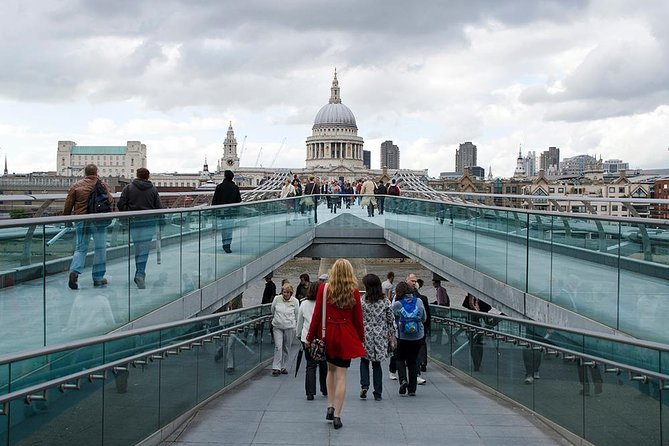
The 325-metre Millennium Bridge crosses the Thames between Tate Modern and the City of London, with St. Paul’s Cathedral nearby. Opened on June 10, 2000, it is one of the clearest places on the route to combine modern engineering with older London architecture.
This is where your guide’s advice about lines and perspective can become especially useful. The bridge gives you strong directional shapes, while the river and skyline add depth. Depending on your position, you can work with the bridge structure, St. Paul’s, the water, or the buildings on either bank.
The stop is listed at ten minutes, so the group will need to keep moving. A maximum of 18 people is not enormous, but it is large enough that you may need patience when several photographers want the same viewpoint. Bring a camera strap and keep your equipment easy to reach.
Tower Bridge and Thames views
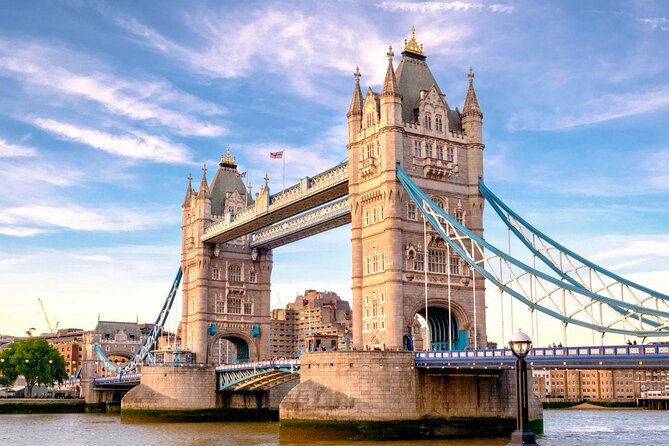
The route continues to views of the Thames and Tower Bridge. This is the most immediately recognizable bridge on the walk, and it gives you the chance to try a wider city composition rather than concentrating on one building.
The information provided does not promise entry to Tower Bridge or a long riverside session. Treat it as a viewpoint stop, with guidance on making the most of the panorama. Ten minutes can work well for a quick series of frames, especially if the light is kind, but it is not enough to wait around for a particular sunset or changing sky.
That limitation matters to serious photographers. If your main goal is a carefully timed bridge image, a self-guided return visit may be worthwhile. If you want to learn how to find and frame the view, this stop fits the tour’s purpose.
Tate Modern finishes with industrial scale
The walk ends at Tate Modern, housed in the former Bankside Power Station. Sir Giles Gilbert Scott designed the power station, and its tall brick exterior gives you a strong final subject with a very different look from the churches and civic buildings earlier in the day.
Tate Modern is Britain’s national gallery of international modern art, but entry to the museum is not part of this photography tour. The building itself is the focus. Its mass, brickwork, and position on the South Bank make it a natural closing image.
Ending here is practical. You can continue along the South Bank, visit the museum separately, or use public transport from the area. Because the route finishes at a major attraction, the tour works well as part of a larger London sightseeing day.
What the photography coaching is really worth
The strongest reason to book is the chance to get direct help from a professional photographer while working in real city conditions. Richard, identified as one of the tour leaders, has helped people adjust camera settings before setting off and has supported mixed groups with different skill levels.
That range is important. You do not need to arrive with advanced technical knowledge. The experience can help if you have become lazy with automatic settings on an SLR, are new to London photography, or simply want someone to suggest a better angle.
You can bring a camera phone, but you will get more from the session if you bring a camera with settings you can control. The tour does not provide photography equipment. A phone user can still practise framing, perspective, and timing, but do not book expecting to borrow a professional camera.
The teaching style appears relaxed and encouraging rather than formal. That is good for a first lesson, and it helps avoid the stiff feeling of a technical course. It also means the depth of instruction may depend on the group, the guide, and the questions you ask.
Price, group size, and the two-hour tradeoff
At $71.63 per person, the cost is reasonable if you want both sightseeing and basic photography instruction. You are not just paying to be led from one famous building to another. The fee covers a professional guide, historical explanation, suggested photo opportunities, and help with camera technique.
The value is less convincing if you already know your camera well and mainly want rare, little-seen locations. One dissatisfied participant expected more unusual views and found the route too focused on standard tourist sights. That is a fair caution. This walk offers fresh angles on famous places, but it does not promise a secret London.
The two-hour length keeps the commitment manageable, especially for a first day in the city. The tradeoff is a brisk schedule. Ten stops, plus the walking between them, leaves little room for waiting on ideal light or making many versions of each image.
The group can include up to 18 people. That size allows some personal help, but it is not the same as a private lesson. If you want one-to-one attention throughout, this may feel too broad. If you like a social class with people at different levels, the mix can work well.
Who should book this London photo walk?
I would recommend it to:
- First-time London visitors who want context along with photographs
- Local residents looking at familiar buildings in a new way
- Beginners who need help with settings, composition, or lighting
- SLR users who have slipped back into automatic mode
- Phone photographers who want to become more deliberate about framing
- People who prefer an interactive walk to a standard sightseeing lecture
I would be more cautious if you want a quiet, slow workshop, rare locations, or advanced instruction in long exposure, portrait work, or post-processing. None of those are promised, and the short stops favor variety over deep practice.
Wear comfortable walking shoes and keep your equipment simple. The route uses public city spaces, and the weather matters. The activity may be canceled in poor weather, with a choice of another date or a full refund. If the minimum number is not reached, the same type of alternative or refund applies.
The booking information lists a minimum age of 18, while also saying children must be accompanied by an adult and both need paid tickets. That wording is not perfectly clear, so families should confirm the age rule before booking. Service animals are allowed, and the route is near public transportation.
Should you book the History of London Photography Tour?
Book it if you want a compact introduction to London’s architecture and a nudge toward better photographs. The best parts are the practical guidance, the mix of old and modern subjects, and the way historical facts give purpose to each stop. Richard’s patient help with camera settings is especially useful if you are out of practice.
Skip it if you already know your camera inside out or expect unknown backstreets rather than major landmarks. At $71.63, the tour earns its price through instruction and structure, not exclusive access. For most beginners and curious sightseers, it is a useful way to turn a standard City walk into a more active, creative afternoon.
FAQ
How long does the photography tour last?
The tour lasts approximately two hours.
Where does the tour start?
It starts at IMPRINT Church London, St. Mary Woolnoth, at 10-13 Lombard Street, London EC3V 9AN.
Where does the tour finish?
The tour ends at Tate Modern on Bankside, London SE1 9TG.
Do I need to bring a camera?
Yes. You need to bring a camera or camera phone to get the most from the experience. Equipment is not listed as included.
How many people can join the tour?
The maximum group size is 18 people.
What happens if bad weather cancels the tour?
If poor weather causes cancellation, you will be offered a different date or a full refund.
Just added around London
- London Private Jack The Ripper Tour★ 5.0 · 9 reviews
- Private Spy Walking Tour of London★ 5.0 · 6 reviews
- Private Shoreditch Street Photography Workshop★ 4.5 · 4 reviews
- Private Sightseeing Walking Tour of The City Of London★ 5.0 · 3 reviews
- Private 2.5 Hour Taxi Tour of London – London’s Greatest Bits!★ 5.0 · 4 reviews
- Shakespeare London Walking Tour★ 5.0 · 26 reviews
- Private Round Trip Transfer between London Airports and Hotel★ 3.5 · 56 reviews
- Private Prison Van Escape Game – London Immersive Experience★ 4.0 · 15 reviews
Historical Tours, compared.
Stonehenge and Bath Day Trip from London with Optional Roman Baths Visit
Read our review →
Shadows of York: Ghost Walk and Horrible History.
Read our review →
Fascinating Walking Tours Of Roman Chester With An Authentic Roman Soldier
Read our review →
A Walk Through Time: History of Liverpool Walking Tour
Read our review →
Royal Historic Pubs Walking Guided Tour in London
Read our review →Browse the lists this tour appears in