
Reviewed · WALKING TOURS
Private Sightseeing Walking Tour of The City Of London
The best thing about this private walk is its unusual mix of famous London sights and easy-to-miss corners. You’ll see the Tower of London, St. Paul’s Cathedral, London Bridge, and the Bank of England, but you’ll also step into the roofless remains of St. Dunstan in the East and look for the London Stone behind glass.
I like the private format, since your guide can answer your questions and adjust the pace for your group. I also like the route’s storytelling, which links Roman Londinium, the Great Fire, wartime London, royal power, finance, and film locations. The main drawback is simple: three hours is enough for an excellent introduction, but not enough time to enter the Tower of London or tour St. Paul’s Cathedral.
Key points to know before booking
- Sixteen or more landmarks in three hours: This is a fast but useful introduction to the City of London.
- A route filled with overlooked places: St. Dunstan in the East, St. Magnus the Martyr, and the London Stone add character beyond the standard sightseeing circuit.
- A private group of up to 15: The $171.09 price is shared by the group, making it better value with several people.
- A clear route through central London: You begin near The Monument and finish outside St. Paul’s Cathedral.
- Strong historical range: Expect Roman origins, medieval stories, the Great Fire, the World Wars, finance, architecture, and popular film locations.
- Guide personality matters: Dewi is described as funny, accommodating, and willing to show places you might not find on your own.
A three-hour walk from The Monument to St. Paul’s
This tour works best as a first look at the City of London. It does not try to take you inside every major attraction. Instead, it shows you where the important places are, explains why they matter, and leaves you with a better plan for the rest of your time in London.
The walk begins at The Monument, near Fish Street Hill, and ends outside St. Paul’s Cathedral. That direction makes sense. You move through the old financial district, cross streets packed with centuries of stories, and finish at one of Christopher Wren’s grandest buildings.
You can choose from morning or afternoon departures. A central meeting point keeps the start fairly simple, and hotel pickup may be available on request. Since the tour lasts about three hours and involves steady walking, wear comfortable shoes and expect a moderate level of physical activity.
The private setup is the biggest practical advantage. A group of up to 15 can book together, and the listed price is $171.09 per group rather than per person. For one or two people, that is a significant cost. For a family or small group, the price becomes more reasonable because you are paying for your own guide and not joining a large public walk.
More Walking Tours in London
- Tour for Muggles The Ultimate Harry Potter Walking Tour in London
★ 5.0 · 4,684 reviews - London Jack The Ripper Guided Walking Tour
★ 5.0 · 3,131 reviews - Changing of the Guard Guided Walking Tour in London
★ 5.0 · 1,793 reviews
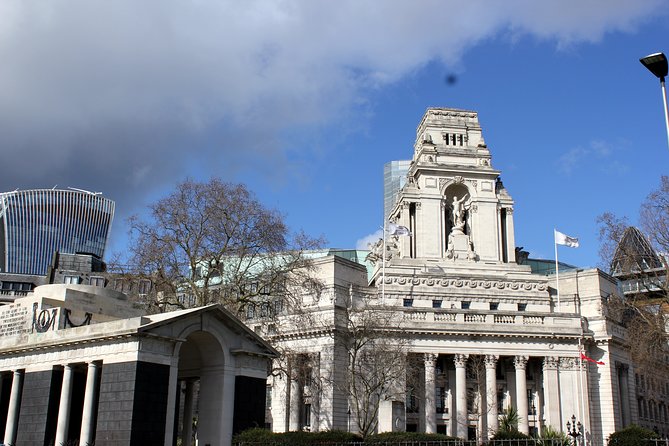
Trinity Square and the wartime role of London’s port
At Trinity Square, you look toward 10 Trinity Square, the former home of the Port of London Authority. The building reflects the era when London was one of the world’s busiest ports, and it also hosted the United Nations’ first reception.
The nearby Merchant Navy memorial gives the guide a chance to explain a side of British history that many short city walks skip. Merchant ships carried food, fuel, and goods to Britain, and their crews suffered heavy losses during both World Wars.
This opening stop gives the tour a useful frame. London is not only royal palaces and old churches. It is also a port city whose survival depended on trade and shipping. If your interests lean toward wartime stories, commerce, or the working life of the capital, listen closely here.
The Tower of London from the outside
The Tower of London is one of London’s major attractions, but this walk does not include admission. You see the fortress from outside while your guide explains its changing roles as royal palace, prison, execution site, and secure home for the Crown Jewels.
The stories move well beyond the usual outline. You may hear about the Tower’s links to London Zoo, the notorious Kray twins, and Rudolf Hess, the senior Nazi official who was imprisoned there during World War II.
This is a useful preview rather than a replacement for a full Tower visit. If you have never been inside, plan separate time and budget for it. The walking tour helps you understand the building before an independent visit, but you will not see the interiors, ravens, exhibitions, or Crown Jewels during this experience.
St. Dunstan in the East, a church turned garden
St. Dunstan in the East is one of the most memorable stops. The former church was originally built in the 12th century, and its tower was later added by Sir Christopher Wren. Bomb damage left the structure in ruins, which are now surrounded by a public garden.
You have about 20 minutes here, enough to look around and take photographs without turning the stop into a rushed glance. Ivy, open sky, and broken stone give the site a very different feel from the polished financial buildings nearby.
The value of this stop is the way it shows London’s repeated rebuilding. Fire, war, redevelopment, and changing city needs have all altered the capital. You get a clear example of how an old church can survive in a new role rather than simply disappear.
Same part of England, a completely different sort of day:
- London Big Bus Hop-On Hop-Off Tour with Optional River Cruise
★ 3.5 · 10,803 reviews - London Small Group Tour of Historical Pubs
★ 5.0 · 10,422 reviews - Tower of London and Crown Jewels Exhibition Ticket
★ 4.5 · 6,677 reviews - Thorpe Park Admission Ticket
★ 4.0 · 5,915 reviews
Leadenhall Market and Roman Londinium
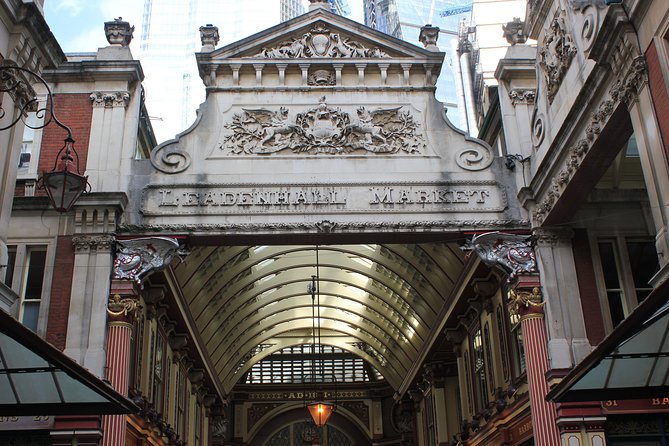
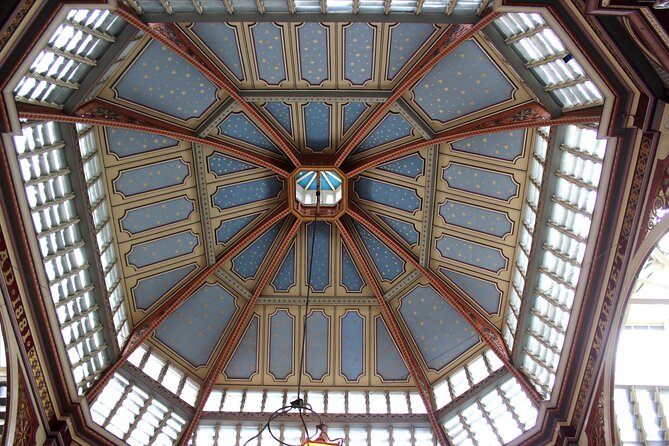
Leadenhall Market brings you into a decorated Victorian setting of crimson, green, gold, and silver. The current Neo-Gothic structure was designed by Sir Horace Jones, and the market takes its name from the lead-roofed hall that once stood here.
The site also connects to the Roman city of Londinium. The old Roman Forum was located in this area, so the market is not merely a pretty arcade. It occupies a place where public life and trade have continued in different forms for centuries.
Fans of Harry Potter may recognize Leadenhall Market from Harry Potter and the Philosopher’s Stone. The film connection is fun, but the guide also explains how the market was used in daily life. That makes the stop more useful than a quick film-location photograph.
You have about 20 minutes, which should allow time for photos and a short explanation. Shops and commercial activity may vary, but the architecture itself is the main attraction.
London Bridge, Tower Bridge, and HMS Belfast
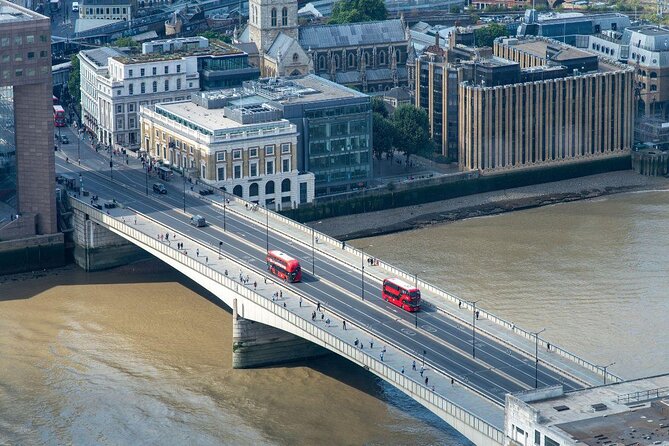
The route explains London Bridge’s long importance. For centuries, it was the only bridge across the Thames in London. The story reaches back to the Roman invasion and includes the old belief that the 18th-century bridge helped shape Britain’s habit of driving on the left.
The tour also provides views toward Tower Bridge, the Tower of London, and HMS Belfast. These are not the same bridge, so pay attention to the guide’s explanations. London Bridge is the older crossing with a long civic and commercial story, while Tower Bridge is the famous suspension and bascule bridge farther east.
HMS Belfast adds a military and naval element. The former Royal Navy cruiser served during the D-Day landings and the Korean War and is now part of the United Kingdom’s Historic Fleet.
The listed stop lasts about 10 minutes. That is enough for orientation and photographs, but not for a visit aboard HMS Belfast or a detailed bridge tour. Think of this as a Thames viewpoint, not a river cruise or museum admission.
The Monument and London’s Great Fire
The Monument to the Great Fire of London commemorates the disaster of 1666 and the rebuilding that followed under Charles II. Here, the guide explains why the fire spread, the theories that grew around it, and why rebuilding London proved difficult even with Wren ready to redesign the city.
You also learn a nursery rhyme connected with the Great Fire. That small touch helps make the story stick, especially for families or anyone who enjoys historical details that are easy to remember.
The stop lasts around 10 minutes. You will not be climbing The Monument as part of this walking tour, so do not expect the viewpoint from the top. The benefit is the setting and the explanation of how one disaster changed the city’s streets, buildings, and public memory.
St. Magnus the Martyr and the old bridge
St. Magnus the Martyr is another church rebuilt after the Great Fire. George Dowdeswell rebuilt it under Wren’s supervision, and the church later appeared in literary references, including Charles Dickens’s Oliver Twist.
The interior is important here. A replica of the old London Bridge helps you understand how crowded and difficult the earlier crossing was to navigate. This is the kind of detail that turns a familiar name into a real place with physical problems and daily inconvenience.
Allow about 20 minutes. The church adds an intimate pause to a route otherwise filled with streets, offices, and large landmarks. If it is open during your visit, take time to look beyond the replica and notice the interior details.
The London Stone and Oxford Court
The London Stone is easy to miss. It is protected behind glass, but it has been associated with London’s identity for centuries. The guide explains its possible connection with Roman Londinium, public proclamations, and old legends involving King Arthur and Excalibur.
The stone’s exact role has attracted stories and speculation, which is part of its appeal. You are not looking at a grand monument. You are looking at a small object that survived while much of the surrounding city changed.
At Oxford Court, a former church site commemorates the wife of Edmund Mortimer, who was held there with her children. Her father was Owain Glyndwr, the last Welsh Prince of Wales. The stop opens a larger discussion about how London drew people from Wales, Scotland, Ireland, England, and beyond.
These brief stops reward curiosity. They are not headline attractions, but they show how much of London’s past is tucked beside ordinary streets.
Mansion House, the Royal Exchange, and the Bank of England
Mansion House is the official home of the Lord Mayor of London and one of the city’s finest Georgian buildings. You can admire the exterior, though the interior is not open to the public on this tour.
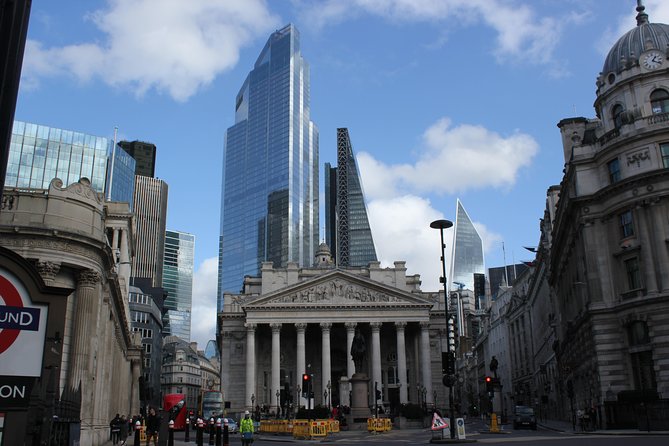
From here, you can view the Royal Exchange. Elizabeth I opened the original exchange, and the site developed into one of the world’s oldest stock exchanges. It also functions today as a high-end shopping destination, giving the guide a chance to connect old commerce with modern retail.
The Bank of England follows naturally. It is Britain’s central bank and holds an enormous quantity of gold in its vaults. The guide explains how the vault has been breached by accident, how old and new locking methods work together, and how the bank manages the British economy.
The Bank of England stop is listed at about five minutes, so expect a compact explanation rather than a long lecture. The area is most useful if you want to understand why the City of London remains a financial center, not just an old quarter with attractive buildings.
Ye Olde Watling and Wren’s working world
Ye Olde Watling is a 17th-century pub associated with the workers who built nearby St. Paul’s Cathedral. It is also linked by tradition with Christopher Wren, who may have used a room there while working on his designs.
The pub gives the tour a human scale. After churches, banks, and government buildings, you get a glimpse of where builders and architects could eat, drink, and work during the rebuilding of London.
You have around 10 minutes at this stop. The tour does not include a meal or drink, so treat it as an architectural and historical pause rather than a pub crawl.
One New Change and the best group photograph
One New Change is a modern shopping center beside St. Paul’s. Its free roof terrace offers views toward St. Paul’s Cathedral, The Shard, Tate Modern, Shakespeare’s Globe, and the River Thames.
This is one of the most practical stops on the route. Your guide can take a group photograph, and you get a clear sense of how old and new London sit side by side. The roof terrace also gives you a useful orientation point before the walk ends.
The stop lasts about 15 minutes. It is a good place to pause, check photographs, and take in the city from above without paying for a separate observation deck.
The College of Arms and London on screen
The College of Arms occupies a 17th-century building and is the world’s oldest heraldic college. Its work includes genealogical research and the creation of coats of arms for new members of the British aristocracy.
The guide explains how new coats of arms are created and connects the area with the James Bond film On Her Majesty’s Secret Service. Nearby streets have also appeared in Doctor Who, Mission Impossible, and Harry Potter.
This stop is especially good for anyone who likes the overlap between real institutions and film locations. The stories also add a less familiar layer to British identity, showing how titles, family lines, and official symbols are managed.
St. Paul’s Cathedral, the final landmark
The walk ends outside St. Paul’s Cathedral, designed by Christopher Wren after the Great Fire. The guide gives you an overview of this huge landmark, but admission is not included.
That arrangement is helpful if you want to visit the cathedral at your own pace afterward. You can decide later how much time to spend inside, rather than trying to fit a full cathedral visit into an already packed three-hour walk.
The finish also works well for independent sightseeing. From here, you can continue exploring the City of London or make St. Paul’s your next stop. Just remember that the tour itself ends outside, so plan a separate ticket if you want to enter.
Who will get the most from this tour
I would choose this walk if you want a broad first look at London and prefer stories to a simple checklist of buildings. It suits first-time visitors, families with older children, small groups, and anyone who wants a private guide without booking separate tours for every landmark.
It is also a good fit if you enjoy overlooked places. St. Dunstan in the East, the London Stone, St. Magnus the Martyr, and Ye Olde Watling give the route more personality than a walk limited to postcard sights.
You may want something else if you dislike steady walking, need long visits inside attractions, or already know the City of London well. The pace covers a lot of ground, and most major sites are viewed from outside.
The guide can make a real difference. Dewi is described as funny, accommodating, and willing to show places that are easy to miss. If he is your guide, tell him early what interests you most. The private format should make it easier to shape the conversation around architecture, wartime events, finance, royal history, or film locations.
Is the $171.09 group price good value?
At $171.09 for up to 15 people, the price is hard to judge without considering group size. For one person, it is expensive for a three-hour walk. For a family or group of friends, the cost can be split several ways, making private attention and flexible conversation more attractive.
You are paying for a guide, not entrance tickets. The Tower of London, St. Paul’s Cathedral, HMS Belfast, and other paid attractions are not included. That can be a benefit if you want a quick overview before choosing which sites deserve your own time and money.
The best value comes from treating this as an orientation walk. It helps you understand the City’s layout, identify places to return to, and avoid wasting half a day wandering between landmarks without context.
Should you book this City of London walk?
Book it if you want a fast, story-filled introduction with a private guide and a route that goes beyond the obvious sights. The mix of Roman London, the Great Fire, wartime shipping, churches, finance, film locations, and St. Paul’s gives you a strong overview in three hours.
Skip it if your main goal is to tour the interiors of the Tower of London or St. Paul’s Cathedral. Those require separate time and admission.
For a small group, the price makes the most sense, especially if you value a guide who can answer questions and adjust the walk. For solo visitors, compare the group cost with a public walking tour. For families and first-time visitors, this private route offers a practical way to get your bearings fast and find the corners of London you might otherwise miss.
FAQ
How long does the walking tour last?
The tour lasts approximately three hours.
Where does the tour begin?
The meeting point is The Monument at 18 Fish Street Hill, London EC3R 6DB.
Where does the tour end?
The tour ends outside St. Paul’s Cathedral at St. Paul’s Churchyard, City of London, London EC4M 8AD.
How many people can join the private tour?
The private tour is for one group of up to 15 people.
Are admission tickets included?
No. The tour includes a local guide, but admission to places such as St. Paul’s Cathedral and the Tower of London is not included.
Can I choose a morning or afternoon departure?
Yes. Multiple morning and afternoon departure times are available.
Is the tour suitable for people with service animals?
Yes. Service animals are allowed, and the tour is near public transportation. A moderate level of physical fitness is recommended.
Just added around London
- London Private Jack The Ripper Tour★ 5.0 · 9 reviews
- Private Spy Walking Tour of London★ 5.0 · 6 reviews
- Private Shoreditch Street Photography Workshop★ 4.5 · 4 reviews
- Private 2.5 Hour Taxi Tour of London – London’s Greatest Bits!★ 5.0 · 4 reviews
- Private Round Trip Transfer between London Airports and Hotel★ 3.5 · 56 reviews
- Shakespeare London Walking Tour★ 5.0 · 26 reviews
- Private Prison Van Escape Game – London Immersive Experience★ 4.0 · 15 reviews
- Private Rock ‘n’ Roll Music Tour of Central London★ 5.0 · 7 reviews
Walking Tours, compared.
Oxford University Walking Tour With University Alumni Guide
Read our review →
Tour for Muggles The Ultimate Harry Potter Walking Tour in London
Read our review →
Cambridge University Walking Tour by Alumni™ Kings College Option
Read our review →
Blackbeard to Banksy – The Ultimate Walking Tour of Bristol
Read our review →
Air Raid Shelter + St. Nicholas Market Walking Tour
Read our review →
Walking Tour of Bath with Blue Badge Tourist Guide
Read our review →
Changing of the Guard Guided Walking Tour in London
Read our review →Browse the lists this tour appears in