

Reviewed · TREASURE HUNTS
Letchworth Garden City: Self-Guided History Puzzle Walk
Letchworth’s story is best understood on foot, and this self-guided puzzle walk gives you a reason to look closely. You follow clues from the old railway station through gardens, churches, a cinema, and the offices where the town’s planners shaped its streets. Along the way, you learn why this was the world’s first Garden City.
I like the freedom to start when you want and pause whenever you need. I also like the mix of local history and light puzzle-solving, which gives children and adults a shared task instead of a list of dates. The main drawback is simple: you get no human guide, so the app and the clues must do all the teaching.
Key points at a glance
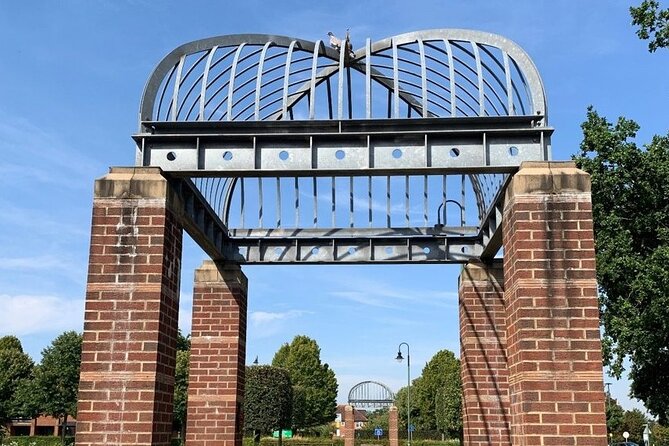
- The first Garden City: Learn how Letchworth put Ebenezer Howard’s ideas into practice.
- Seven history stops: Follow a route linking railway sites, gardens, churches, cinema history, and town planning.
- A flexible 90-minute walk: Start at a time that suits you, pause for a break, and continue later.
- Puzzles instead of a standard tour: Search for answers on site, use hints when needed, and move forward through the story.
- Good value for groups: At $5.90 per person, the activity costs little for a private group outing, with group discounts available.
- Offline play: Download or open the game before setting out so you can play without a live internet connection.
Why Letchworth works so well as a puzzle walk
Letchworth Garden City is not just a town with a few old buildings. Its streets, open spaces, gardens, and civic buildings were planned around an idea that was new in the early 20th century: combine the advantages of town and country in one carefully designed community.
That makes the town a good place for a clue-based walk. You are not only looking for a plaque or taking a photograph. You are asked to notice details around you, find an answer, and connect each stop to the bigger story. The format turns ordinary walking into a small hunt.
The activity takes about one and a half hours, though the flexible format means you can take longer. Four adults can play together, and the puzzle structure also suits families. Children may enjoy searching for answers, while adults can fill in the wider story of Ebenezer Howard, Raymond Unwin, Barry Parker, and the Garden City movement.
This is not a guided lecture. It is closer to an outdoor escape game with local history added. The app gives you the next challenge, and you inspect the place around you for the answer. If you get stuck, helpful hints are available.
More treasure hunts in England:
- Fun, Flexible Treasure Hunt Around Manchester with Cryptic Clues & Hidden Gems
★ 5.0 · 253 reviews - Fun, Flexible Treasure Hunt Around York with Cryptic Clues & Hidden Gems
★ 5.0 · 248 reviews - The Hunt for the Cheshire Cat by HiddenCity
★ 5.0 · 225 reviews
Starting at Station Place and the lost first station

The walk begins at Station Place, Letchworth Garden City SG6. This is an apt starting point because the railway helped connect the new Garden City with the wider region.
The first station known as Letchworth Garden City opened in 1903 with a restricted service. It gained a full passenger service on 15 April 1905, then was replaced by a new station on another site on 18 May 1913. Your first task is to look around the starting area, find the answer to the challenge, and use it to move on.
This opening stop sets the tone. The railway station is not treated as a simple meeting point. It becomes part of the town’s growth story. A new planned community needed links to other places, and the changes to the station reflect Letchworth’s early development.
The practical point is to give yourself a few minutes to get the app ready before solving the first clue. The ticket is mobile, and the game can be played offline, but you should make sure the activity is available on your phone before you rely on it in the street.
Broadway Gardens and Ebenezer Howard’s plan
From the railway area, the route brings you to Broadway Gardens and Walk. This is one of the clearest places to see the Garden City idea in physical form.
The gardens were developed after a £1 million grant from the Heritage Lottery Fund. Their layout and design reflect the early aims of Ebenezer Howard, whose principles helped shape the world’s first Garden City.
Here, the puzzle asks you to look closely and find an answer in the setting. That matters because the gardens are not just decoration. Their layout shows how open space was treated as part of the town’s plan rather than an afterthought.
I would take this stop slowly. The activity is designed to last about 90 minutes, but the gardens are one of the places where a short pause makes sense. If you are with children, this is also a useful point to let them search while you explain that Letchworth was planned around green space and orderly design.
The clue format gives the stop a bit of purpose. Instead of walking through the gardens while checking your phone, you have something specific to find. The trade-off is that the app may not give the same depth as a local guide standing beside you and explaining Howard’s ideas in detail.
The college and the Sisters of Charity
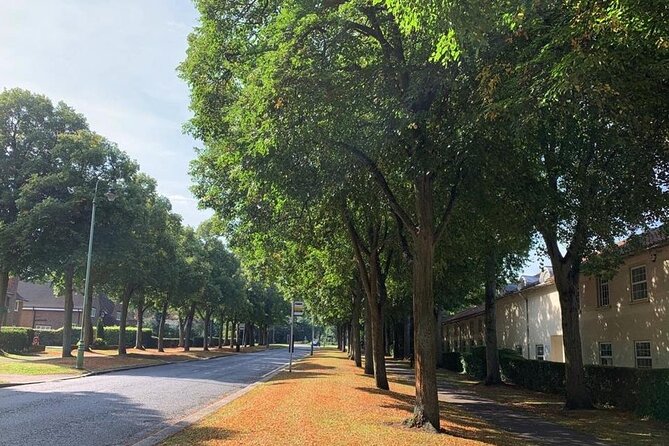
The next stop adds a different thread to Letchworth’s story: education and religious life. The history of the college begins with an order founded in Belgium in 1803 by Canon Triest. The order later developed international missions, and the Sisters were already running schools in Devon and Lancashire before a site in Letchworth came to their attention.
This stop broadens the walk beyond civic planning. Letchworth was not only about streets, gardens, and transport. Institutions came here too, bringing their own work and traditions.
Again, the challenge asks you to inspect the area and find the answer that advances the game. The puzzle structure can help keep the walk moving, especially if your group has different interests. Someone who is less interested in architectural details can still contribute by spotting the clue.
There is no stated requirement for a particular fitness level. Most people can take part, and the route is near public transport. Still, you are walking between several outdoor stops, so comfortable shoes are sensible. The activity is short compared with a full-day city tour, but it is more active than sitting through a talk.
More historical tours in England:
- London Small Group Tour of Historical Pubs
★ 5.0 · 10,422 reviews - Stonehenge and Bath Day Trip from London with Optional Roman Baths Visit
★ 5.0 · 2,028 reviews - Soho Music & Historic Pubs Tour
★ 5.0 · 1,993 reviews - Shadows of York: Ghost Walk and Horrible History.
★ 5.0 · 1,403 reviews
A 1936 cinema with a Fred Astaire opening

The cinema stop supplies one of the most entertaining details on the route. The cinema dates from 1936 and opened with a black-tie gala showing of Follow the Fleet, starring Fred Astaire and Ginger Rogers.
It was built because the nearby Palace Cinema, dating from 1909, struggled to handle local crowds. The Palace was one of the first purpose-built cinema venues in the country, so this part of the walk connects Letchworth to the wider story of early cinema-going.
The stop works well because it gives you a lively detail to remember. A black-tie opening and a Fred Astaire film tell you more than a bare construction date. They suggest the place’s role as a social venue and show how local demand shaped the town.
The puzzle asks you to find an answer at the cinema area before moving on. If you enjoy architecture, you may want to look beyond the clue and compare the cinema with the older Palace Cinema mentioned in the history. The activity does not promise an interior visit, so treat this as an outside history stop rather than a cinema tour.
St Mary the Virgin and Old Letchworth
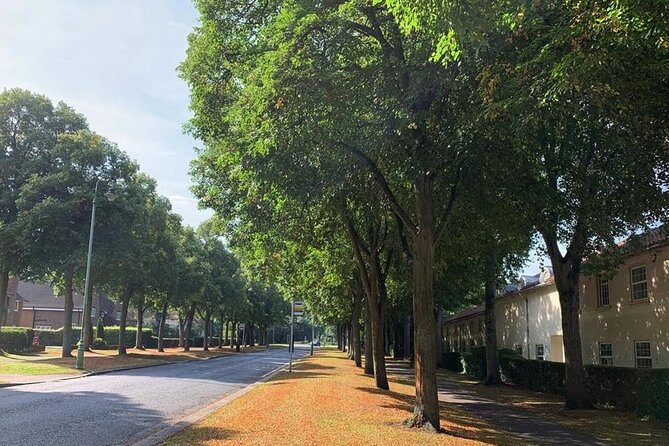
The Church of St Mary the Virgin takes the walk back before the Garden City itself. It was the parish church for Old Letchworth, and the current building was constructed in the late 12th century. It is Grade II listed and belongs to the Diocese of St Albans.
This is a useful contrast with Broadway Gardens and the planned streets. The church belongs to the older settlement, showing that Letchworth Garden City was not created on an empty page. The new town developed around an existing place with its own buildings and religious history.
The clue here asks you to look around and identify the answer needed for the next stage. Churches can be good puzzle locations because dates, names, signs, and architectural details often reward careful observation. The activity does not state that you enter the church, so you should expect to solve the challenge from the accessible area.
I especially like this stop for the way it gives the walk a sense of time. You move from the late 12th century to the 20th-century Garden City, then onward to later community buildings. That broad time span makes the route more than a quick tour of new town architecture.
The International Garden Cities Institute
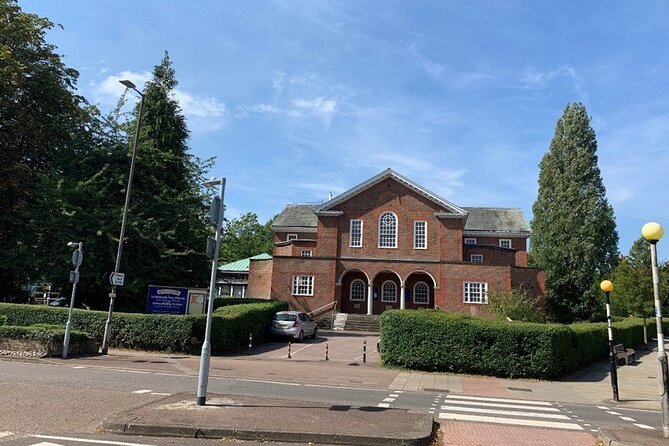
The stop on Norton Way South is the clearest place to connect the clues with the wider Garden City movement. The International Garden Cities Institute occupies the former offices of Letchworth’s town planners and architects, Raymond Unwin and Barry Parker.
From these offices, the streets and open spaces of Letchworth were designed. The institute also explores how Letchworth influenced Garden City developments in other parts of the world.
This is where the earlier stops begin to fit together. The station, gardens, open spaces, and planned layout are not isolated features. They came from a design process carried out by people working in this part of town.
The tour ends at 296 Norton Way South, Letchworth Garden City SG6 1SU, which makes this a natural closing point. It is also the stop where you may want to spend extra time if the Garden City idea interests you most.
The activity uses a clue to bring you here rather than offering a formal presentation. That is convenient and private, but it also limits how much background you receive. If you want a detailed study of Unwin, Parker, or Garden City planning, you will need to do extra reading on your own.
St Michael’s Church and the changing town centre

The final stop is St Michael’s Church. It was dedicated on 22 February 1908 and designed by Courtenay Crickmer as a mission church to St Mary’s in Letchworth.
The church later developed its permanent site on Town Square between 1966 and 1968. That shift gives you another small lesson in how the town changed over time. Letchworth was planned at the start of the 20th century, but its religious and civic needs continued to develop decades later.
The walk’s sequence, from railway history to planning offices and churches, helps you see Letchworth as a living town rather than a preserved model. Some buildings belong to the early Garden City period, while others reflect later changes.
As with the other stops, the game asks you to inspect the location for an answer. You do not need to follow a guide’s pace, so you can stop for a photograph or a short break without holding up anyone else.
How the app and puzzle format affect the visit
The activity combines three familiar ideas: a walking tour, a treasure hunt, and an outdoor escape game. The result is more active than an audio guide and less demanding than a full escape room.
You work through clues in sequence. Each correct answer advances you to the next location and reveals more of the local story. Hints are available if you get stuck, which is important for families and mixed groups. A difficult clue should slow you down, not end the outing.
The app is described as easy to use, and the game works offline. That makes it practical in areas where mobile service may be uneven. I would still prepare before setting out, since an offline game is only useful once it is ready on your phone.
The private format is another strength. Only your group takes part, so you can solve clues at your own speed. You do not need to match a stranger’s walking pace, and there is no contact with a human guide.
The downside is that the app cannot answer a follow-up question in the way a local guide can. If you want stories, conversation, or a detailed explanation of every building, choose a guided tour instead. If you like working things out as you go, this format is a better fit.
Price, timing, and who gets good value
At $5.90 per person, this is a low-cost way to spend roughly 90 minutes in Letchworth. The value is strongest for a group, since you get a private activity with a shared goal rather than paying for a separate guide.
Group discounts are available, though the exact discount is not specified. The low base price also makes this a reasonable add-on to a day in town. You are paying for the puzzle route and app-based story, not admission to a museum or a guided interpretation of the buildings.
You can start at any hour, take a break, and resume later. The activity is available every day, and the stated opening window is 5:00 AM to 9:00 PM from Monday through Sunday. The booking information also describes the game as available around the clock, so check the access details shown for your chosen date if you plan a very early or late start.
Free cancellation is allowed up to 24 hours before the start time. Inside that period, the booking is non-refundable and changes are not accepted.
Who should book this Letchworth walk?
I would choose this for families, couples, friends, and local residents who want to see familiar streets with a fresh purpose. The clues give children an active role, while the history provides enough substance for adults. One group of four adults can also stay engaged together rather than splitting between a guide and a phone screen.
It suits you especially well if you enjoy:
- Short walks with regular points of interest
- Puzzles that use things you can see on site
- Town planning, architecture, and local history
- Flexible start times
- Private activities without a guide or strangers
- Low-cost outings with a group
You may want something else if you dislike using your phone while sightseeing, need a detailed spoken explanation, or want to spend a long time inside historic buildings. The route is a puzzle walk, not a museum visit or a traditional guided tour.
A small bonus is the chance to spot Letchworth’s black squirrels. Several people have seen them during the walk, and one outing produced three sightings. There is no guarantee, of course, but keeping an eye out adds a playful extra to a route already built around searching.
Should you book it?
Book this walk if you want an inexpensive, flexible way to understand Letchworth through its streets and buildings. The strongest points are the town’s unusual Garden City story, the mix of seven different stops, and the freedom to play at your own pace.
Skip it if you want a guide to lead the way or a full architectural lecture. For everyone else, $5.90 buys a clever local outing with exercise, clues, and enough history to make Letchworth’s design easier to notice.
FAQ
How long does the Letchworth puzzle walk take?
The walk takes approximately 1 hour and 30 minutes.
How much does the activity cost?
The listed price is $5.90 per person. Group discounts are available.
Where does the walk start?
It starts at Station Place, Station Place, Letchworth Garden City SG6, UK.
Where does the walk finish?
It finishes at 296 Norton Way South, Letchworth Garden City SG6 1SU, UK.
Is the activity guided?
No. It is self-guided, and no physical tour guide is included.
Can I choose my own start time?
Yes. The activity offers a flexible start time, and you can begin at any hour within the stated operating information.
Can I pause the game?
Yes. You can take a break at any time and resume later.
Do I need an internet connection?
No. The game can be played offline.
Is the activity private?
Yes. It is a private activity, and only your group takes part.
What happens if I need to cancel?
You can receive a full refund if you cancel at least 24 hours before the start time. Cancellations or changes made within 24 hours are not accepted, and the amount paid is not refunded.
More Self-Guided Tours in England
- Western Approaches Self Guided Tour
★ 5.0 · 505 reviews - Private Self-Guided Dinky Door Hunt in Cambridge
★ 4.5 · 103 reviews - Bristol Street Art: Banksy Exploration Game and Tour
★ 3.5 · 39 reviews - Public BucketRace – Scavenger Hunts with a Twist
★ 5.0 · 32 reviews
More Walking Tours in England
- Oxford University Walking Tour With University Alumni Guide
★ 5.0 · 6,905 reviews - Tour for Muggles The Ultimate Harry Potter Walking Tour in London
★ 5.0 · 4,684 reviews - London Jack The Ripper Guided Walking Tour
★ 5.0 · 3,131 reviews - Cambridge University Walking Tour by Alumni™ Kings College Option
★ 5.0 · 2,336 reviews
Just added around England
- London Private Jack The Ripper Tour★ 5.0 · 9 reviews
- Private Spy Walking Tour of London★ 5.0 · 6 reviews
- Private Shoreditch Street Photography Workshop★ 4.5 · 4 reviews
- Private Sightseeing Walking Tour of The City Of London★ 5.0 · 3 reviews
- Private 2.5 Hour Taxi Tour of London – London’s Greatest Bits!★ 5.0 · 4 reviews
- Private Round Trip Transfer between London Airports and Hotel★ 3.5 · 56 reviews
- London to Southampton Cruise Port Including Stonehenge★ 5.0 · 13 reviews
- Shakespeare London Walking Tour★ 5.0 · 26 reviews
Treasure Hunts, compared.

Fun, Flexible Treasure Hunt Around Manchester with Cryptic Clues & Hidden Gems
Read our review →
Fun, Flexible Treasure Hunt Around York with Cryptic Clues & Hidden Gems
Read our review →
Fun, Flexible Treasure Hunt Around Bath with Cryptic Clues & Hidden Gems
Read our review →
Fun, Flexible Treasure Hunt Around Oxford with Cryptic Clues & Hidden Gems
Read our review →
Fun, Flexible Treasure Hunt Around Birmingham with Cryptic Clues & Hidden Gems
Read our review →
Fun, Flexible Treasure Hunt Around Chester with Cryptic Clues & Hidden Gems
Read our review →
Fun, Flexible Treasure Hunt Around Brighton with Cryptic Clues & Hidden Gems
Read our review →Browse the lists this tour appears in